Short Answer
These 20 high-fiber dinner recipes run on beans, lentils and whole grains, and 16 reach 5.6 grams of fiber or more per serving.
- 5.6 grams is the FDA line for high (20% of the 28-gram Daily Value).
- The Quinoa and Black Bean Stuffed Peppers have the most fiber, about 12 grams each.
- The Chickpea and Spinach Curry cooks in about 20 minutes, a fast dinner.
Fiber comes only from plant foods, and cooked beans and lentils carry several times more of it per cup than most vegetables do, which is why you will find one of them at the base of nearly every recipe here.
The dinners run from a curry that cooks in about 20 minutes to a moussaka that needs close to an hour and a half in the kitchen, and none of them needs meat. Each fiber figure comes from USDA FoodData Central values for the amounts in the recipe.
1 What Counts as a High-Fiber Dinner?
The FDA lets a label call a food high in fiber when a serving has 20% or more of the Daily Value, and its Daily Value for fiber is 28 grams, so the line you are aiming for sits at 5.6 grams per serving. A food with 10 to 19% of the Daily Value counts as a good source, which is roughly 3 to 5 grams.
The fiber figures are calculated from USDA FoodData Central (SR Legacy) values for each recipe's ingredient amounts, divided by its servings and rounded down. Oil, broth, spices, sauces and cheese are left out, so your serving may run a little higher, and brands differ.
- Sixteen of the 19 recipes with a figure reach 5.6 grams.
- The fried rice, the acorn squash and the fritters land just under it at about 5, and each one names the change that lifts it over.
- The farro risotto has no figure because farro is not in that dataset.
2 Which Ingredients Carry the Most Fiber?
Legumes lead by a wide margin, so recipes built on them reach the FDA line with very little else. A cooked cup of lentils has 15.6 grams, nearly three times the 5.6-gram line, while cooked whole grains give about 3 to 6 grams a cup.
| Ingredient, 1 cooked cup | Fiber (g) | Used in |
|---|---|---|
| Lentils | 15.6 | Shepherd's pie, red lentil stew, sheet pan dinner, moussaka |
| Black beans | 15.0 | Stuffed peppers, burgers, chili |
| Chickpeas | 12.5 | Curry, patties, falafel bowls, fritters |
| White beans and kidney beans | 11.3 | Spaghetti, spaghetti squash, minestrone |
| Edamame | 8.1 | Cauliflower fried rice |
| Pearl barley | 6.0 | Barley casserole |
| Quinoa | 5.2 | Stuffed peppers, chili, patties |
| Brown rice | 3.2 | Curry, stir-fry, fried rice |
Three more figures per cup: baked sweet potato 6.6 grams (shepherd's pie, enchiladas), cooked whole wheat spaghetti 4.6 (spaghetti, minestrone) and wild rice 3.0 (acorn squash).
Canned beans run lower than home-cooked ones. FoodData Central lists canned black turtle beans at 6.9 grams per 100 grams against 8.7 for boiled black beans, so every recipe that uses a can is calculated from the lower canned value.
Check the list before you swap one ingredient for another, because a cup of cooked brown rice in place of a cup of black beans takes 15.0 grams down to 3.2, and a cup of lentils or beans, such as a lentil salad with lemon vinaigrette on the side, is the quickest way to repair any plate that falls short.
3 Which High-Fiber Dinner Should You Make?
Start with the time you have, because cooking time is what separates these dinners most. Six cook in 20 minutes or less, the stews, risotto, falafel bowls and sheet pan dinner take 25 to 40 minutes, the stir-fry needs 15 minutes plus the time its brown rice takes, and the bakes need 45 to 85 minutes.
Fiber does not rise with time: the spaghetti with white beans reaches 9 grams in about 15 minutes of cooking, the same as the shepherd's pie that needs an hour or more.
Ready in 20 minutes or less, with fiber per serving:
- Black bean burgers: about 10 minutes, 8 g
- Whole wheat spaghetti with white beans: about 15 minutes, 9 g
- Cauliflower fried rice: about 15 minutes, 5 g
- Chickpea and spinach curry: about 20 minutes, 8 g
- Chickpea and quinoa patties: about 20 minutes, 7 g
- Zucchini and chickpea fritters: about 20 minutes, 5 g
Ready in 25 to 40 minutes, with the stir-fry that needs its rice first:
- Falafel bowls: about 25 minutes, 11 g
- Minestrone: about 30 minutes, 10 g
- Butternut squash and farro risotto: about 35 minutes, no figure
- Red lentil stew: about 40 minutes, 9 g
- Lentil sheet pan dinner: about 40 minutes, 7 g
- Vegetable stir-fry with tofu: about 15 minutes plus the rice, 6 g
Bakes of 45 to 55 minutes:
- Spaghetti squash with white beans: about 45 minutes, 9 g
- Stuffed acorn squash: about 45 minutes, 5 g
- Quinoa and black bean stuffed peppers: about 50 minutes, 12 g
- Sweet potato and kale enchiladas: about 55 minutes, 6 g
The longest cooks:
- Lentil and sweet potato shepherd's pie: 60 to 70 minutes, 9 g
- Barley and mushroom casserole: about 75 minutes, 8 g
- Eggplant and lentil moussaka: about 85 minutes, 10 g
- Slow cooker chili: 6 to 8 hours on low after one stir-together, 11 g
Cooking time adds the recipe's own timed steps, with steps that run together counted once, so chopping and shaping are extra. Where an ingredient list calls for cooked rice, quinoa or wild rice, your cooking time for that grain is not included.
4 Which High-Fiber Dinners Cook in 20 Minutes or Less?
Canned chickpeas and beans, or brown rice and quinoa cooked earlier in the week, do the slow work in these dinners, so no pot of dried beans stands between you and the table. Brown rice or quinoa cooked ahead is what the curry, the fried rice and the patties call for.
1. Chickpea and Spinach Curry with Brown Rice
Canned chickpeas are already tender, so the sauce needs no long simmer: 10 minutes of gentle bubbling in the coconut milk is enough, and the chickpeas supply most of the curry's fiber. You stir the garam masala, turmeric, cumin and chili powder into the onions, garlic and ginger before any liquid goes in, which gives the spices a minute in hot oil to release their flavor.
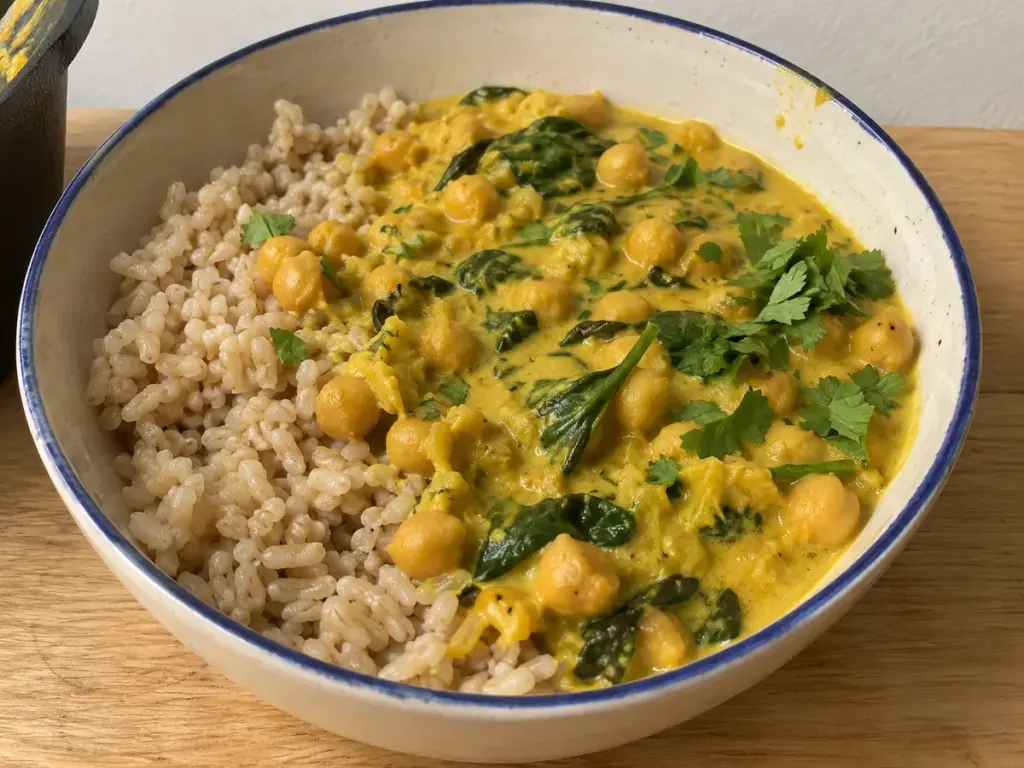
The heat stays gentle, because the only chili in the pot is ¼ teaspoon of chili powder next to the tablespoon of garam masala, and you can leave it out for a milder curry.
Add the spinach last, because it needs only 2 to 3 minutes to wilt and longer heat turns it dull and watery.
Ingredients (for 3 servings)
- 1 tablespoon vegetable oil
- 1 medium onion, finely chopped
- 2 garlic cloves, minced
- 1 tablespoon grated fresh ginger
- 1 tablespoon garam masala
- 1 teaspoon ground turmeric
- ½ teaspoon ground cumin
- ¼ teaspoon chili powder
- 1 can (15 ounces) chickpeas, drained and rinsed
- 1 can (14 ounces) coconut milk
- 2 cups fresh spinach leaves
- 1 ½ cups cooked brown rice
- Salt to taste
- Fresh cilantro, chopped (optional)
Instructions
- Soften the onion. Cook the onion in the oil over medium heat for about 5 minutes until soft and translucent.
- Bloom the spices. Stir in the garlic and ginger for 1 minute, then the garam masala, turmeric, cumin and chili powder until the onions are coated.
- Simmer. Pour in the coconut milk, add the chickpeas and cook at a gentle simmer for 10 minutes until the sauce thickens slightly.
- Wilt the spinach. Stir in the spinach for 2 to 3 minutes, then salt to taste.
- Serve. Spoon the curry over the brown rice and top with cilantro.
Swaps
- Cashew cream replaces the coconut milk 1 to 1 and keeps the sauce smooth, with less coconut flavor.
Leftover curry thickens as the chickpeas soak up the sauce, so keep the rice in its own container and loosen the curry with a spoonful of water when you reheat it to 165°F.
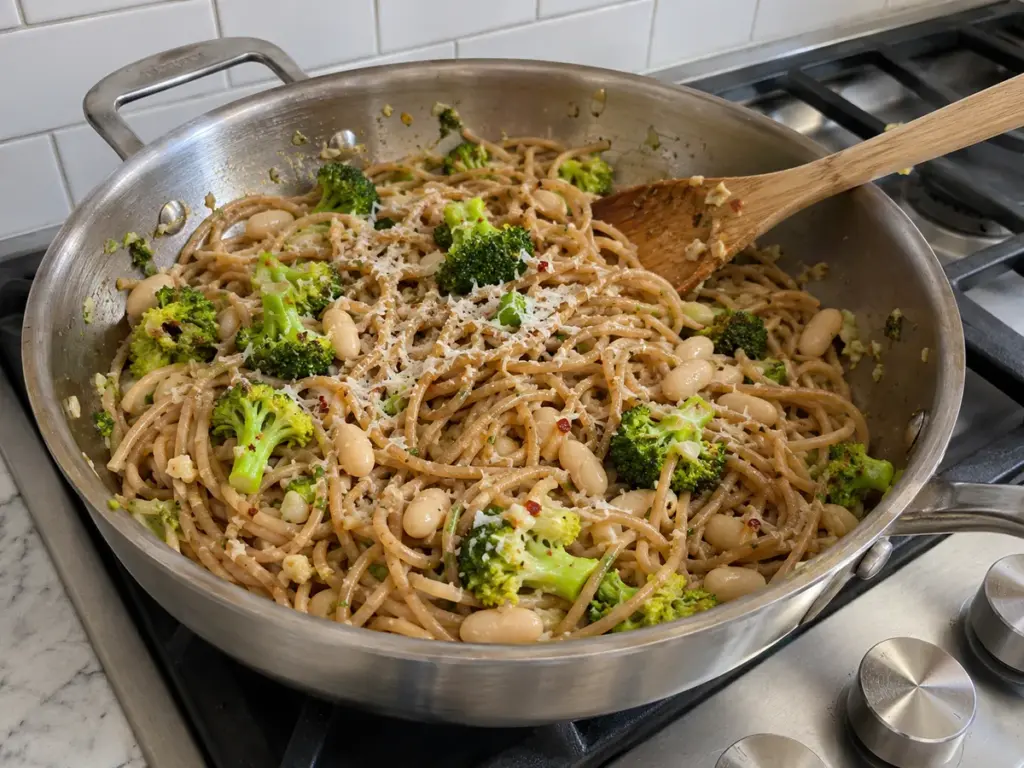
2. Whole Wheat Spaghetti with Broccoli and White Beans
Broccoli joins the pot for the last 3 minutes of the boil, so one pot cooks both, and the white beans warm in the skillet without a pan of their own. The pasta itself carries more than half of the plate's fiber, because 2 ounces of dry whole wheat spaghetti, a standard serving, holds about 5 grams.
Keep the reserved pasta water, because its starch binds the olive oil into a light coating that clings to the strands, and a few beans break against the pan and thicken it further. Garlic that colors past pale gold turns bitter, so pull the pan off the heat while you can still smell it fragrant, and add the lemon juice after that so it keeps its sharpness.
Ingredients (for 4 servings)
- 8 ounces whole wheat spaghetti
- 2 cups broccoli florets
- 1 can (15 ounces) white beans such as cannellini or navy, drained and rinsed
- 3 tablespoons extra-virgin olive oil
- 3 cloves garlic, minced
- ½ teaspoon red chili flakes
- ½ teaspoon salt
- ¼ teaspoon black pepper
- ¼ cup reserved pasta cooking water
- Grated Parmesan cheese (optional)
- Fresh lemon juice (optional)
Instructions
- Boil the pasta. Cook the spaghetti in salted water to al dente per the package, adding the broccoli for the last 3 minutes.
- Warm the garlic. Heat the olive oil with the garlic and chili flakes over medium heat for about 1 minute until fragrant but not browned.
- Combine. Drain the pasta and broccoli, keeping ¼ cup of the water, and move both to the skillet.
- Finish. Add the beans and reserved water, toss over medium heat for 2 to 3 minutes, season with salt and pepper, and add lemon juice and Parmesan if you like.
Swaps
- Cauliflower florets cook in the same last 3 minutes when you cut them to the same size, while 1-inch pieces of asparagus need only the last minute or two. The fiber barely changes, because the pasta and beans carry most of it.
- A pinch of smoked paprika can stand where the chili flakes go, giving smoke without the heat, and leaving the flakes out makes a mild pan.
- Any whole wheat pasta shape follows the same steps. FoodData Central lists dry whole wheat pasta at 9.2 grams of fiber per 100 grams, so boil it for its package time and add the broccoli for the last 3 minutes.
3. Cauliflower Fried Rice with Edamame and Brown Rice
Cold brown rice from the fridge separates into loose grains in a hot pan, while warm fresh rice clumps and steams. A cup of prepared edamame has about 8 grams of fiber, about a third of the whole pan's total.
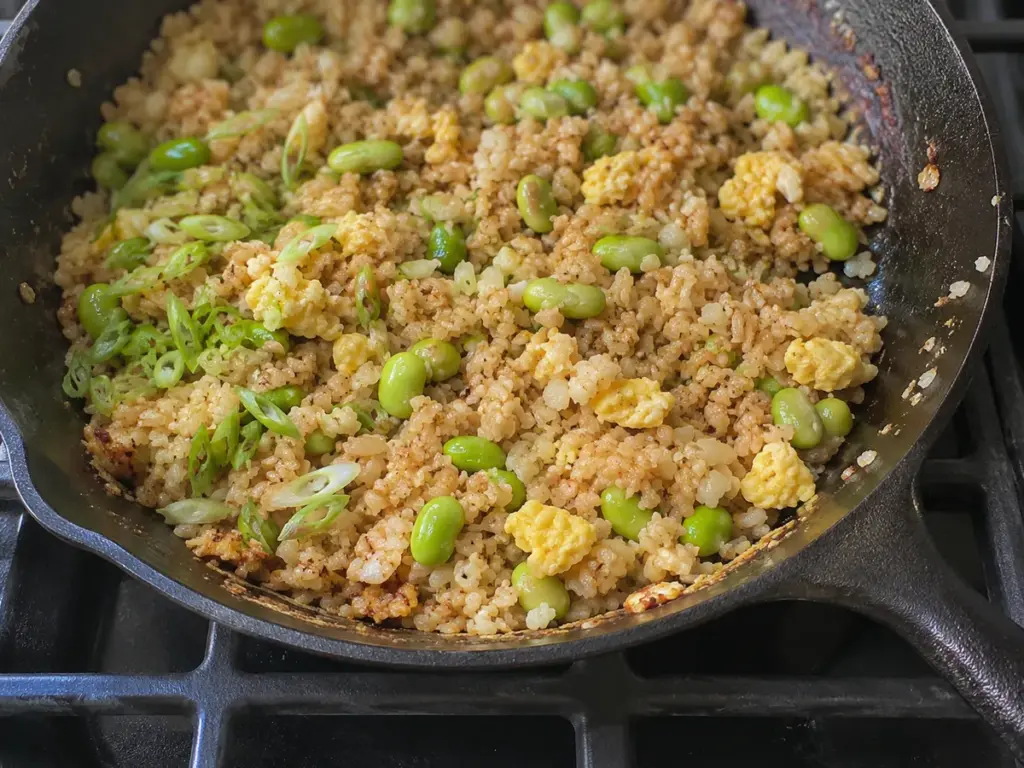
At about 5 grams a serving, this is one of three recipes that land just under the 5.6-gram line.
Stir in 1 ½ cups of edamame instead of 1 cup and each serving passes the line at about 6 grams. Pulse the cauliflower in short bursts until it matches the rice grains, because a few seconds too long turns it to mush.
Ingredients (for 4 servings)
- 1 medium head cauliflower, cut into florets and processed into rice-size pieces
- 1 cup cooked brown rice, cooled, preferably refrigerated overnight
- 1 cup shelled edamame, thawed if frozen
- 1 small onion, finely chopped
- 2 cloves garlic, minced
- 2 large eggs, lightly beaten
- 2 tablespoons soy sauce
- 1 tablespoon sesame oil
- 1 tablespoon vegetable oil
- 2 green onions, sliced thinly
- Salt and black pepper
Instructions
- Start the base. Cook the onion in the vegetable oil over medium-high heat for 2 to 3 minutes, then add the garlic and edamame for 2 minutes.
- Scramble the eggs. Push the vegetables aside, pour the eggs into the empty space and stir gently until just set, then mix them in.
- Add the rice. Stir in the cauliflower rice and brown rice and cook 5 to 7 minutes until the cauliflower is tender but still slightly firm.
- Season. Drizzle on the soy sauce and sesame oil, cook 1 more minute, and top with the green onions.
Swaps
- Finely chopped broccoli or green beans cook in about the same 5 to 7 minutes once they are cut to rice size, and raw broccoli has 2.6 grams of fiber per 100 grams against 2.0 for raw cauliflower.
- A cooked cup of green peas has about 8.8 grams of fiber and large lima beans 13.2, so either can replace the edamame, which has 8.1.
- For a vegan pan, scramble crumbled firm tofu in the cleared space until it is hot and lightly golden, then mix it in where the eggs would go.
4. Black Bean Burgers with Avocado Slaw
Black beans mashed until mostly smooth, with a few left whole, give these patties both a binder and some chew, and the egg and breadcrumbs hold the rest together. Not all of the fiber sits in the patty: the mashed avocado in the slaw supplies about a quarter of it, which is part of how a patty with its topping reaches about 8 grams.
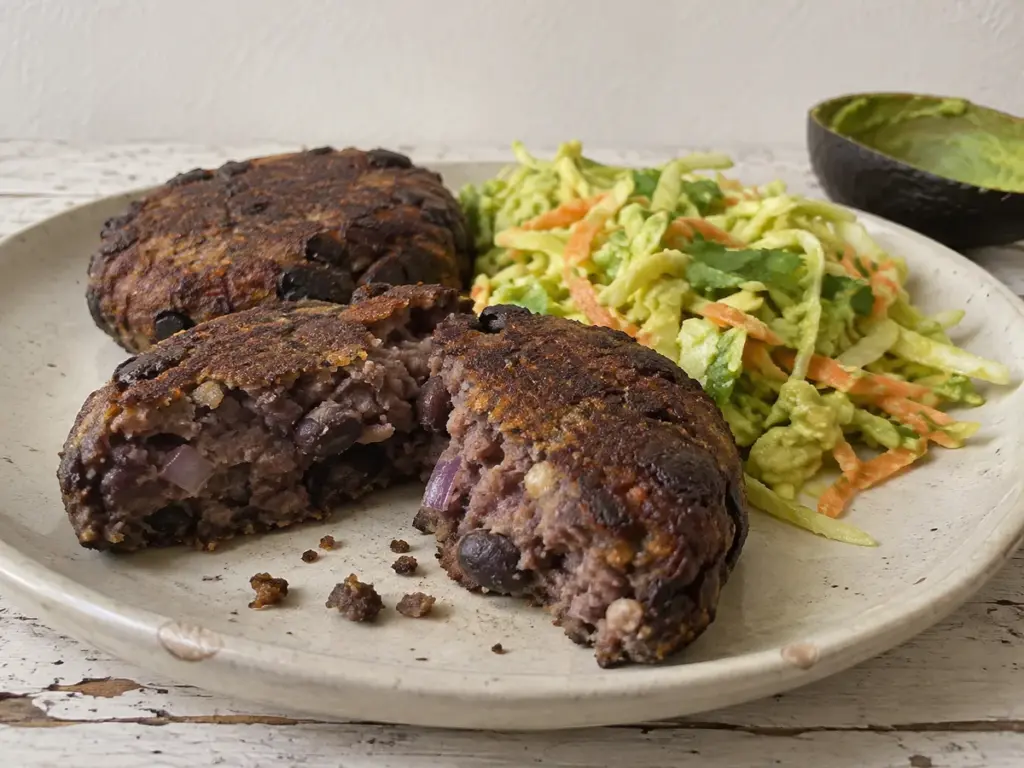
Leave each patty alone for its first 4 minutes in the pan, because a patty you move early tears away from the crust that is still forming. The mixture holds a raw egg, so cook the patties until a thermometer in the center reads 160°F, the USDA mark for egg dishes.
Lime juice in the slaw slows the avocado from browning, which matters if you make it ahead.
Ingredients (for 4 servings, 4 patties)
- 1 can (15 ounces) black beans, drained and rinsed thoroughly
- ½ cup breadcrumbs
- ¼ cup finely chopped red onion
- 1 garlic clove, minced
- ½ teaspoon ground cumin
- ½ teaspoon smoked paprika
- ¼ teaspoon chili powder
- 1 large egg
- Salt and black pepper
- 1 tablespoon olive oil
- 1 ripe avocado, peeled, pitted and mashed until smooth
- 2 cups shredded cabbage
- ½ cup shredded carrot
- 1 tablespoon fresh lime juice
- 2 tablespoons chopped fresh cilantro (optional)
Instructions
- Mash the beans. Mash the black beans with a fork or potato masher until mostly smooth, leaving some whole.
- Mix and shape. Stir in the breadcrumbs, onion, garlic, cumin, paprika, chili powder, egg, salt and pepper, then press the mixture firmly into 4 equal patties.
- Pan-cook. Brown the patties in the olive oil over medium heat for 4 to 5 minutes per side, until the center reads 160°F.
- Mix the slaw. Toss the avocado, cabbage, carrot, lime juice, cilantro, salt and pepper while the patties cook.
- Serve. Pile the slaw on the patties, on a bun or a bed of greens.
Swaps
- Hummus stirred into the slaw gives a creamy dressing that never browns, though FoodData Central lists hummus at 4.0 grams of fiber per 100 grams homemade and 5.5 store-bought against 6.7 for avocado, so the slaw gives up a little.
- A smaller pinch of chili powder mellows the heat while the smoked paprika keeps the smoke, and a larger one makes the patties hotter.
Add the slaw when the plates reach the table so each portion gets it fresh.
5. Chickpea and Quinoa Patties with Tahini Sauce
The chickpeas get mashed until mostly smooth but not to a paste, since the bits that stay visible and the quinoa grains are what give each patty a bite. Two patties come to about 7 grams of fiber, and the tahini in the sauce adds a share of it because sesame paste is a concentrated source.
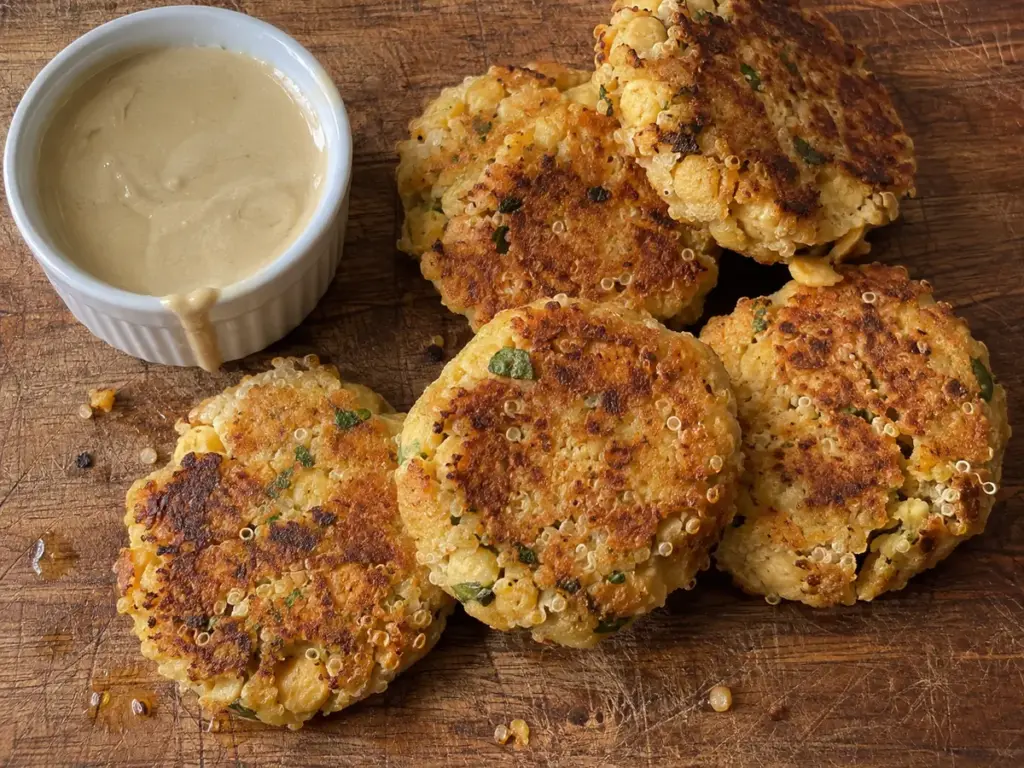
Fry the eight patties in two batches, because a crowded pan steams them instead of browning them. Like the black bean burgers, the mixture contains a raw egg, so check that the centers read 160°F on your thermometer (USDA egg-dish mark).
Add the water to your sauce a tablespoon at a time, since tahini stiffens at first and then loosens.
Ingredients (for 4 servings, 8 patties)
- 1 cup cooked quinoa
- 1 can (15 ounces) chickpeas, rinsed and drained
- ½ cup breadcrumbs
- ¼ cup fresh cilantro, chopped
- 2 cloves garlic, minced
- 1 teaspoon ground cumin
- ½ teaspoon smoked paprika
- 1 large egg
- Salt and black pepper
- 2 tablespoons olive oil
- ¼ cup tahini
- 2 tablespoons lemon juice
- 1 small garlic clove, minced finely
- 3 to 4 tablespoons water
- Pinch of salt
Instructions
- Mash and mix. Mash the chickpeas until mostly smooth with some texture left, then mix in the quinoa, breadcrumbs, cilantro, garlic, cumin, paprika, egg, salt and pepper.
- Shape. Form 8 equal patties about 3 inches wide.
- Fry. Cook the patties in the olive oil over medium heat for 4 to 5 minutes per side until golden, then drain on paper towels.
- Whisk the sauce. Beat the tahini, lemon juice, garlic and a pinch of salt with enough water to make a creamy, pourable sauce, and drizzle it over the patties.
Swaps
- The cooked grain in the mix can change: a cooked cup has 8.2 grams of fiber for bulgur, 5.2 for quinoa, 3.2 for brown rice and 2.2 for couscous. Across the whole batch that is a swing of about 3 grams either way, under 1 gram a serving.
- Dill or parsley takes the cilantro's place without changing anything else in the mix.
Two patties fit inside a whole-grain wrap with greens, or sit on a bed of greens with the sauce spooned over. You can shape the patties ahead and chill them, and they still need the 160°F center when they hit the pan.
6. Zucchini and Chickpea Fritters with Yogurt Dip
Grated zucchini holds a lot of water, and every drop left in the shreds turns the fritters soft, so you squeeze the shreds in a clean towel before they meet the batter. The chickpeas bring most of the fiber, which puts this recipe at about 5 grams a serving, just under the 5.6-gram line.
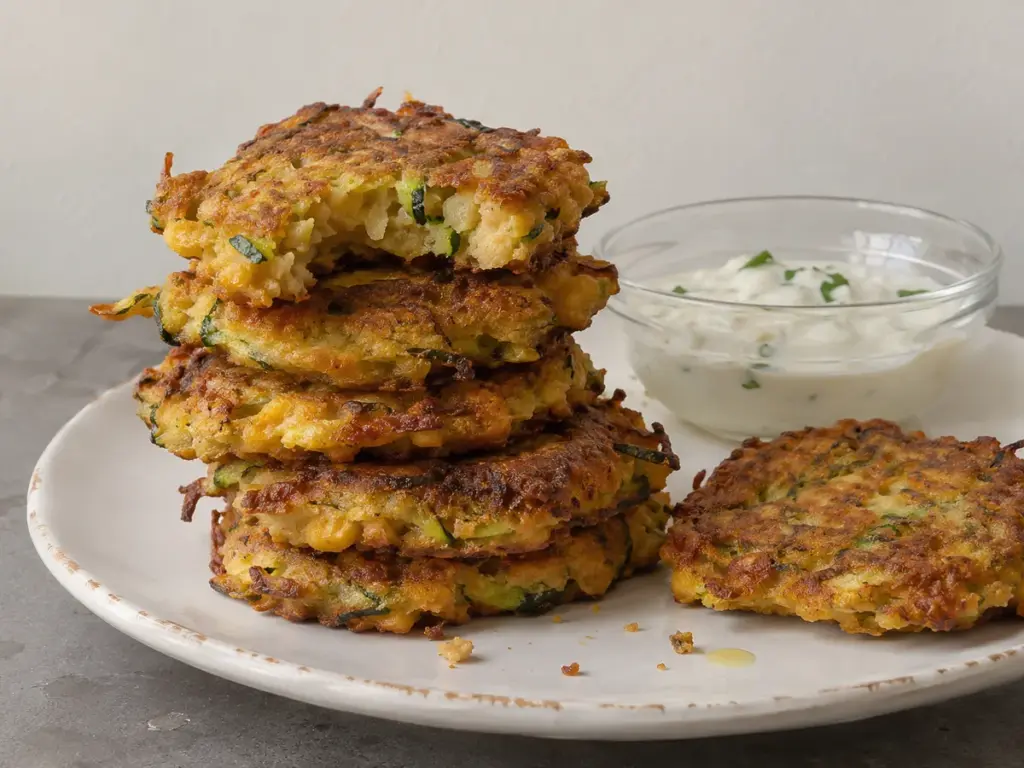
Fry in batches over medium heat so the oil stays hot, since fritters added all at once drop its temperature and soak it up. The batter has a raw egg, so a thermometer in the center of a fritter should read 160°F, the same egg-dish mark as for the burgers.
Whisk the yogurt dip first and salt it last, because the zucchini and garlic already add flavor.
Ingredients (for 4 servings)
- 2 medium zucchini, grated, with excess moisture squeezed out
- 1 can (15 ounces) chickpeas, drained and rinsed
- ½ cup all-purpose flour
- ¼ cup fresh parsley, finely chopped
- 2 cloves garlic, minced
- 1 teaspoon ground cumin
- ½ teaspoon salt
- ¼ teaspoon black pepper
- 1 large egg, beaten
- 3 tablespoons olive oil
- 1 cup plain Greek yogurt
- 1 tablespoon lemon juice
- 1 small garlic clove, minced
Instructions
- Squeeze the zucchini. Wring the grated zucchini in a clean kitchen towel until it stops dripping.
- Mix the batter. Mash the chickpeas lightly, leaving some texture, and stir in the zucchini, flour, parsley, garlic, cumin, salt, pepper and egg.
- Fry. Scoop spoonfuls into the olive oil, flatten them into small patties and fry 3 to 4 minutes per side until golden and crisp, then drain on a paper towel.
- Make the dip. Whisk the Greek yogurt, lemon juice, minced garlic, salt and pepper, and serve it alongside.
Swaps
- Whole wheat flour in place of the all-purpose flour lifts a serving from about 5 to just over 6 grams, because whole wheat flour has 10.7 grams of fiber per 100 grams against 2.7 for all-purpose.
- Grated carrot instead of zucchini takes a serving from 5 to about 7 grams, because raw carrot has 2.8 grams of fiber per 100 grams and raw zucchini 1.0. Carrot sheds less water, so wring the shreds in the towel only if they feel wet.
- A dip of sour cream or dairy-free yogurt comes out thinner and milder than Greek yogurt, so add the lemon juice a little at a time and taste.
Reheat leftover fritters in a skillet over medium-low heat until the centers read 165°F, which crisps the edges again, and keep the yogurt dip cold until serving.
5 Which High-Fiber Soups and Stews Suit Batch Cooking?
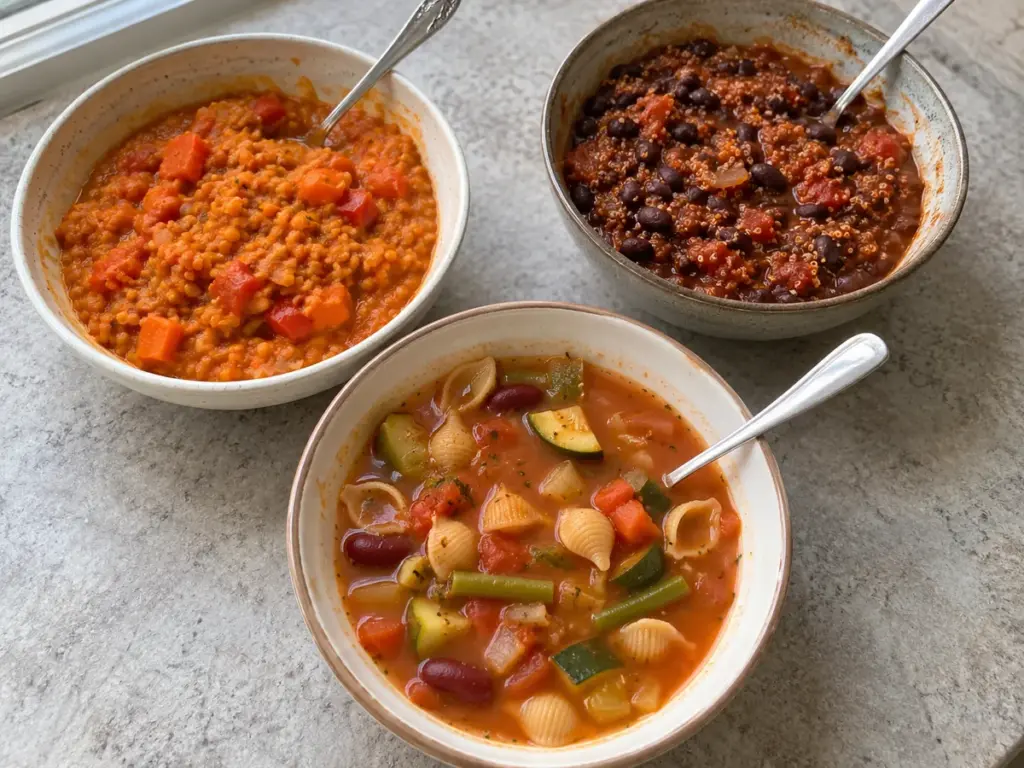
Split red lentils, kidney beans with pasta and black beans with quinoa each build a different pot, and all three keep 3 to 4 days in your fridge. FoodKeeper lists soups and stews at 2 to 3 months in the freezer, so a double batch pays off.
7. Red Lentil and Vegetable Stew
Red lentils are split and have lost their seed coats, so they dissolve into the broth and thicken the stew with no cream and no blender.
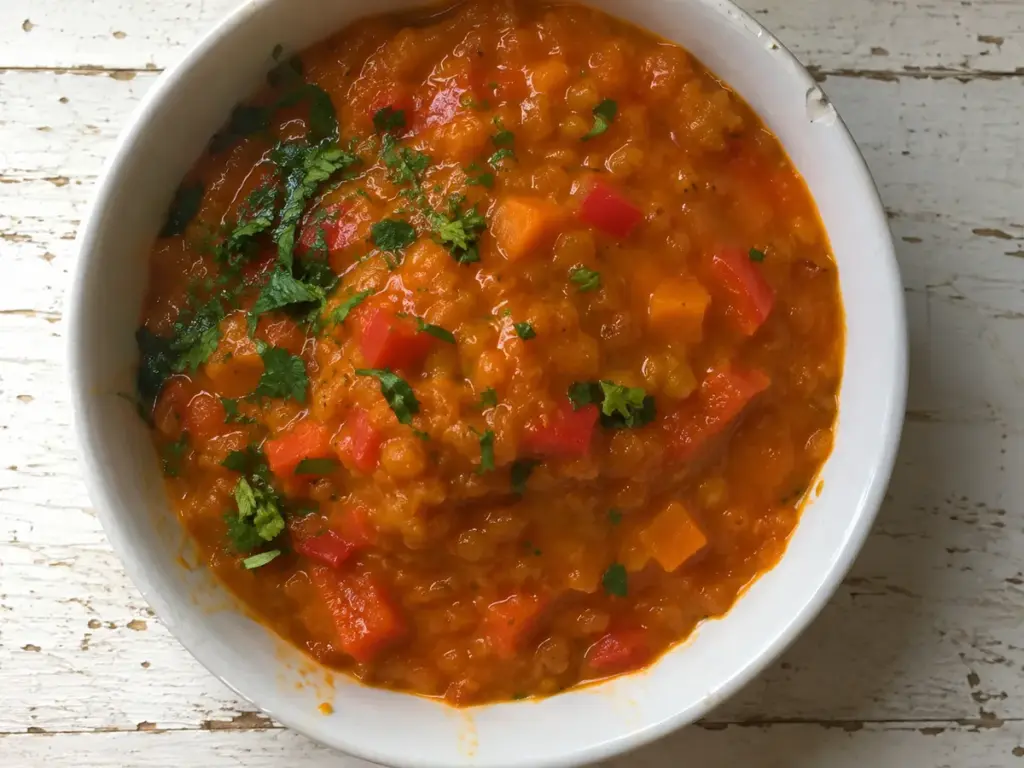
A cup of them supplies more than half of the pot's fiber, which puts a bowl at about 9 grams. USA Pulses puts split red lentils at 5 to 10 minutes to cook, and the 25 to 30 minute simmer is what softens the carrots and bell pepper while the lentils melt into the sauce.
Ingredients (for 4 servings)
- 1 cup red lentils, rinsed and drained
- 2 tablespoons olive oil
- 1 medium onion, finely chopped
- 2 garlic cloves, minced
- 2 medium carrots, diced
- 1 red bell pepper, chopped
- 1 can (14 ounces) diced tomatoes, with juices
- 4 cups vegetable broth
- 1 teaspoon ground cumin
- 1 teaspoon smoked paprika
- ½ teaspoon ground turmeric
- Salt and black pepper
- Fresh parsley or cilantro, chopped, for garnish
Instructions
- Soften the onion. Cook the onion in the olive oil over medium heat for about 5 minutes, then add the garlic for 1 minute.
- Add the vegetables. Stir in the carrots and bell pepper and cook about 5 minutes, stirring now and then, until they begin to soften.
- Simmer. Add the lentils, tomatoes with their juices, broth, cumin, paprika, turmeric, salt and pepper, bring to a boil, then cover and simmer on low for 25 to 30 minutes, stirring occasionally.
- Season and serve. Adjust the salt and pepper and top with parsley or cilantro.
Swaps
- Split peas need more time than red lentils: USA Pulses gives split peas 35 to 40 minutes at a simmer and split red lentils 5 to 10, so leave the stew about 10 minutes past its 25 to 30 minute simmer and bite a pea to check.
- Diced butternut squash can take the carrots' place and sweeten the stew, softening in the same simmer when cut to the same size. Raw butternut has 2.0 grams of fiber per 100 grams against 2.8 for raw carrot.
The stew keeps thickening as it stands, because lentils keep absorbing broth, so thin it with ¼ cup of broth or water at a time when you reheat it. Taste for salt at the end before you serve it, since vegetable broth varies a lot in how much it carries.
Steamed rice or crusty bread turns a bowl of the stew into a full dinner, and single portions freeze well for a later night.
8. Minestrone Soup with Kidney Beans and Whole Wheat Pasta
Kidney beans are the biggest fiber source in this pot, with the whole wheat pasta second, and together they bring a bowl to about 10 grams. The pasta goes in near the end and cooks in the soup for about 10 minutes, so its starch thickens the broth slightly.
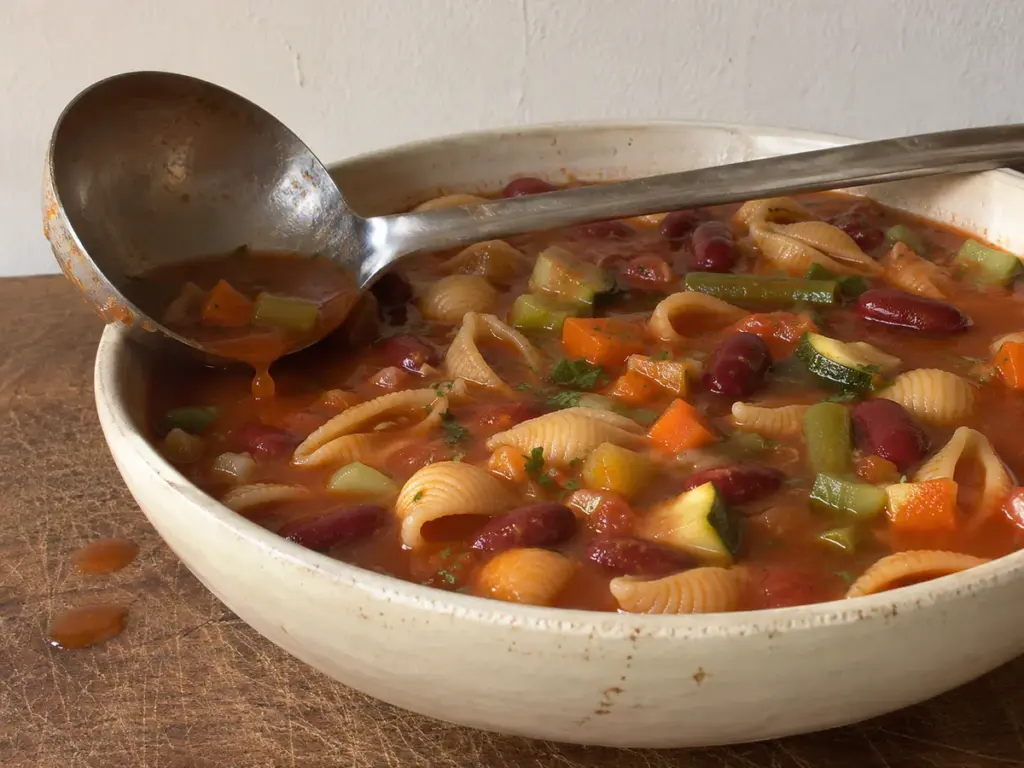
Whole wheat pasta keeps swelling after the pot comes off the heat, so leftovers turn thick by the next day. Add a splash of broth when you reheat, and bring the soup to 165°F.
Ingredients (for 4 servings)
- 1 tablespoon olive oil
- 1 medium onion, diced
- 2 garlic cloves, minced
- 2 medium carrots, peeled and diced
- 2 celery stalks, diced
- 1 medium zucchini, diced
- 1 cup green beans, trimmed and cut
- 1 can (15 ounces) kidney beans, drained and rinsed
- 1 can (14.5 ounces) diced tomatoes
- 6 cups vegetable broth
- ¾ cup whole wheat pasta in small shapes such as elbows or shells
- 1 teaspoon dried oregano
- 1 teaspoon dried basil
- Salt and black pepper
- Fresh parsley, chopped (optional)
Instructions
- Soften the base. Cook the onion, carrots and celery in the olive oil over medium heat for 5 to 7 minutes, then add the garlic for 1 minute.
- Add the rest. Stir in the zucchini, green beans, kidney beans, tomatoes with their juice, oregano and basil, pour in the broth and bring to a simmer.
- Simmer. Cook gently for 15 minutes until the vegetables are tender.
- Cook the pasta. Add the whole wheat pasta and cook uncovered about 10 minutes until just tender, stirring occasionally.
- Season. Add salt and pepper, ladle into bowls and top with parsley.
Swaps
- Pasta cooked in its own pot and spooned into each bowl keeps leftover soup from thickening overnight, because the noodles never sit in the broth to swell.
9. Slow Cooker Chili with Black Beans and Quinoa
Raw quinoa goes straight into the slow cooker with the beans and tomatoes and cooks in their liquid, so you have nothing to brown and nothing to cook ahead. Two cans of black beans and a cup of dry quinoa make this the highest-fiber of the three stews, at about 11 grams a bowl.
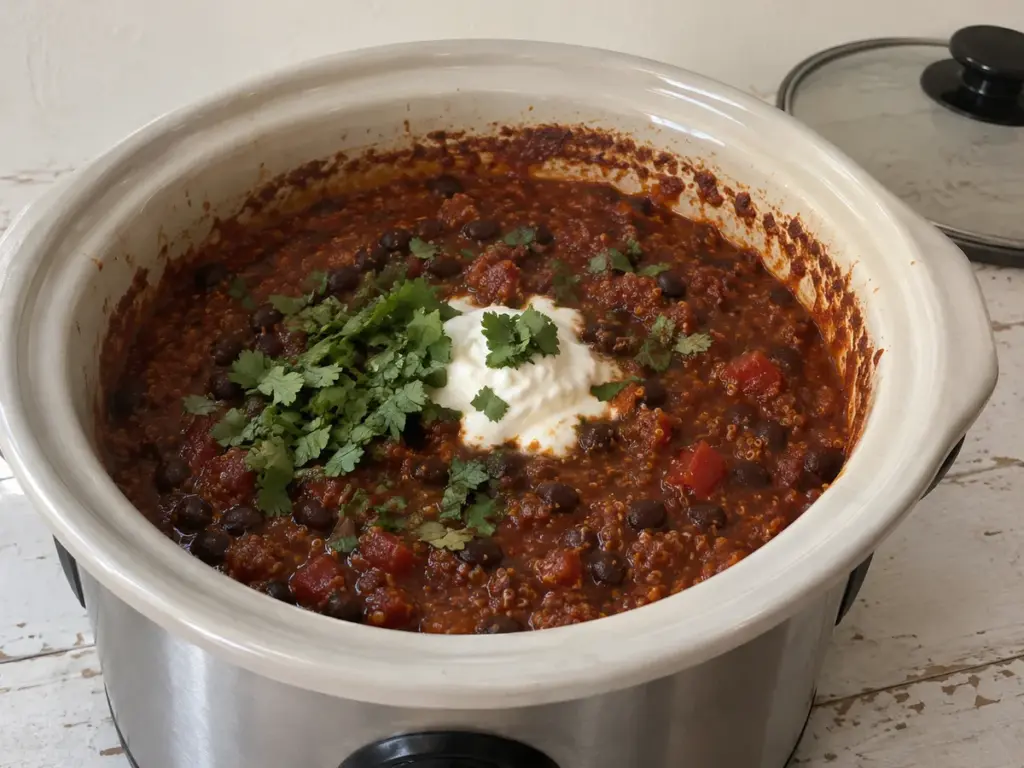
Rinse the quinoa first to wash off the bitter coating it carries.
Quinoa keeps softening for hours, so on the long low setting it gives up its shape and thickens the chili, and a splash of broth loosens it if yours ends up too stiff. Taste at the end, because the quinoa and beans absorb seasoning over the long cook, and add salt or a squeeze of lime then.
Ingredients (for 6 servings)
- 1 cup dry quinoa, rinsed
- 2 cans (15 ounces each) black beans, drained and rinsed
- 1 can (28 ounces) diced tomatoes, undrained
- 1 medium onion, diced
- 3 cloves garlic, minced
- 1 cup vegetable broth
- 1 tablespoon chili powder
- 1 teaspoon ground cumin
- ½ teaspoon smoked paprika
- ½ teaspoon black pepper
- ½ teaspoon salt
- ¼ teaspoon cayenne pepper (optional)
- 1 tablespoon olive oil
- Chopped cilantro, lime and Greek yogurt for serving (optional)
Instructions
- Load the cooker. Add the quinoa, beans, tomatoes with their juice, onion, garlic and broth and stir to combine.
- Season. Stir in the chili powder, cumin, paprika, pepper, salt and cayenne if using, and drizzle the olive oil on top.
- Cook. Cover and cook on low for 6 to 8 hours or on high for 3 to 4 hours, until the quinoa is tender.
- Finish. Stir, taste and adjust the seasoning, and serve with cilantro, lime or a spoonful of Greek yogurt.
Swaps
- Chopped bell pepper or diced sweet potato goes in with the beans and softens over the long cook, and the sweet potato adds fiber at 3.0 grams per 100 grams raw.
6 Which Bowls and Pan Dinners Fit a Weeknight?
The stir-fry and the risotto keep you at the stove for most of their cooking, while the sheet pan dinner and the falafel bowls need only a stir or a turn halfway, which leaves you the other minutes free.
10. Baked Falafel Bowls with Hummus and Roasted Veggies
Falafel gets its crunch from the fryer, and here the oven does that job: the shaped pieces are brushed with olive oil and baked on parchment until their edges crisp.
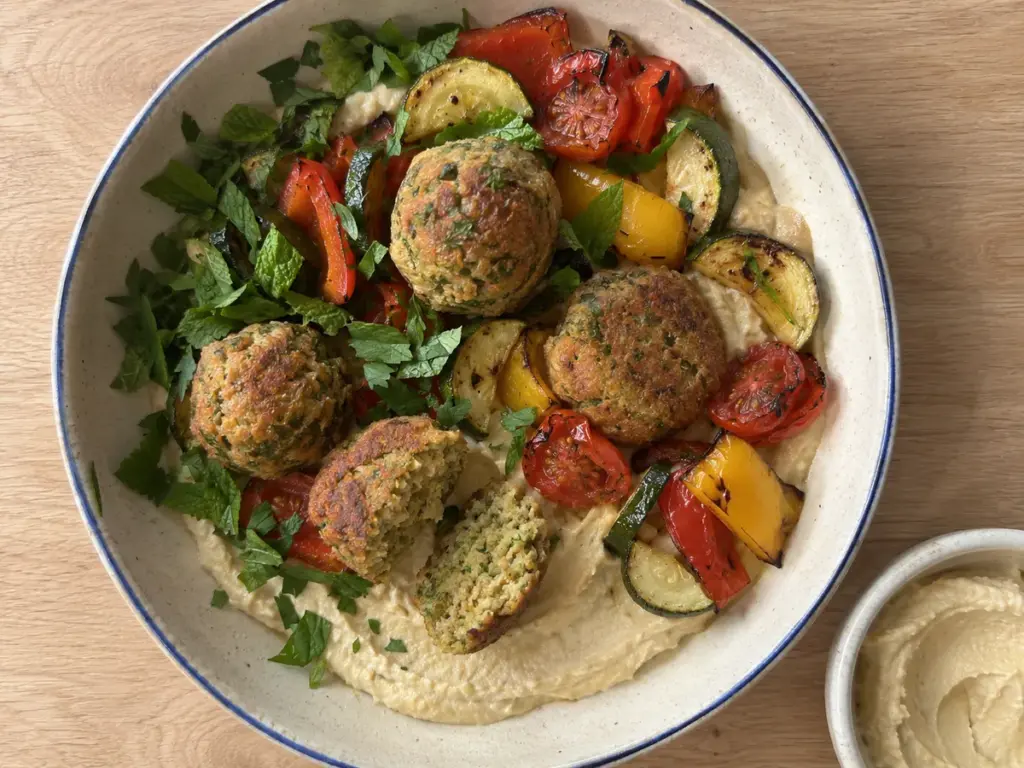
Canned chickpeas, a cup of hummus under the bowls and the roasted vegetables add up to about 11 grams of fiber per bowl. Pulse the mix only until it holds together and still looks coarse, because a smooth paste bakes into dense, dry falafel.
Ingredients (for 3 servings)
- 1 can (15 ounces) chickpeas, drained and rinsed thoroughly
- ½ cup fresh parsley, chopped
- ½ cup fresh cilantro, chopped
- 1 small onion, finely chopped
- 3 cloves garlic, minced
- 1 teaspoon ground cumin
- 1 teaspoon ground coriander
- ½ teaspoon baking powder
- ¼ cup all-purpose flour or chickpea flour
- 1 teaspoon salt
- ½ teaspoon black pepper
- 2 tablespoons olive oil, for brushing
- 2 cups mixed vegetables such as bell peppers, zucchini and cherry tomatoes, cut into bite-size pieces
- 1 cup hummus, homemade or store-bought
- Lemon wedges and fresh mint or parsley, for serving
Instructions
- Mix. Preheat the oven to 400°F and line a baking sheet with parchment. Pulse the chickpeas, parsley, cilantro, onion, garlic, cumin, coriander, baking powder, flour, salt and pepper in a food processor until the mix comes together but stays coarse.
- Shape. Form the mix into balls or small patties, set them on the sheet and brush them lightly with olive oil.
- Roast. Toss the vegetables with olive oil, salt and pepper on a second lined sheet, then bake both for 20 to 25 minutes, turning the falafel halfway, until golden and crisp.
- Assemble. Spread hummus in each bowl, add the roasted vegetables and falafel, and serve with lemon wedges and mint or parsley.
Swaps
- The oven is optional, since air-fried falafel take 12 to 15 minutes at 375°F with the basket shaken halfway and a spray of olive oil.
- Store-bought hummus saves a step and keeps the fiber, since FoodData Central lists it at 5.5 grams per 100 grams against 4.0 for homemade.
Keep the baked falafel, the roasted vegetables and the hummus in separate containers and build the bowls as you eat. Hummus, store-bought or homemade, keeps 7 days in the fridge and is not frozen (FoodKeeper); the cooked falafel and vegetables follow the 3 to 4 day limit and should reach 165°F when you warm them.
11. Roasted Vegetable and Lentil Sheet Pan Dinner
Brown or green lentils roast right on the pan, under a layer of broth that the pan holds while the vegetables brown on top.
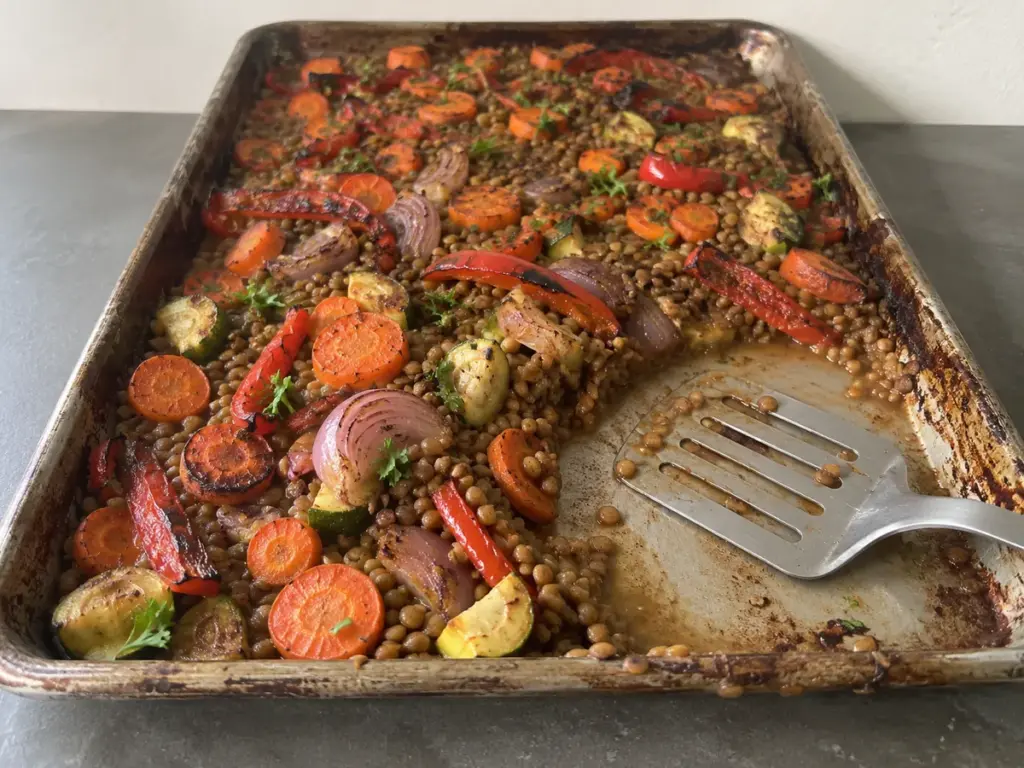
Dry lentils need about 2 ½ cups of liquid per cup according to USA Pulses, so this pan gets 2 ½ cups of broth and a foil lid for the first stretch of the roast. Lentils make up most of the fiber, which brings a plate to about 7 grams.
Cut the vegetables to about the same size so they finish together, and spread the lentils in a single layer between them so each one sits in the broth. The 15 uncovered minutes at the end let the vegetable edges caramelize and any leftover liquid soak in or evaporate.
Ingredients (for 4 servings)
- 1 cup dried green or brown lentils, rinsed and drained
- 3 cups assorted vegetables such as bell peppers, carrots, zucchini and red onion, chopped into bite-size pieces
- 2 tablespoons olive oil
- 1 teaspoon garlic powder
- 1 teaspoon smoked paprika
- ½ teaspoon ground cumin
- Salt and black pepper
- 2 ½ cups vegetable broth
- Fresh parsley or cilantro (optional)
Instructions
- Season. Preheat the oven to 400°F, then toss the vegetables with the olive oil, garlic powder, paprika, cumin, salt and pepper.
- Load the pan. Spread the vegetables on a large rimmed baking sheet, scatter the rinsed lentils between them and pour the broth over everything.
- Roast covered. Cover tightly with foil and roast for 25 minutes.
- Roast uncovered. Remove the foil, stir once and roast about 15 minutes more, until the vegetables are tender and caramelized and the lentils are cooked through.
- Serve. Top with parsley or cilantro.
Swaps
- Sweet potato, cauliflower or extra carrots can replace the zucchini and peppers on the same pan, as long as the dense vegetables are cut smaller than the soft ones so everything finishes together.
- A drained can of chickpeas stirred in for the last 15 uncovered minutes adds protein and fiber, because chickpeas are already cooked and need no extra liquid.
- Cumin can give way to ½ teaspoon of dried oregano or thyme, which turns the pan from warm and smoky to herbal.
To check doneness, taste a few lentils from the middle of the pan: they should be tender with no chalky center. If the pan still looks wet after the foil comes off, roast it a few more minutes uncovered.
12. Whole Grain Vegetable Stir-Fry with Tofu
Brown rice takes far longer than the stir-fry itself, so it goes on first and the rest comes together while it cooks. Tofu and brown rice supply most of the fiber, about 6 grams a serving, and pressing the tofu before you cut it dries the surface, which is what lets the cubes brown instead of steaming in the pan.
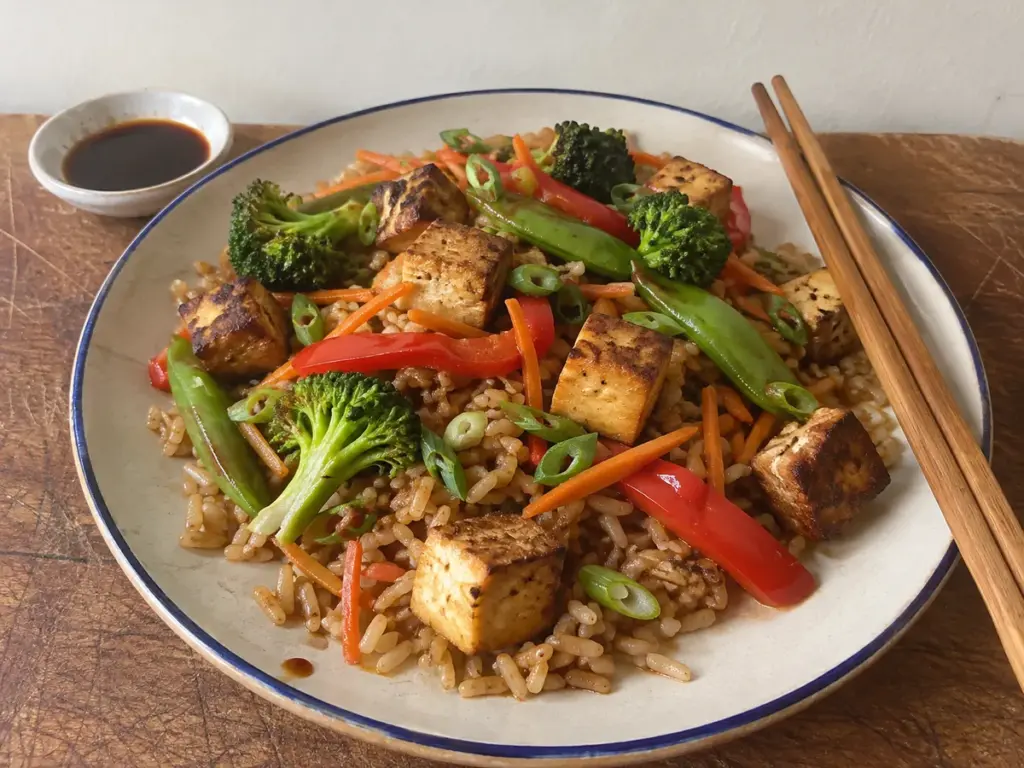
Tofu that you stir constantly never forms a crust, so let the cubes sit for a minute between turns until they release easily. The vegetables stay crisp-tender if the pan is hot and they cook only 4 to 5 minutes, and the vinegar and maple syrup in the sauce balance the soy sauce's salt.
Ingredients (for 4 servings)
- 1 cup brown rice, rinsed and drained
- 14 ounces firm tofu, drained, pressed and cut into cubes
- 2 tablespoons vegetable oil
- 1 cup broccoli florets
- 1 medium carrot, julienned or thinly sliced
- 1 red bell pepper, sliced into thin strips
- ½ cup snap peas, ends trimmed
- 3 green onions, sliced thinly
- 2 cloves garlic, minced
- 1 tablespoon grated fresh ginger
- 3 tablespoons soy sauce or tamari
- 1 tablespoon rice vinegar
- 1 teaspoon maple syrup or honey
- ¼ teaspoon crushed red pepper flakes (optional)
- Salt and pepper
Instructions
- Start the rice. Cook the brown rice per the package until tender and set it aside.
- Brown the tofu. Heat 1 tablespoon of oil in a large nonstick skillet or wok over medium-high heat and cook the cubes for about 8 minutes until golden on all sides, then remove them.
- Build the stir-fry. Add the second tablespoon of oil, cook the garlic, ginger and green onions for about 1 minute, then add the broccoli, carrot, bell pepper and snap peas for 4 to 5 minutes.
- Sauce and serve. Return the tofu, stir in the soy sauce, vinegar, maple syrup and pepper flakes, heat through for 2 minutes, and serve over the brown rice.
Swaps
- Tempeh is firmer and nuttier than tofu and needs no pressing, so cube it and brown it the same way. A can of rinsed chickpeas is already cooked and only needs to heat through with the sauce for the last 2 minutes.
- A splash of toasted sesame oil stirred in after the pan leaves the heat adds an aroma that high heat would dull.
13. Butternut Squash and Farro Risotto
Farro cooks risotto-style, with warm broth stirred in ½ cup at a time for 25 to 30 minutes until the grains are tender with some chew, which draws their starch into a creamy sauce with only Parmesan for richness.
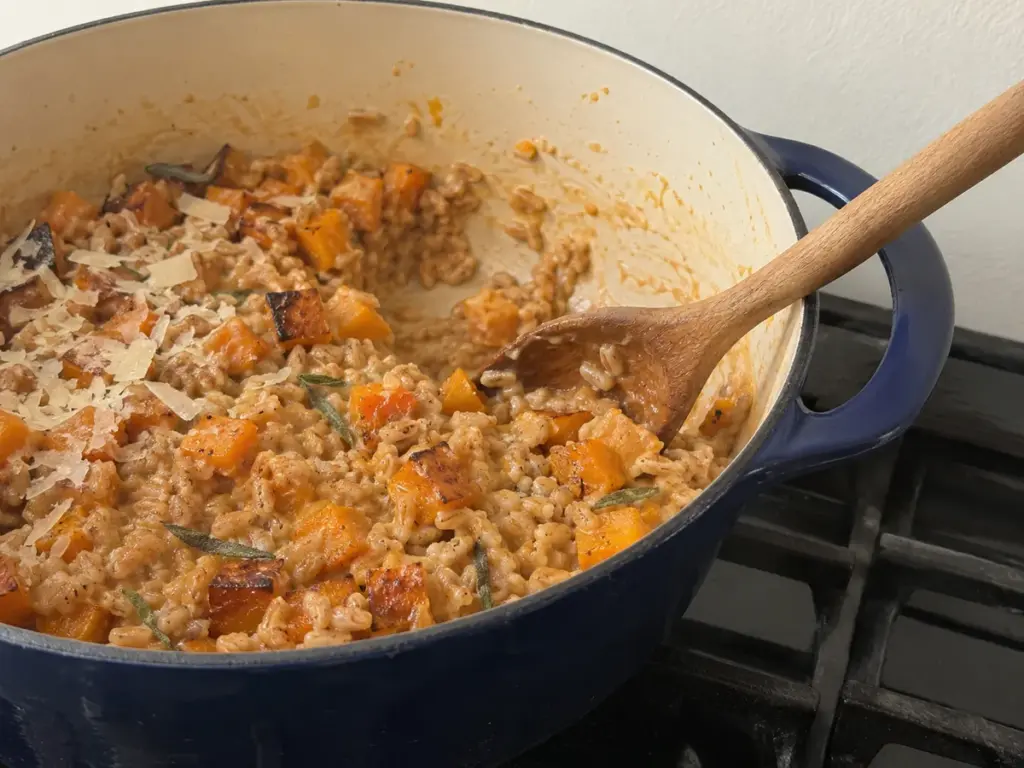
Farro is missing from the USDA dataset behind these figures, so this risotto is the one recipe with no number. Pearled farro has had some or all of its bran removed, so whole or semi-pearled farro keeps more fiber, and the package label gives the figure for the farro you buy.
Keep the broth hot in a second pot so the farro never stops simmering when you add it.
Ingredients (for 4 servings)
- 1 small butternut squash, peeled, seeded and cut into 1-inch cubes
- 2 tablespoons olive oil, divided
- 1 cup pearled farro, rinsed well
- 1 small onion, finely chopped
- 2 cloves garlic, minced
- 4 cups vegetable broth, kept warm
- ½ cup dry white wine (optional)
- ½ cup freshly grated Parmesan cheese, plus extra for serving
- Salt and freshly ground black pepper
- Fresh sage or thyme leaves, chopped (optional)
Instructions
- Roast the squash. Toss the squash with 1 tablespoon of olive oil and a pinch of salt, spread it on a baking sheet at 425°F and roast 20 to 25 minutes until tender and caramelized at the edges.
- Soften the aromatics. Cook the onion in the remaining oil in a large skillet or Dutch oven over medium heat for about 5 minutes, then add the garlic for 1 minute.
- Toast the farro. Stir the farro into the pan to coat it, add the wine if using and cook until it reduces by half.
- Add the broth. Stir in the warm broth ½ cup at a time, waiting until it is mostly absorbed before the next, for 25 to 30 minutes until the farro is tender but chewy.
- Finish. Fold in the squash and Parmesan, season with salt and pepper, and top with sage or thyme.
Swaps
- Pearl barley or spelt as a farro swap keeps the risotto texture, though each grain cooks at its own pace, so judge by chew and not the clock. A cup of dry pearl barley holds about 31 grams of fiber (FoodData Central, 15.6 grams per 100 grams), which is about 7.8 grams a serving before the squash is counted.
- Pumpkin or kabocha roasts the same way as butternut and tastes similarly sweet, though pumpkin has less fiber, 0.5 gram per 100 grams raw against 2.0 for butternut.
- The wine is optional. Without it the risotto tastes a little less bright, and the warm broth carries all the liquid.
7 Which High-Fiber Bakes Are Worth the Extra Time?
Seven dinners need 45 to 85 minutes of cooking. In return most of them reheat well and feed several people, and FoodKeeper lists casseroles at 3 to 4 days in the fridge.
14. Lentil and Sweet Potato Shepherd's Pie
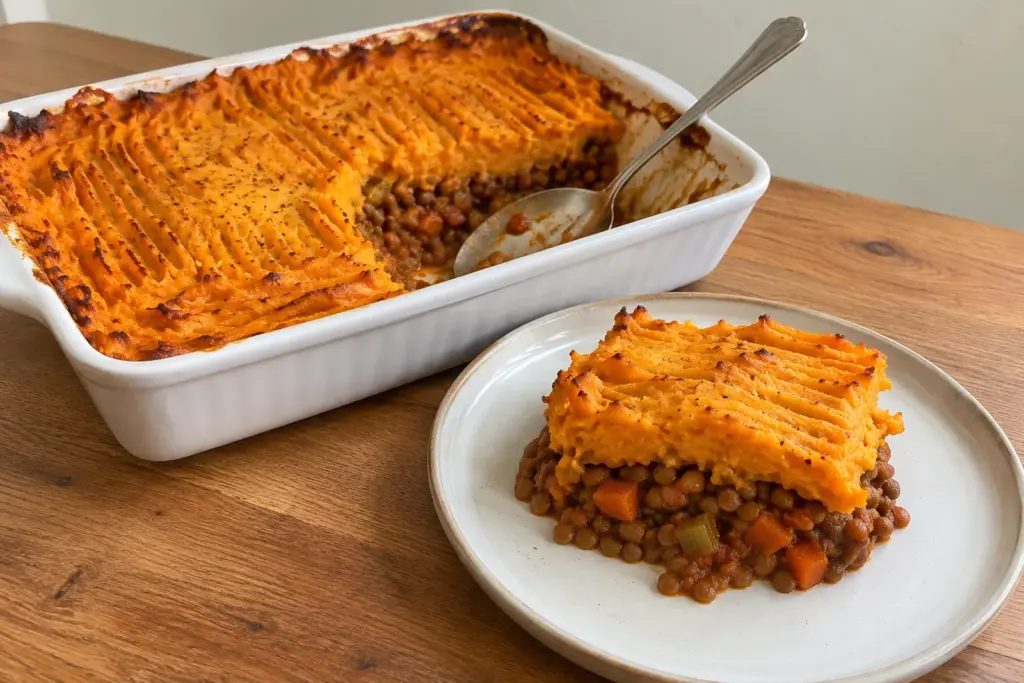
Brown lentils keep their shape through a 25 to 30 minute simmer, which lets the filling bake under its sweet potato topping without turning to paste.
More than half of the fiber comes from the cup of dry lentils and most of the rest from the sweet potatoes, which puts a serving at about 9 grams. Dry lentils need about 2 ½ cups of liquid per cup, so the filling gets 2 ½ cups of broth, and USA Pulses lists that ratio.
Let the filling thicken until most of the broth is absorbed before it goes into the dish, because a loose filling soaks into the topping as it bakes. Drain the boiled sweet potatoes well and mash them with only the 2 tablespoons of milk so the topping stays stiff enough to hold fork ridges, which brown at the tips in the oven.
Ingredients (for 4 servings)
- 2 large sweet potatoes, peeled and cut into chunks
- 1 cup dried brown lentils, rinsed and drained
- 2 tablespoons olive oil
- 1 medium onion, finely chopped
- 2 cloves garlic, minced
- 2 carrots, diced
- 1 celery stalk, diced
- 1 tablespoon tomato paste
- 2 ½ cups vegetable broth
- 1 teaspoon dried thyme
- ½ teaspoon smoked paprika
- 2 tablespoons unsweetened plant-based milk
- Salt and black pepper
Instructions
- Boil the sweet potatoes. Cook the chunks in salted water for about 15 minutes until tender, drain, and mash with the plant milk, salt and pepper.
- Soften the vegetables. Cook the onion, garlic, carrots and celery in the olive oil over medium heat for about 7 minutes.
- Simmer the lentils. Stir in the tomato paste, thyme and paprika, then add the lentils and broth, bring to a simmer, cover and cook 25 to 30 minutes until the lentils are tender and most of the liquid is absorbed. Season with salt and pepper.
- Assemble. Heat the oven to 375°F, put the filling in a baking dish and spread the mashed sweet potatoes on top, scoring the surface with a fork.
- Bake. Bake uncovered 20 to 25 minutes until the top is golden and the edges bubble, then rest 5 minutes before serving.
Swaps
- White potatoes, alone or half and half with carrots, make a milder topping, and boiled white potato has 1.8 grams of fiber per 100 grams against 2.5 for boiled sweet potato.
- Canned lentils skip the 25 to 30 minute simmer: drain and rinse them, stir them in with the tomato paste and thyme, and add only enough broth to loosen the filling.
- Mushrooms, peas or corn stirred into the filling add texture and sweetness, and mushrooms should brown first so their liquid cooks off and the filling does not loosen.
- Rosemary or sage gives a stronger herb note than thyme, so start with less than the 1 teaspoon and taste the filling before it bakes.
You can assemble the pie ahead: spread the topping over the filling, cover and chill it, then bake until the center reaches 165°F, adding minutes when it goes in cold. Serve squares with a green salad or roasted vegetables.
15. Quinoa and Black Bean Stuffed Peppers
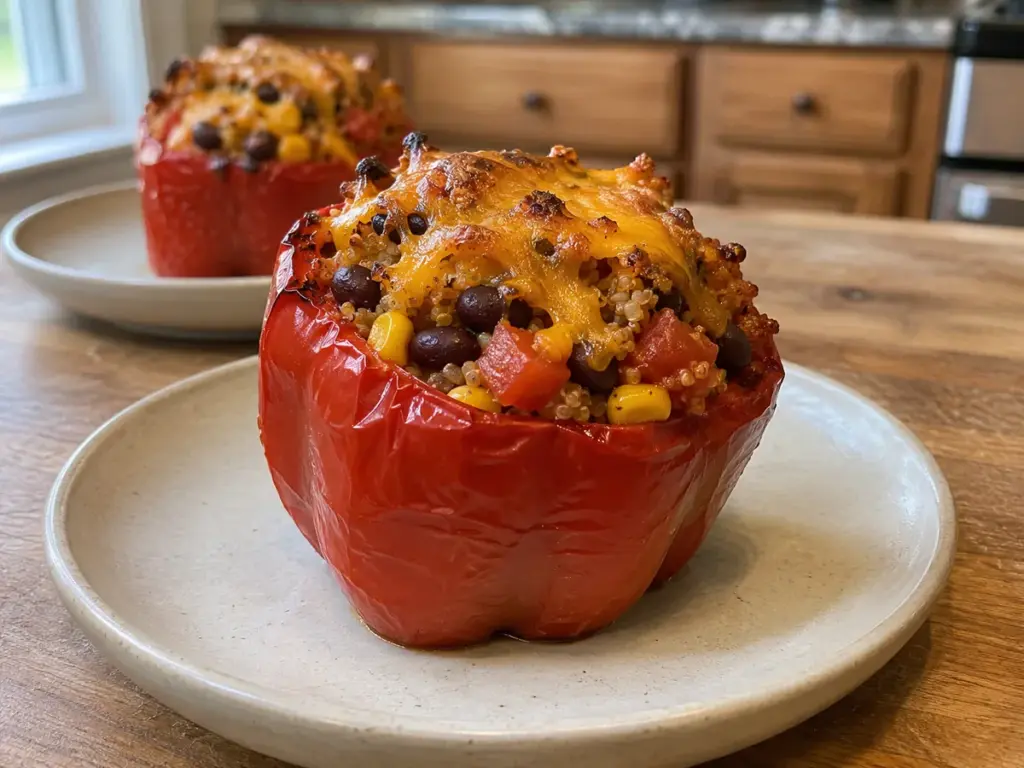
The quinoa cooks in broth first, and 1 ¾ cups of liquid per cup of grain leaves it fluffy and not wet when it goes into the pepper. That filling matters, because three quarters of the fiber sits in it: quinoa, black beans, corn and tomatoes together bring a pepper to about 12 grams, the most of any recipe here with a figure.
Stand the peppers close together in the baking dish so they hold each other upright, and slice a thin piece off any base that wobbles. Foil traps steam for the first 25 minutes so the pepper walls soften, and the uncovered last 10 minutes let you brown the cheese.
Ingredients (for 4 servings, 4 peppers)
- 4 large bell peppers, any color, tops cut off and seeds removed
- 1 cup quinoa, rinsed well
- 1 ¾ cups vegetable broth
- 1 can (15 ounces) black beans, drained and rinsed
- 1 cup corn kernels, fresh or frozen
- 1 small onion, finely chopped
- 2 cloves garlic, minced
- 1 teaspoon ground cumin
- ½ teaspoon chili powder
- ½ teaspoon smoked paprika
- 1 cup diced tomatoes
- 1 cup shredded cheddar or Monterey Jack (optional)
- 2 tablespoons olive oil
- Salt and pepper
- Fresh cilantro or parsley, chopped
Instructions
- Prep the peppers. Heat the oven to 375°F, stand the peppers upright in a baking dish and brush them lightly with olive oil.
- Cook the quinoa. Boil the broth, add the quinoa, cover on low for 15 minutes until fluffy and the liquid is absorbed, then fluff with a fork.
- Make the filling. Cook the onion in olive oil for 3 to 4 minutes, add the garlic, cumin, chili powder and paprika for 1 minute, then mix with the quinoa, black beans, corn, tomatoes, half the cheese, salt and pepper.
- Stuff and bake. Spoon the filling into the peppers, top with the remaining cheese, cover with foil and bake 25 minutes, then uncover and bake 10 minutes more.
- Serve. Top with cilantro or parsley.
Swaps
- Brown rice in place of the quinoa would cost about 1.3 grams a pepper, because 1 cup of dry quinoa holds 11.9 grams of fiber and 1 cup of dry brown rice 6.7 (FoodData Central). The rice then follows its own package timing and liquid.
- Poblano peppers or large tomatoes hold the same filling. Poblanos are narrower and take less, and tomatoes soften sooner, so check both with a fork before the full time is up.
Stuff the peppers a day ahead only after the filling has cooled within 2 hours of cooking, then cover and chill them. Bake until the filling reads 165°F, which takes longer when they go in cold.
16. Barley and Mushroom Casserole
Nothing is boiled first here: the barley bakes right in the dish in 3 cups of broth, takes 45 minutes under foil to turn tender, and after that needs no stirring. That pearl barley is nearly all of this casserole's fiber, about 31 grams from the cup of dry barley, so a quarter of the dish comes to about 8 grams.
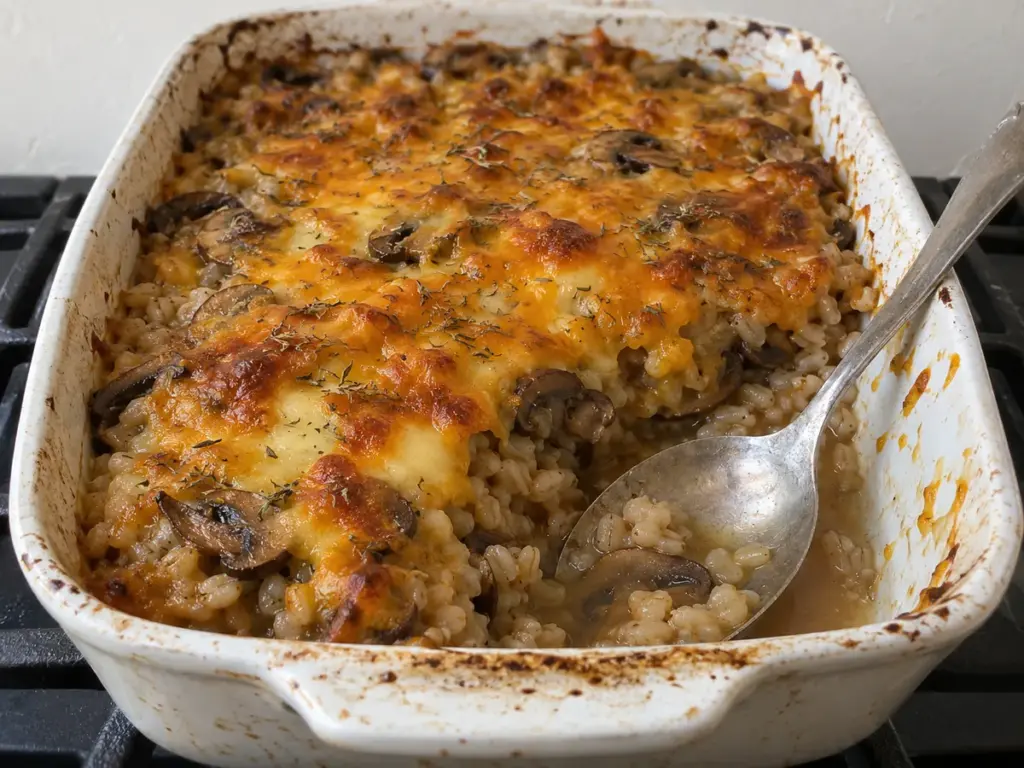
Brown the mushrooms until their liquid cooks off, about 7 minutes, because mushrooms that go into the dish wet thin the broth and leave the barley underdone. Stir the yogurt or sour cream in after baking, when it adds creaminess without curdling in the oven.
Ingredients (for 4 servings)
- 1 cup pearl barley, rinsed and drained
- 2 tablespoons olive oil
- 1 medium onion, finely chopped
- 3 cups sliced mushrooms, button, cremini or a mix
- 3 cloves garlic, minced
- 3 cups vegetable or chicken broth
- 1 cup shredded cheddar cheese
- 1 teaspoon dried thyme
- Salt and black pepper
- ½ cup plain Greek yogurt or sour cream (optional)
Instructions
- Soften the onion. Heat the oven to 375°F and cook the onion in the olive oil over medium heat for about 5 minutes until translucent.
- Brown the mushrooms. Add the mushrooms and cook about 7 minutes until they release their moisture and begin to brown, then add the garlic and thyme for 1 minute.
- Combine. Mix the sautéed vegetables with the rinsed barley, broth, salt and pepper in a greased casserole dish.
- Bake. Cover with foil and bake 45 minutes until the barley is tender and most of the liquid is absorbed, then sprinkle the cheddar on top and bake uncovered 10 minutes more.
- Rest and serve. Let it stand 5 minutes, then stir in the yogurt or sour cream if using.
Swaps
- Brown rice instead of the barley takes a serving from about 8 grams to about 2, because a cup of dry brown rice holds 6.7 grams of fiber against about 31 for pearl barley. The rice follows its own package liquid and time.
- Cremini or shiitake mushrooms give a deeper, earthier flavor than button mushrooms. Cut the stems off shiitake, since they stay tough, and brown the caps for the same 7 minutes.
- Mozzarella or a blend melts into a milder, stretchier top at the same 1 cup, while cheddar gives the sharper taste and a deeper color.
17. Sweet Potato and Kale Enchiladas
Roast the sweet potato cubes until their edges caramelize and the filling tastes sweet and a little smoky next to the tangy sauce, then roll the tortillas and set them seam side down so they hold shut. The eight flour tortillas supply about half of the fiber, and the sweet potato and kale make up most of the rest, which brings two enchiladas to about 6 grams.
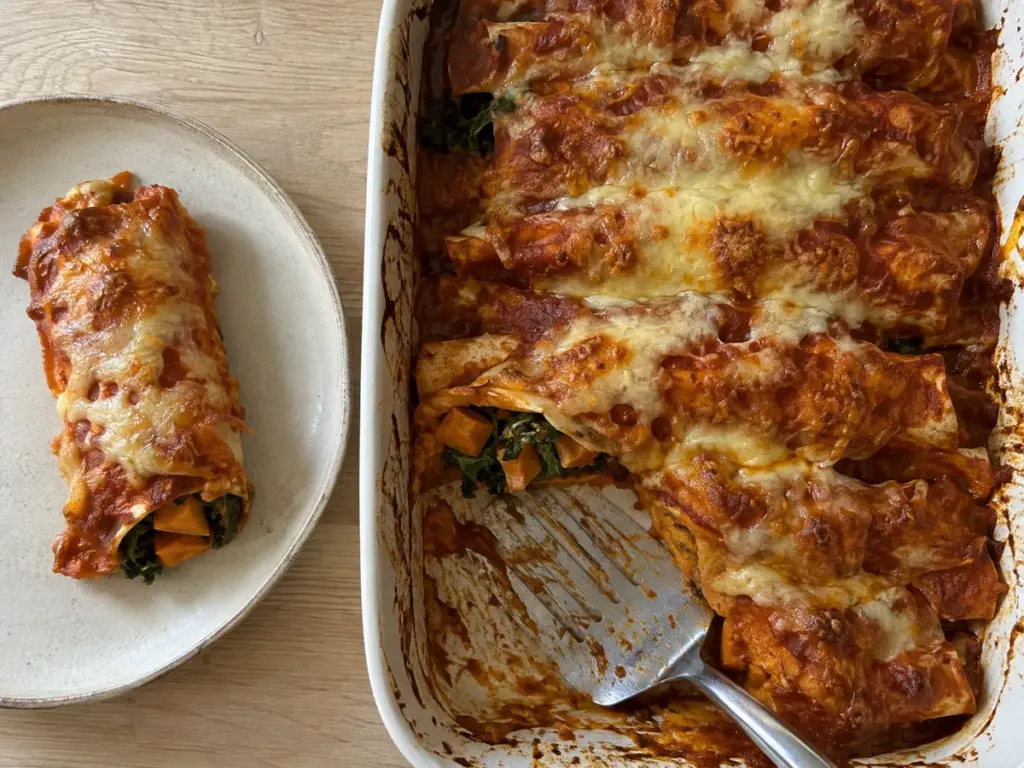
Roll the tortillas seam side down and cover them completely with sauce and cheese, because exposed tortilla edges dry out in the oven.
Ingredients (for 4 servings, 8 enchiladas)
- 2 medium sweet potatoes, peeled and diced into ½-inch cubes
- 1 tablespoon olive oil, divided
- 1 small onion, finely chopped
- 3 cloves garlic, minced
- 4 cups kale leaves, stems removed and chopped
- 1 teaspoon ground cumin
- ½ teaspoon smoked paprika
- ¼ teaspoon chili powder
- 2 cups red enchilada sauce
- 8 large flour tortillas (8-inch)
- 1 ½ cups shredded cheese, such as a Monterey Jack and cheddar blend
- Salt and black pepper
Instructions
- Roast the sweet potatoes. Heat the oven to 400°F, toss the cubes with half the olive oil and a pinch of salt and roast on a baking sheet for 25 to 30 minutes until tender and slightly caramelized.
- Cook the kale. Soften the onion in the remaining oil for about 5 minutes, add the garlic for 1 minute, then the kale, cumin, paprika, chili powder, salt and pepper for 4 to 5 minutes until the kale wilts. Stir in the sweet potatoes.
- Assemble. Lower the oven to 350°F and spread about ½ cup of sauce in a 9x13-inch dish. Divide the filling among the 8 tortillas, roll them up and set them seam side down in the dish.
- Bake. Pour the remaining sauce over the tortillas, top with cheese and bake uncovered 20 to 25 minutes until bubbly, then rest 5 minutes.
Swaps
- Butternut squash or pumpkin roasts in the same 25 to 30 minutes when cut to the same size. Raw butternut has 2.0 grams of fiber per 100 grams against 3.0 for sweet potato, and pumpkin has 0.5.
- Pepper jack is Monterey Jack with chili peppers added, so the same 1 ½ cups brings a little heat to the top of the pan.
- A quick sauce from tomato sauce stands in for store-bought: per cup of sauce, stir 1 tablespoon chili powder, ½ teaspoon cumin and ¼ teaspoon garlic powder into 1 cup of tomato sauce for a quick enchilada sauce stand-in, and double that for this pan.
Top the baked pan with cilantro, sour cream or sliced avocado, and note that half an avocado on a plate adds about 4.5 grams of fiber: FoodData Central lists raw avocado at 6.7 grams per 100 grams, and a 68-gram half holds about that much.
18. Spaghetti Squash with White Bean Tomato Sauce
A few mashed white beans thicken the sauce without flour or cream. Spaghetti squash strands are mostly water and carry little fiber themselves, so the beans and canned tomatoes in that sauce make up most of the roughly 9 grams in a serving.
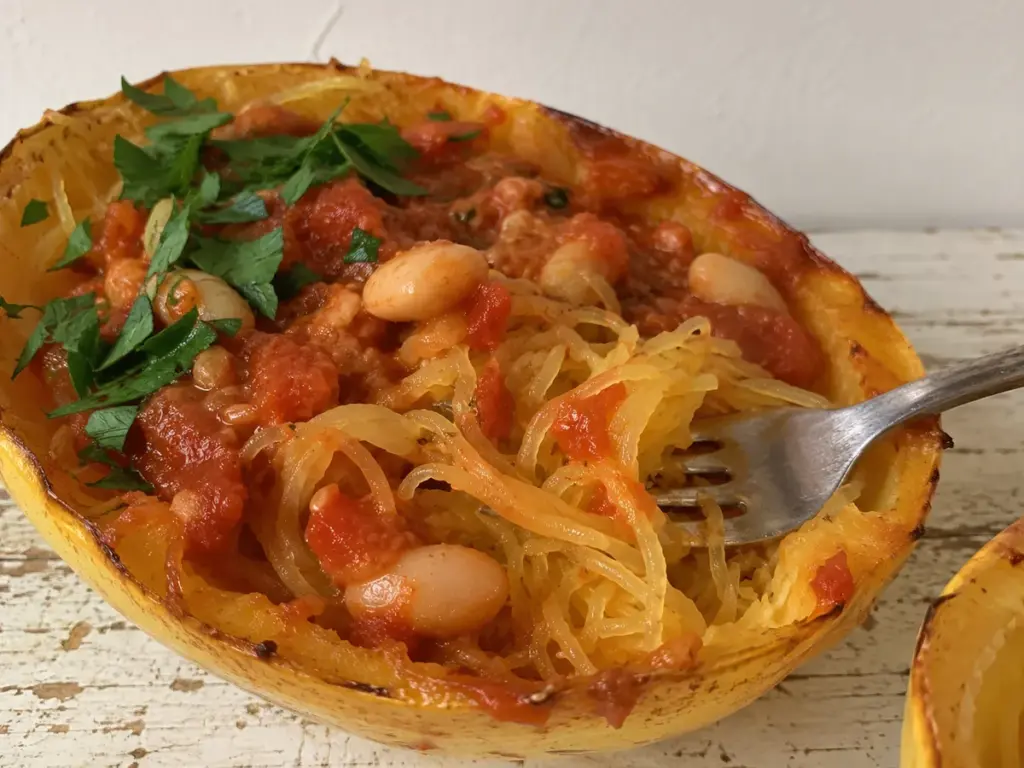
Roast the halves cut side down so the flesh steams against the pan, and test with a fork: the strands are ready when they pull apart easily. Salt the squash after roasting as well as the sauce, because the strands taste flat without it.
Ingredients (for 3 servings)
- 1 medium spaghetti squash, halved and seeds removed
- 1 tablespoon olive oil, plus extra for roasting
- 1 small onion, finely chopped
- 2 cloves garlic, minced
- 1 can (14 ounces) white beans, drained and rinsed
- 1 can (14 ounces) diced tomatoes, undrained
- ½ teaspoon dried oregano
- ¼ teaspoon red pepper flakes (optional)
- Salt and black pepper
- 2 tablespoons fresh parsley, chopped
Instructions
- Roast the squash. Heat the oven to 400°F, brush the cut sides with olive oil and salt, set them cut side down on a baking sheet and roast 40 to 45 minutes until the flesh shreds easily.
- Start the sauce. Cook the onion in 1 tablespoon of olive oil for about 5 minutes, then add the garlic for 1 minute.
- Simmer. Add the white beans, tomatoes with their juice, oregano and pepper flakes and simmer gently 10 to 15 minutes, mashing some beans with the back of a spoon. Season with salt and pepper.
- Serve. Scrape the squash into strands with a fork, divide among plates, ladle the sauce over and top with parsley.
Swaps
- Zucchini noodles need no 40 to 45 minute roast: blot them dry and warm them briefly in a skillet. Raw zucchini has 1.0 gram of fiber per 100 grams against 1.5 for raw spaghetti squash, so the plate loses little.
- The Instant Pot cooks halved squash in only 7 minutes at high pressure for Instant Pot spaghetti squash, which replaces the 40 to 45 minute roast.
- Fire-roasted canned tomatoes add smokiness to the sauce, while fresh tomatoes in season need a few more minutes to break down.
The sauce keeps for a few days in the fridge (3 to 4, like any cooked leftover), so you can make it ahead and roast the squash fresh on the night.
19. Stuffed Acorn Squash with Wild Rice and Cranberries
Roast the squash cut side down until the flesh is tender, then fill it with wild rice, sweetened dried cranberries for tartness against the sweet squash, and cinnamon and nutmeg to warm the filling.
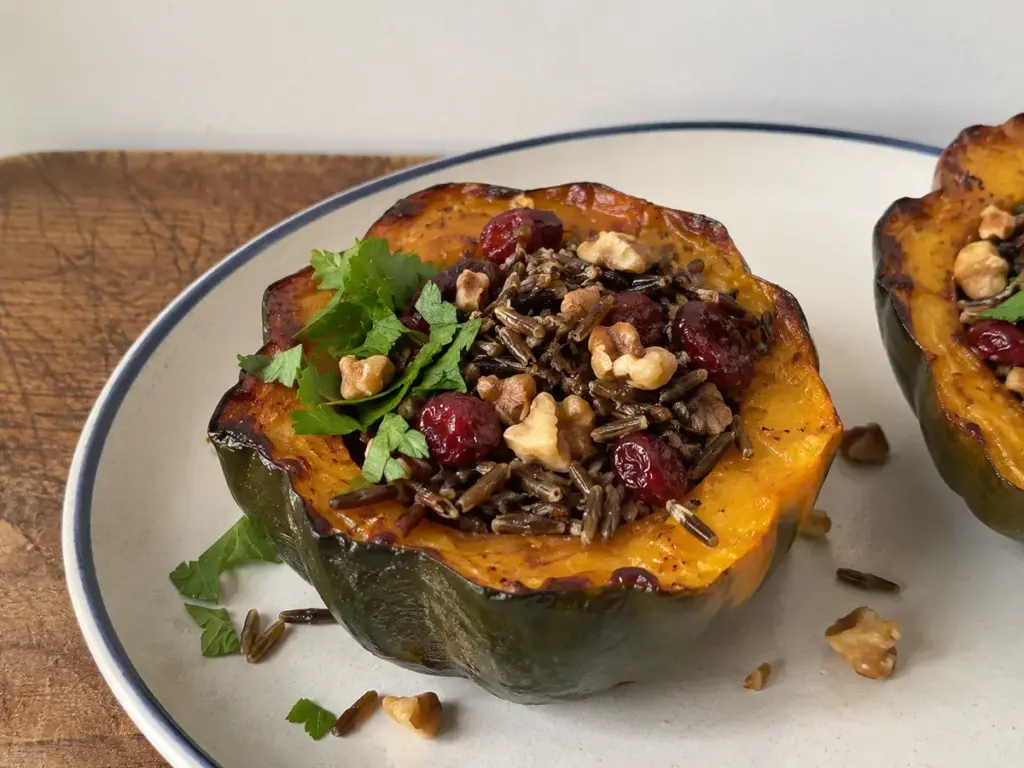
The squash itself gives more than half of the fiber, with the wild rice, cranberries and walnuts adding the rest. That is about 5 grams a half, just under the 5.6-gram line, and stirring ½ cup of cooked lentils into the filling brings it to about 7.
Cook the wild rice a day ahead and the dish becomes an assembly job, since the squash roasts while the filling cooks. Nuts toasted in a dry pan for a few minutes taste fuller, and they stay crunchier when you stir them in at the end.
Ingredients (for 4 servings, 4 squash halves)
- 2 medium acorn squashes, halved and seeded
- 1 cup cooked wild rice, cooled
- ⅓ cup dried cranberries
- ¼ cup chopped walnuts or pecans (optional)
- 1 small onion, finely chopped
- 2 cloves garlic, minced
- 1 tablespoon olive oil
- ½ teaspoon ground cinnamon
- ¼ teaspoon ground nutmeg
- Salt and freshly ground black pepper
- Fresh parsley or thyme, chopped
Instructions
- Roast the squash. Heat the oven to 400°F, drizzle the halves with half the olive oil, season with salt and pepper and roast cut side down 30 to 35 minutes until tender.
- Cook the aromatics. Soften the onion in the remaining oil for about 5 minutes, then add the garlic, cinnamon and nutmeg for 1 minute.
- Mix the filling. Combine the wild rice, cranberries, toasted nuts, the onion mixture, salt and pepper.
- Fill and bake. Turn the squash cut side up, pack the filling in gently and bake 10 minutes more to warm it through.
- Serve. Top with parsley or thyme.
Swaps
- Butternut squash in place of the acorn squash, by weight, lifts a half from about 5 to about 6.5 grams, because FoodData Central lists raw butternut at 2.0 grams of fiber per 100 grams and raw acorn squash at 1.5.
- Quinoa or brown rice gives the filling a softer texture than wild rice. A cooked cup has 5.2 grams of fiber for quinoa, 3.2 for brown rice and 3.0 for wild rice, and either can be cooked a day ahead like the wild rice.
- Dried cherries or raisins sweeten the filling more and tart it less. Sweetened dried cranberries have 5.3 grams of fiber per 100 grams, tart dried cherries 2.5 and dark raisins 4.5.
- Roasted pumpkin seeds add crunch and fiber where the walnuts or pecans would go, at 6.5 grams per 100 grams for roasted shelled seeds.
20. Eggplant and Lentil Moussaka
The lentils stand in for the ground meat in the layer between the eggplant slices, and cinnamon in the filling is the classic moussaka flavor that warms the tomatoes without making the dish sweet. The two large eggplants and the cup of dry lentils supply most of the fiber, about 10 grams a serving.
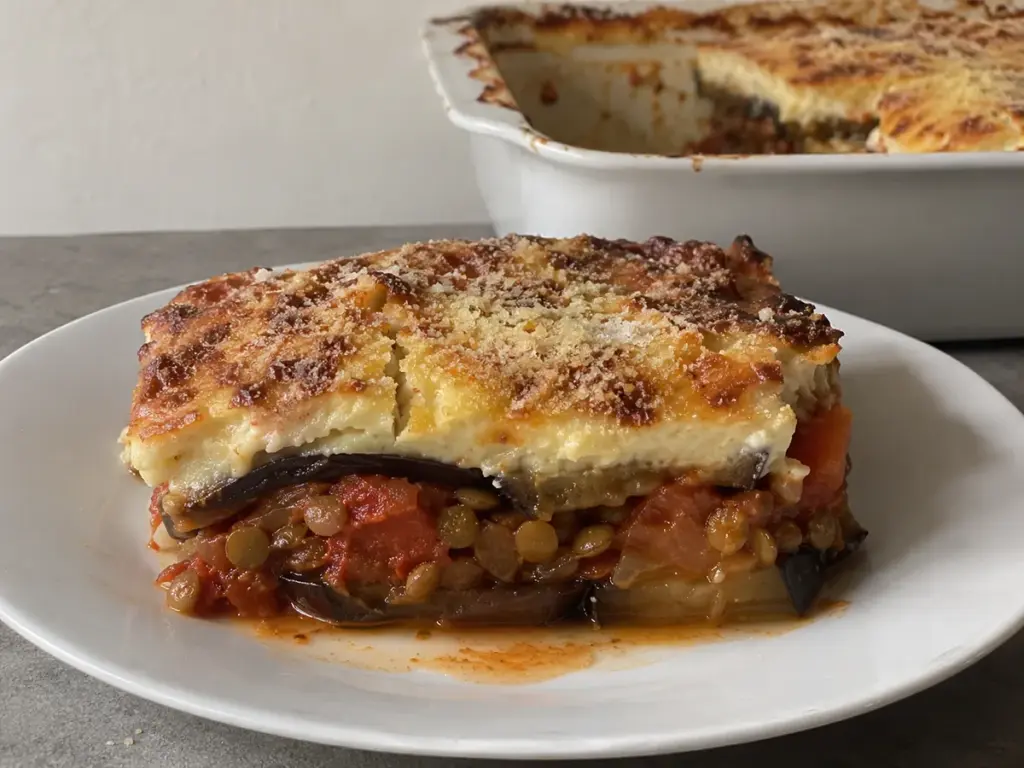
Whisk the flour into the melted butter for 1 to 2 minutes without letting it brown, then add the warm milk gradually so the sauce stays smooth. A 10 minute rest before you slice lets the layers set, and leftovers should be reheated to 165°F in the center.
Ingredients (for 6 servings)
- 2 large eggplants, sliced into ¼-inch rounds
- 1 cup dried brown lentils, rinsed and drained
- 1 medium onion, finely chopped
- 3 cloves garlic, minced
- 1 can (14 ounces) crushed tomatoes
- ¼ cup olive oil, divided
- 1 teaspoon ground cinnamon
- 1 teaspoon dried oregano
- Salt and black pepper
- 3 tablespoons butter
- 3 tablespoons all-purpose flour
- 2 ½ cups milk, warmed
- ¼ teaspoon ground nutmeg
- ½ cup grated Parmesan cheese
Instructions
- Roast the eggplant. Heat the oven to 400°F, brush both sides of the slices with olive oil, season and roast on baking sheets for 20 minutes, turning once, until softened and lightly browned.
- Boil the lentils. Cook the lentils in boiling water for 20 to 25 minutes until tender but not mushy, then drain.
- Make the filling. Soften the onion in 2 tablespoons of olive oil for 5 minutes, add the garlic, cinnamon and oregano for 1 minute, then stir in the crushed tomatoes and lentils and simmer 10 minutes. Season with salt and pepper.
- Make the béchamel. Melt the butter, whisk in the flour for 1 to 2 minutes, add the warm milk gradually and cook until creamy, then stir in the nutmeg and half the Parmesan.
- Layer and bake. Layer half the eggplant, the lentil filling and the rest of the eggplant in a baking dish, pour the béchamel over, top with the remaining Parmesan and bake at 350°F for 30 to 35 minutes until golden and bubbling, then rest 10 minutes.
Swaps
- Zucchini slices in place of the eggplant take a serving from about 10 to about 6.8 grams, because FoodData Central lists raw zucchini at 1.0 gram of fiber per 100 grams and raw eggplant at 3.0.
- Sweet potato slices keep the fiber level, since raw sweet potato also has 3.0 grams per 100 grams. Cut them ¼ inch thick like the eggplant and roast until a fork slides in, because they soften more slowly.
Assemble the moussaka a day ahead only after the lentil filling and the béchamel have cooled within 2 hours of cooking, then cover and chill it. Bake until the center reads 165°F, adding minutes because it goes in cold.
8 Which Swaps Work Across These Dinners?
Four swaps fit more than one dinner here, so they are covered once and the swap lists above name only what is specific to each dinner.
- Any cooked or canned bean or lentil can take another's place can for can in the chili, stuffed peppers, burgers, patties, fritters, minestrone, spaghetti and spaghetti squash; cooked lentils make a softer burger, patty or fritter mix, so add a spoonful of flour if it will not hold. A cooked cup holds 15.6 grams of fiber for lentils, 15.0 for black beans, 12.5 for chickpeas and 11.3 for white and kidney beans, so the dinner's fiber moves with the bean.
- Lentil type changes the timing. Brown and green lentils hold their shape for the shepherd's pie, moussaka and sheet pan dinner. Split red lentils melt in 5 to 10 minutes according to USA Pulses, against 20 to 40 for most lentils, so they suit only the red lentil stew.
- Quinoa raises fiber wherever brown rice is served. Cook it as the package directs, or as in the stuffed peppers (about 15 minutes in 1 ¾ cups of liquid per cup of grain). In the curry it lifts a serving from 8 to about 9 grams, while white rice drops it to about 7 (cooked white rice has 0.4 grams of fiber per 100 grams, brown rice 1.6, quinoa 2.8).
- The gain depends on the grain amount in a serving. In the fried rice, quinoa adds about 0.5 gram a serving, because a cooked cup holds 5.2 grams against 3.2 for brown rice and the pan makes 4 servings, so a pan just under the 5.6-gram line ends near it or just past it.
- The stir-fry gains more: 1 cup of dry quinoa for 1 cup of dry brown rice adds about 1.3 grams a serving, since a dry cup holds 11.9 grams against 6.7.
- Spinach, kale and Swiss chard trade places in the curry, red lentil stew, minestrone and enchiladas once you adjust the time. Spinach wilts in 2 to 3 minutes, and kale or chard needs 4 to 5. Raw kale has 4.1 grams of fiber per 100 grams, spinach 2.2 and chard 1.6.
9 How Do You Cook Dried Beans and Lentils for These Dinners?
USA Pulses says lentils need no soaking: rinse them and simmer in 2 ½ cups of water per cup. Beans and chickpeas take a soak first, either overnight in cool water or a quick one, 3 minutes at a boil (2 for chickpeas) and 1 hour standing.
| Pulse | Water per cup | Simmer |
|---|---|---|
| Most lentils | 2 ½ cups | 20 to 40 minutes |
| Split red lentils | 2 ½ cups | 5 to 10 minutes |
| Soaked beans | 2 cups | 1 to 2 hours |
| Soaked chickpeas | 3 cups | 1 ½ to 2 hours |
10 Which of These Dinners Are Vegan or Gluten-Free?
Whether a dinner is vegan or gluten-free depends on its ingredient list as written, and the swaps in each item can change the answer. Check the labels on broth, soy sauce and spice blends either way.
Twelve dinners are vegan as written, with the optional cheese and Parmesan left off: the curry, spaghetti, red lentil stew, minestrone, chili, falafel bowls, sheet pan dinner, stir-fry, shepherd's pie, stuffed peppers, spaghetti squash and acorn squash. Use maple syrup in the stir-fry, because honey is not vegan.
- Eggs are in the fried rice, the burgers, the patties and the fritters.
- Dairy is in the risotto (Parmesan), barley casserole (cheddar), enchiladas (cheese) and moussaka (butter, milk, Parmesan), and the fritters add a yogurt dip.
Vegan cheese or nutritional yeast replaces the Parmesan in the risotto and moussaka, and plant-based margarine with almond milk makes a vegan béchamel for the moussaka.
Eight dinners contain no wheat, barley or rye as written: the curry, red lentil stew, chili, sheet pan dinner, shepherd's pie, stuffed peppers, spaghetti squash and acorn squash. A few swaps cover most of the rest.
- Tamari in place of the soy sauce in the stir-fry and fried rice; pick one labeled gluten-free.
- Gluten-free breadcrumbs or crushed cornflakes in the burgers and patties, and chickpea flour in the falafel and fritters.
- Corn tortillas for the enchiladas and corn spaghetti for the white bean pasta.
Corn pasta keeps the fiber: FoodData Central lists dry corn spaghetti at 11.0 grams per 100 grams against 9.2 for dry whole wheat, which takes a serving of the spaghetti to about 10 grams, while plain dry pasta at 3.2 would leave about 5.7.
11 How Do You Add More Fiber Without Stomach Trouble?
MedlinePlus advises adding fiber gradually over a few weeks, because a sudden jump can cause gas, bloating and cramps, and it says the problem often fades as the body adjusts. It also recommends about 8 glasses of water or other noncaloric fluid a day, since water helps fiber pass through the digestive system.
Each serving counts toward the 28-gram Daily Value, and the share climbs quickly from the lightest dinners to the heaviest.
- Cauliflower fried rice: 5 g a serving, 18% of the Daily Value
- Sweet potato enchiladas: 6 g, 21%
- Slow cooker chili: 11 g, 39%
- Stuffed peppers: 12 g, 43%
The dinners near 5 or 6 grams, including the fritters, acorn squash and stir-fry, are a gentler place to begin than the chili and the peppers, and you can step up from there over the weeks.
12 How Do You Store and Reheat High-Fiber Dinners?
Cool your leftovers in shallow containers and refrigerate them within 2 hours, or within 1 hour when the room is above 90°F, per FSIS.
FoodKeeper lists soups, stews and casseroles at 3 to 4 days in the fridge, and soups and stews at 2 to 3 months in the freezer, so the red lentil stew, minestrone and chili are the dinners to portion and freeze. Bean, lentil and grain dishes thicken as they stand, so a splash of broth or water loosens them when you reheat.
Casseroles (shepherd's pie, peppers, barley, enchiladas, moussaka) keep 3 to 4 days in the fridge, and FoodKeeper lists no freezer time for them.
The curry, stir-fry and pasta dinners contain no meat, fish, poultry or egg, so FoodKeeper lists them at 3 to 4 days in the fridge and 1 to 2 months in the freezer. The burgers, patties, fritters and fried rice contain egg: 3 to 4 days in the fridge and 2 to 3 months in the freezer.
Warning
Reheat every leftover to 165°F, checked with a food thermometer in several spots. Burgers, patties and fritters that contain egg also need 160°F the first time they cook.
Cooked rice follows the same 3 to 4 day limit, so brown rice you cook on Sunday can go under a roasted vegetable and chickpea bowl through Wednesday.
Sources
- FDA: Daily Value on the Nutrition and Supplement Facts Labels
- 21 CFR 101.54: Nutrient content claims for "good source," "high," "more," and "high potency"
- USDA FoodData Central: SR Legacy fiber values
- USA Pulses: Cooking with Pulses
- USDA FSIS: Leftovers and Food Safety
- USDA FSIS: Safe Minimum Internal Temperature Chart
- USDA FoodKeeper
- MedlinePlus: Fiber

Andrew Gray is a seasoned food writer and blogger with a wealth of experience in the restaurant and catering industries. With a passion for all things delicious, Andrew has honed his culinary expertise through his work as a personal chef and caterer.
His love for food led him to venture into food writing, where he has contributed to various online publications, sharing his knowledge and insights on the culinary world. As the proud owner of CooksCrafter.com, Andrew covers a wide range of topics, including recipes, restaurant reviews, product recommendations, and culinary tips.
Through his website, he aims to inspire and educate fellow food enthusiasts, offering a comprehensive resource for all things food-related.