Short Answer
These 11 peanut butter cookies run from classic Peanut Butter Blossoms to flourless, vegan and almond flour versions.
- The Peanut Butter Blossoms are the pick for a cookie with a chocolate kiss.
- A flourless dough suits you when you want one bowl and a spoon.
- Natural peanut butter needs a thorough stir before you measure it.
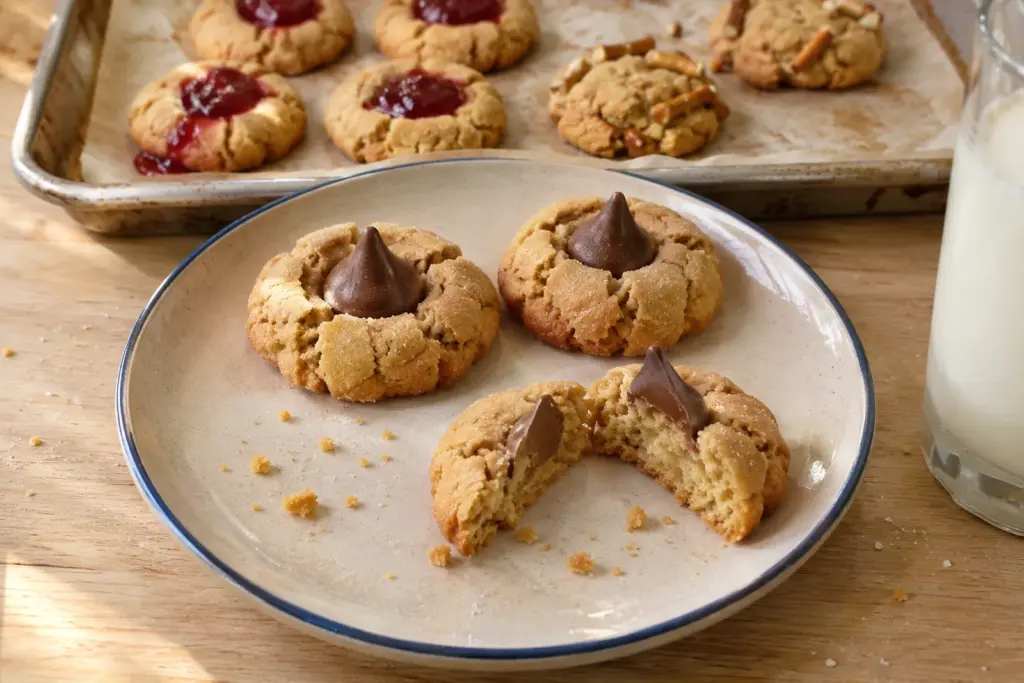
Peanut butter works as the fat, the flavor and, in the flourless doughs, most of the structure, which makes your first decision whether the cookie gets flour. Dough with flour bakes like any butter cookie, while the flourless kind stirs together in one bowl.
Ten of these 11 dessert recipes bake at 350°F (175°C), and only the Blossoms bake hotter, at 375°F (190°C), which means the Blossoms tray goes in before or after the other doughs rather than beside them.
Which Peanut Butter Cookie Should You Bake?
The flour question sorts these recipes faster than any flavor does, because it decides how much work the dough takes. The Blossoms, chunky pretzel, espresso, banana chia and salted caramel cookies use all-purpose flour and mix in two bowls, while the other six skip wheat flour and come together with a spoon.
Flour and butter give a firmer, more traditional crumb, and the flourless doughs bake into dense, tender cookies that crumble a little at the edge.
Bake times split the recipes into two groups, which helps when you plan two batches in one session.
- 8 to 10 minutes: the Blossoms, espresso, Nutella, spicy and vegan cookies.
- 10 to 12 minutes: the chunky pretzel, banana chia, salted caramel, PB&J, oatmeal and almond flour cookies.
The Nutella, spicy and vegan cookies take only six or seven ingredients, which gets them to the oven fastest, while the Blossoms and the salted caramel cookies ask for the most shaping.
What you need from the cookie usually points to one recipe.
- A cookie tray: the Peanut Butter Blossoms and the espresso drizzle cookies look finished without frosting.
- One bowl and a spoon: any of the flourless cookies, such as the PB&J thumbprints.
- No eggs or dairy: the vegan cookies use flax eggs and maple syrup.
- No wheat flour: the almond flour cookies, or the oatmeal cookies with oats labeled gluten-free.
Every recipe here needs the oven, and when you want peanut butter cookies without baking, chocolate peanut butter no-bake cookies boil the sugar, butter and cocoa on the stove and set without an oven.
Should You Use Natural or No-Stir Peanut Butter?
Peanut butter decides how far a cookie spreads, and loose oil is the part that changes it. America's Test Kitchen found that cookies made with the oily top layer of a natural jar spread too much, while the dry bottom layer made hard, stunted cookies (Cook's Illustrated).
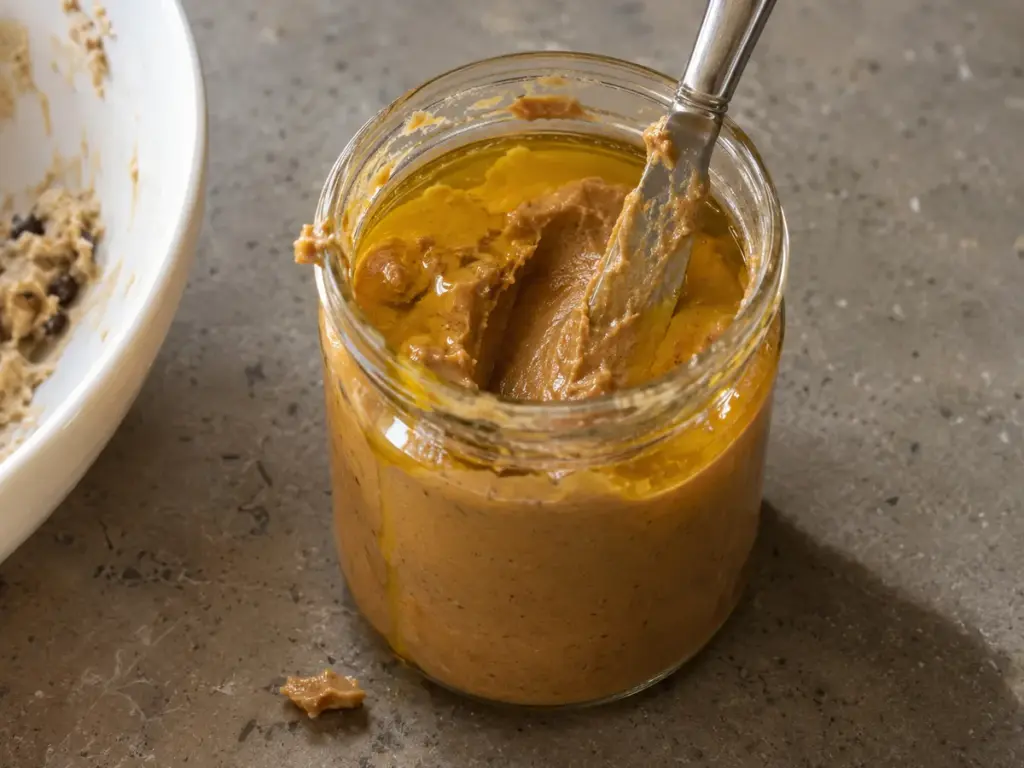
What separates the two kinds of jar is how much loose oil sits in them, and that oil goes into the dough along with the peanut butter you measure.
Natural peanut butter
The label lists peanuts and usually salt, and the dough tastes of roasted peanut.
Oil rises to the top, and you stir the whole jar smooth before you measure.
No-stir peanut butter
The oil stays blended in, and you can measure straight from the jar.
Most labels add a little sugar and a stabilizer oil, which makes the dough slightly sweeter.
Federal rules cap the fat in peanut butter at 55 percent and require any oil stabilizer to be hydrogenated vegetable oil (21 CFR 164.150), and that stabilizer is what keeps the oil blended in a no-stir jar.
Natural peanut butter mixes smooth when you work a knife up from the bottom of the jar, and the oil stays in because the doughs count on it. A spatula around the measuring cup gets the full amount into the bowl.
Either jar works in each recipe as long as you stir natural peanut butter first and measure right after stirring, which matters most in the flourless doughs because no flour is there to soak up extra oil.
Shiny, loose dough usually points to an under-stirred jar, and you chill the scooped balls until they are firm before baking. Where a list says creamy or crunchy, you can pick either, and crunchy leaves chopped peanuts in every bite.
Classic Peanut Butter Cookies Made With Flour
Butter and flour give the dough enough body to carry chocolate, caramel, pretzel pieces and banana, which makes these the cookies to bake when you plan to add things to the dough.
1. Peanut Butter Blossoms with Dark Chocolate Kisses
Peanut Butter Blossoms are sugar-rolled peanut butter balls with a dark chocolate kiss pressed into the center, and they look finished without any frosting. The dark kiss tastes less sweet than the milk chocolate one, which suits a dough that already holds 1 cup of sugar.
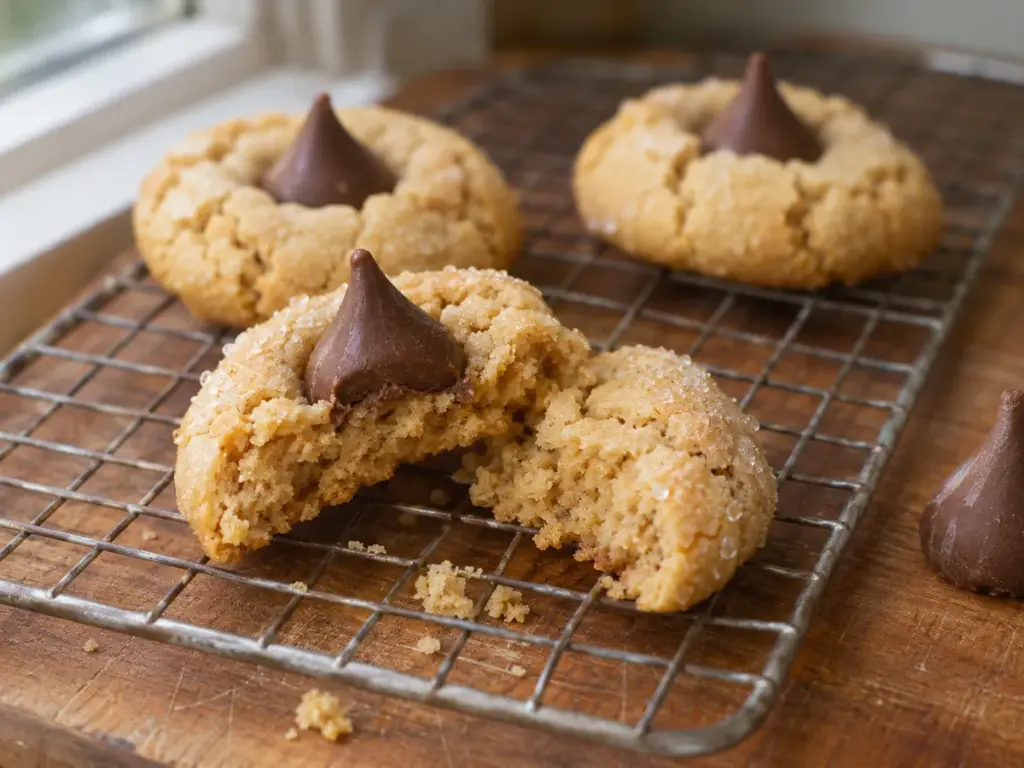
The kisses need to be unwrapped before the oven timer ends, because one pressed into each cookie the moment the tray comes out meets a hot cookie that softens the chocolate just enough to grip it and cracks into the ring that gives a blossom its look.
Granulated sugar from a shallow dish coats each ball and bakes into a thin, crackly shell.
If a ball sticks to your palms or flattens on the tray, the butter has softened in your hands, and a short chill in the refrigerator firms the dough before you roll the rest.
The 1-inch balls come out after 8 to 10 minutes, when the edges are set and the center still looks soft, and they finish setting on the hot sheet.
Because a soft kiss smears onto its neighbor, the chocolate has to harden before the cookies are stacked or packed, and a few minutes in the refrigerator speeds it up. Milk or white chocolate kisses make a sweeter cookie.
- ½ cup unsalted butter, softened
- ½ cup granulated sugar
- ½ cup packed brown sugar
- ½ cup creamy peanut butter
- 1 large egg
- 1 ½ teaspoons vanilla extract
- 1 ¼ cups all-purpose flour
- ¾ teaspoon baking soda
- ½ teaspoon salt
- Granulated sugar, for rolling
- About 36 dark chocolate kisses, unwrapped
- Heat the oven to 375°F (190°C) and line a baking sheet with parchment paper or a silicone mat.
- Beat the butter, granulated sugar and brown sugar until light and fluffy, then mix in the peanut butter, egg and vanilla, mixing well after each addition.
- Whisk the flour, baking soda and salt in a second bowl, then stir the dry mix into the wet mix until combined.
- Roll the dough into 1-inch balls, roll each ball in granulated sugar and set them 2 inches apart on the sheet.
- Bake 8 to 10 minutes, until the edges are lightly golden and the centers are still soft, then press a kiss into each cookie right away. Cool 5 minutes on the sheet, then move the cookies to a wire rack.
2. Chunky Peanut Butter Cookies with Pretzels and Milk Chocolate Chips
With ¾ cup of chopped pretzels and ¾ cup of milk chocolate chips folded into a butter and peanut butter dough, these are the chunkiest cookies on the list. The pretzels bring salt and crunch to a soft cookie, and the chips melt into small pockets.
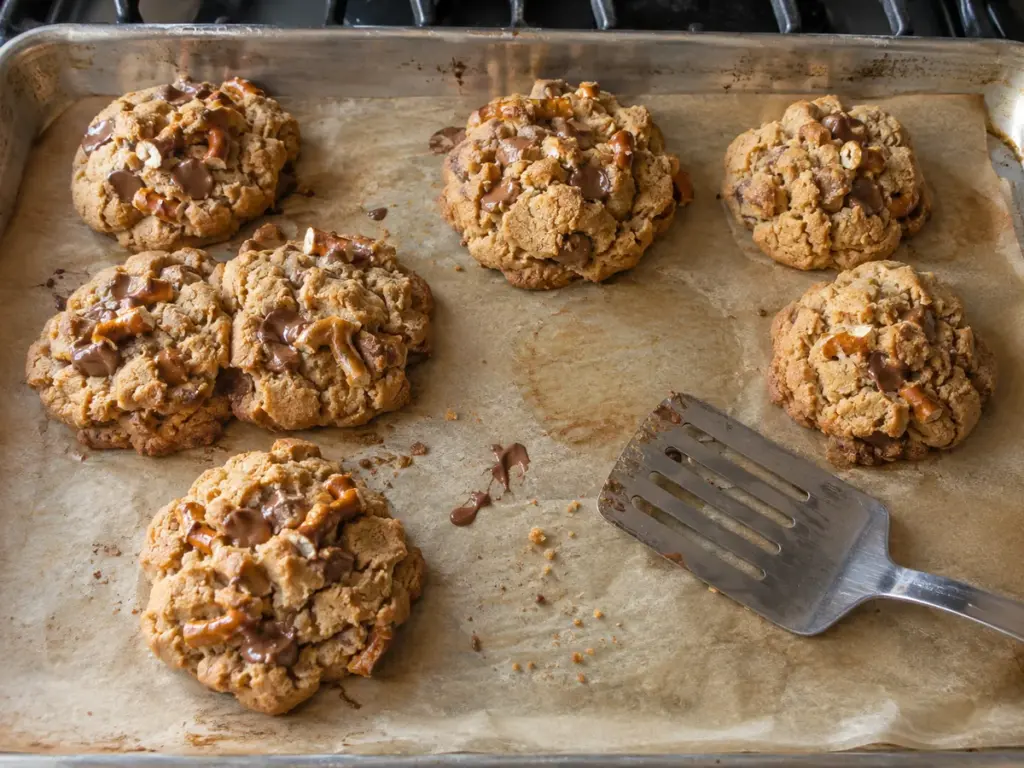
Coarse pieces about the size of the chocolate chips work best, because fine crumbs dissolve into the dough and whole pretzels split the cookie when you bite it.
Pretzel pieces soften as the cookies sit in a closed container, which is why the crunch is best on the day you bake them.
At 10 to 12 minutes the edges look just set and slightly golden, and the middles keep firming up on the sheet, while a few extra minutes in the oven give a dry, crumbly cookie.
The chocolate chips stay molten for a few minutes after baking, which is why the cookies set on the sheet before you lift one.
Dark chocolate chips make the cookie less sweet, and crushed salted nuts or crisp cereal replace the pretzels when you want a different crunch.
- 1 cup creamy peanut butter
- ½ cup unsalted butter, softened
- ¾ cup granulated sugar
- ¾ cup packed light brown sugar
- 1 large egg
- 1 teaspoon vanilla extract
- 1 ¼ cups all-purpose flour
- ½ teaspoon baking soda
- ¼ teaspoon salt
- ¾ cup chopped pretzels
- ¾ cup milk chocolate chips
- Heat the oven to 350°F (175°C) and line two baking sheets with parchment paper.
- Beat the butter, peanut butter, granulated sugar and brown sugar until smooth and creamy, then mix in the egg and vanilla.
- Whisk the flour, baking soda and salt together, then stir the dry mix into the wet mix until just incorporated.
- Fold in the pretzels and chocolate chips until they are spread evenly through the dough.
- Scoop rounded tablespoons of dough 2 inches apart and flatten each slightly with the back of a spoon.
- Bake 10 to 12 minutes, until the edges are just set and slightly golden. Let the cookies rest on the sheet for 5 minutes, then lift them onto a wire rack.
3. Peanut Butter Cookies with Espresso Powder and Dark Chocolate Drizzle
One teaspoon of espresso powder is small enough to sit behind the peanut flavor instead of in front of it, and 2 ounces of melted dark chocolate add a bitter edge to the ¾ cup of brown sugar.
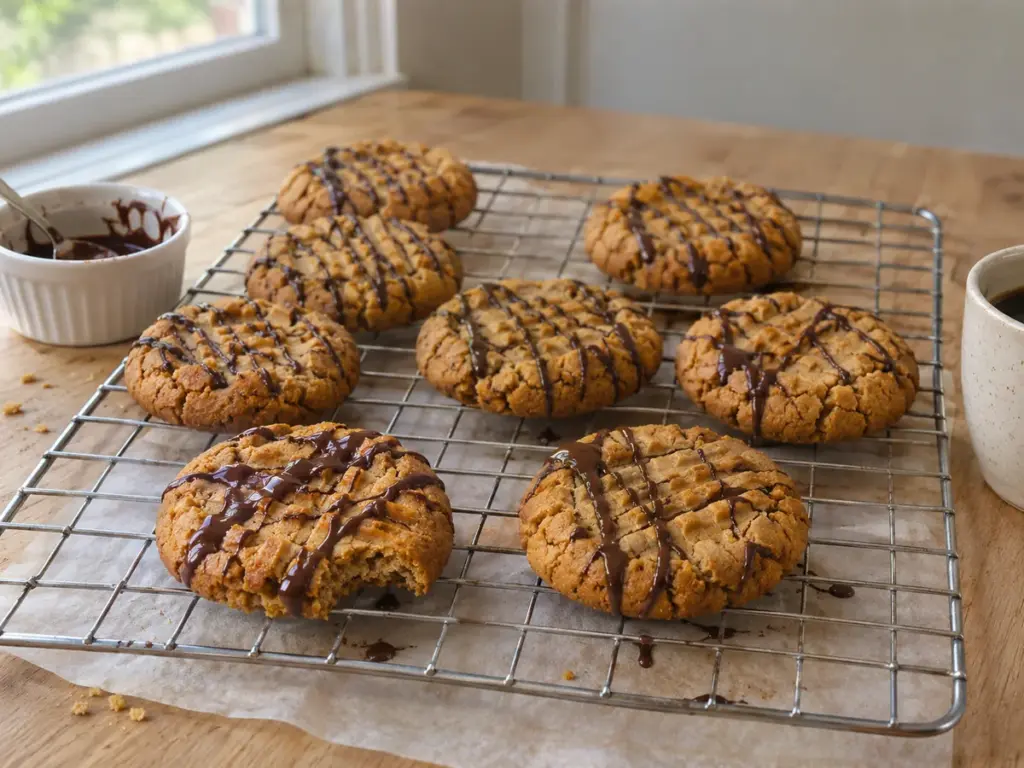
Chocolate drizzled on a warm cookie melts into the surface and leaves a smear instead of lines, which is why the cookies should be cool to the touch before the drizzle.
Espresso powder is finely ground coffee that dissolves instantly, and a teaspoon of instant coffee granules does the same job in this dough.
Short microwave bursts with stirring between melt the chocolate safely, and it comes out while a few pieces are still visible, because chocolate keeps its shape as it melts and scorches easily.
Chopped bar chocolate gives a smoother drizzle than chips, which are formulated to hold their shape, and semi-sweet or milk chocolate make a sweeter drizzle if dark tastes too bitter next to peanut butter.
- 1 cup creamy peanut butter
- ¾ cup packed brown sugar
- 1 large egg
- 1 teaspoon vanilla extract
- ¾ cup all-purpose flour
- ½ teaspoon baking soda
- ¼ teaspoon salt
- 1 teaspoon espresso powder
- 2 ounces dark chocolate
- Heat the oven to 350°F (175°C) and line a baking sheet with parchment paper or a silicone mat.
- Stir the peanut butter, brown sugar, egg and vanilla in a large bowl until smooth and well blended.
- Whisk the baking soda, salt, espresso powder and flour in a smaller bowl, then stir the dry mix into the wet mix just until combined.
- Scoop tablespoon portions 2 inches apart and flatten each slightly with a fork in a crisscross pattern.
- Bake 8 to 10 minutes, until the edges are set and lightly golden. After 5 minutes on the sheet, transfer the cookies to a wire rack to cool completely.
- Melt the chocolate in a heatproof bowl over simmering water or in the microwave in short bursts. Drizzle it over the cooled cookies with a spoon or a small piping bag and let it set.
4. Peanut Butter Banana Cookies with Chia Seeds
Mashed banana stands in for the butter and most of the sugar in this dough, which leaves no butter or granulated sugar, only ¼ cup of honey or maple syrup for sweetness.
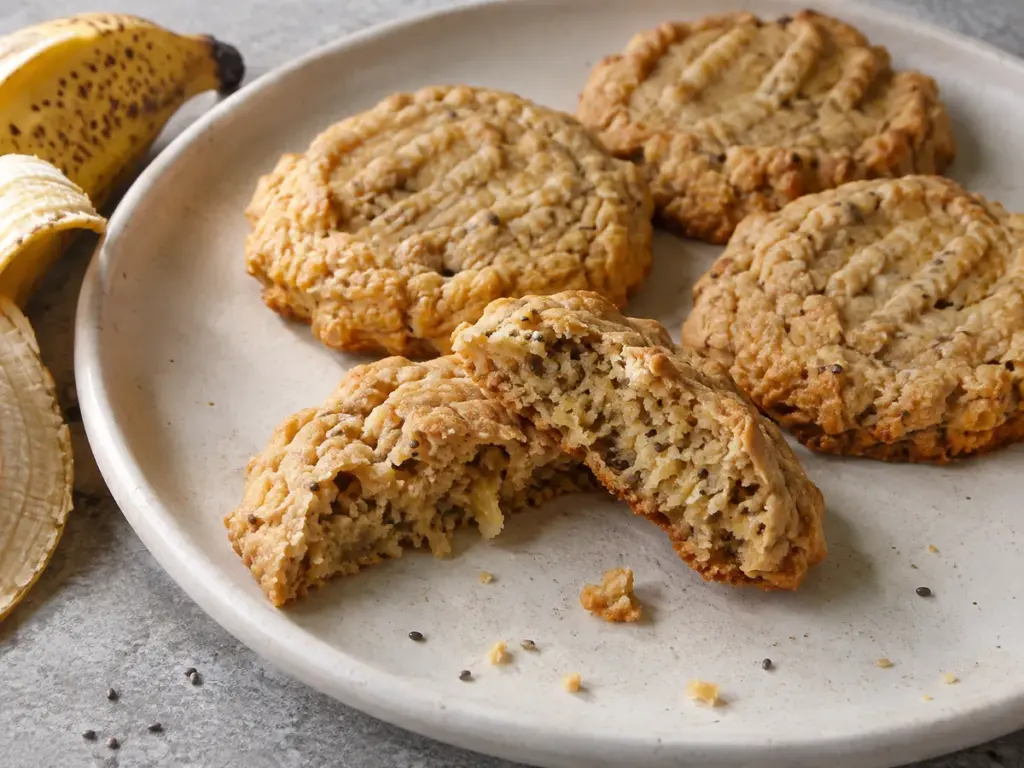
One cup of banana adds a lot of moisture and gives a soft, cake-like cookie closer to a muffin top than a crisp peanut butter cookie. Each scoop flattens with the back of a spoon instead of a hard fork press.
Bananas with brown freckles give the most sweetness, and you mash them until smooth to keep wet chunks out of the dough. You measure the mashed banana in a cup instead of counting bananas, because medium bananas vary in size.
Extra mixing builds gluten and makes a tough cookie, which is why the dry mix goes in just until the flour disappears.
The cookies are done when the edges are lightly golden and the tops look set, since a banana dough that leaves the oven too early stays gummy in the middle.
The banana and chia make these cookies work as a snack, and ground flaxseed can replace the chia. Oats can replace the flour in a banana and peanut butter dough too, as in peanut butter banana trail cookies with almonds and dried fruit.
Whatever is left after the first day can go into the freezer.
- 1 cup mashed ripe banana (2 to 3 medium bananas)
- ½ cup peanut butter, creamy or crunchy
- ¼ cup honey or maple syrup
- 1 large egg
- 1 teaspoon vanilla extract
- 1 cup all-purpose flour
- ½ teaspoon baking soda
- ¼ teaspoon salt
- 2 tablespoons chia seeds
- Heat the oven to 350°F (175°C) and line a baking sheet with parchment paper.
- Mix the mashed banana, peanut butter, honey, egg and vanilla in a large bowl until smooth.
- Whisk the flour, baking soda, salt and chia seeds in a separate bowl.
- Add the dry mix to the wet mix gradually, stirring just until combined.
- Scoop tablespoon portions 2 inches apart and flatten each slightly with the back of a spoon.
- Bake 10 to 12 minutes, until the edges are lightly golden. Cool a few minutes on the sheet, then move the cookies to a wire rack.
5. Salted Caramel Peanut Butter Cookies with Pretzel Crust
Caramel pieces sealed inside a 1 ½-inch dough ball make these the only cookies here with a caramel center, and the crushed pretzels give the outside a salty crunch.
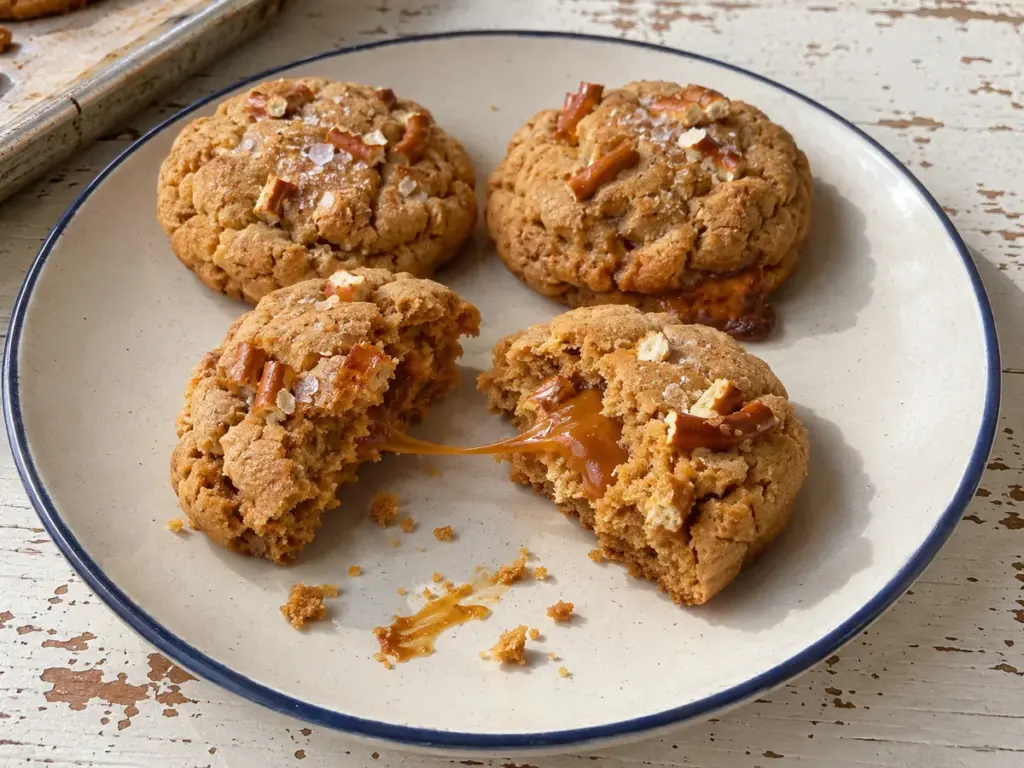
Caramel that leaks through a gap burns on the pan and welds the cookie to the sheet, which is why the dough has to seal completely around each piece.
Small caramel pieces, about the size of a chocolate chip, let a dough ball wrap around them without bulging.
Pretzels crushed in a zip-top bag with a rolling pin to pieces about the size of peas keep the crust crunchy instead of dusty.
The cookies stay on the sheet for the full 5 minutes, because the caramel inside stays hot long after the outside feels cool.
Gluten-free pretzels alone do not make this cookie gluten-free, because the dough also holds 1 ¼ cups of all-purpose flour. Vegan butter in place of the butter still leaves milk in most caramel bits, which is why you read the caramel label before you call the cookie dairy-free.
- 1 cup peanut butter, creamy or chunky
- ½ cup unsalted butter, softened
- 1 cup brown sugar, firmly packed
- ½ cup granulated sugar
- 2 large eggs, at room temperature
- 1 ¼ cups all-purpose flour
- ½ teaspoon baking soda
- ½ teaspoon salt
- 1 cup crushed pretzels, plus a few for the tops
- ½ cup salted caramel bits or caramel squares, chopped small
- Heat the oven to 350°F (175°C) and line a baking sheet with parchment paper.
- Cream the peanut butter, butter, brown sugar and granulated sugar until smooth and fluffy, then beat in the eggs one at a time.
- Whisk the flour, baking soda and salt together, mix the dry mix into the wet mix until just combined, then fold in the crushed pretzels.
- Roll the dough into balls about 1 ½ inches wide, flatten each one and press a few caramel pieces into the center. Fold the dough around the caramel and reshape the ball to enclose it.
- Set the cookies 2 inches apart and press a few crushed pretzels on top of each one.
- Bake 10 to 12 minutes, until the edges are golden and the centers are still soft. Leave the cookies on the sheet for 5 minutes, then slide them onto a rack to cool.
Peanut Butter Cookies Made Without Wheat Flour
Peanut butter plus an egg, oats or flax holds these doughs together, and each one mixes in a single bowl with a spoon. Because flourless dough is dense and spreads little, you press most of these cookies flat before they bake.
The Nutella and spicy cookies share one base of 1 cup of peanut butter, ¾ cup of sugar and 1 egg, plus baking soda and salt. Once you can make one, you can make the other.
6. Peanut Butter and Jelly Thumbprint Cookies
Each thumbprint cookie holds ½ teaspoon of jam in a dent pressed into the dough ball, which puts the salt of the peanut butter right next to the fruit. With only 1 cup of peanut butter, two sugars and an egg, and no flour at all, the dough comes together in one bowl.
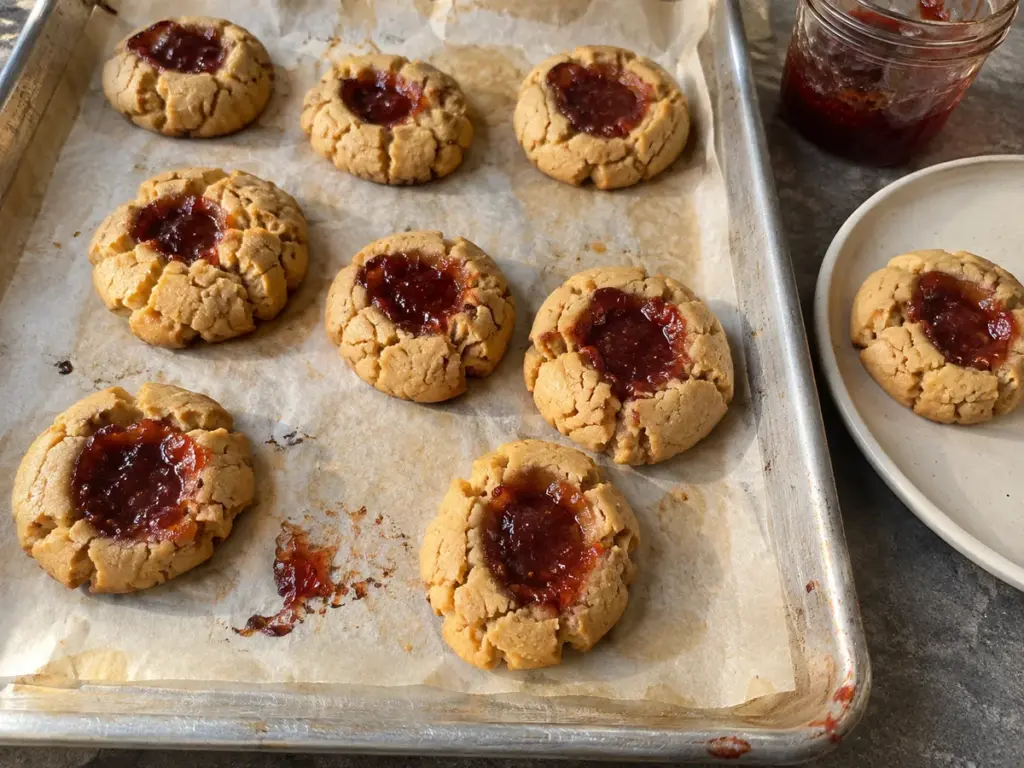
The dough cracks a little around the dent, which is normal, and the back of a small spoon makes a smoother dent than a thumb does.
More than that bubbles over and burns onto the parchment, and a thick jam or preserves stays put where thin jelly runs out of the dent.
Balls rolled to about a tablespoon of dough each give every dent the same amount of jam and bake at the same pace.
Jam stays hot and soft in the dent long after the cookie feels cool, which is why the tray gets its 5 minutes on the sheet before you lift anything.
Strawberry, raspberry and apricot all fit, and a tart jam such as raspberry balances the sugar in the dough better than sweet grape jelly, while a low-sugar preserve lowers the sweetness of the filling and leaves the dough with its 1 cup of sugar.
- 1 cup creamy peanut butter
- ½ cup granulated sugar
- ½ cup packed brown sugar
- 1 large egg
- 1 teaspoon vanilla extract
- ½ teaspoon baking soda
- ¼ teaspoon salt
- ⅓ cup fruit jelly or jam
- Heat the oven to 350°F (175°C) and line a baking sheet with parchment paper or a silicone mat.
- Mix the peanut butter, granulated sugar and brown sugar until smooth, then mix in the egg and vanilla.
- Stir in the baking soda and salt until evenly distributed.
- Roll tablespoon portions of dough into balls and set them 2 inches apart. Press your thumb or the back of a spoon into the center of each ball.
- Fill each dent with about ½ teaspoon of jam. Bake 10 to 12 minutes, until the edges are set and slightly golden. Wait 5 minutes before lifting the cookies from the sheet to a wire rack.
7. Peanut Butter Cookies Swirled with Nutella
A teaspoon of Nutella swirled into each scoop bakes into a marbled top, which puts chocolate-hazelnut flavor against peanut butter without a second dough.
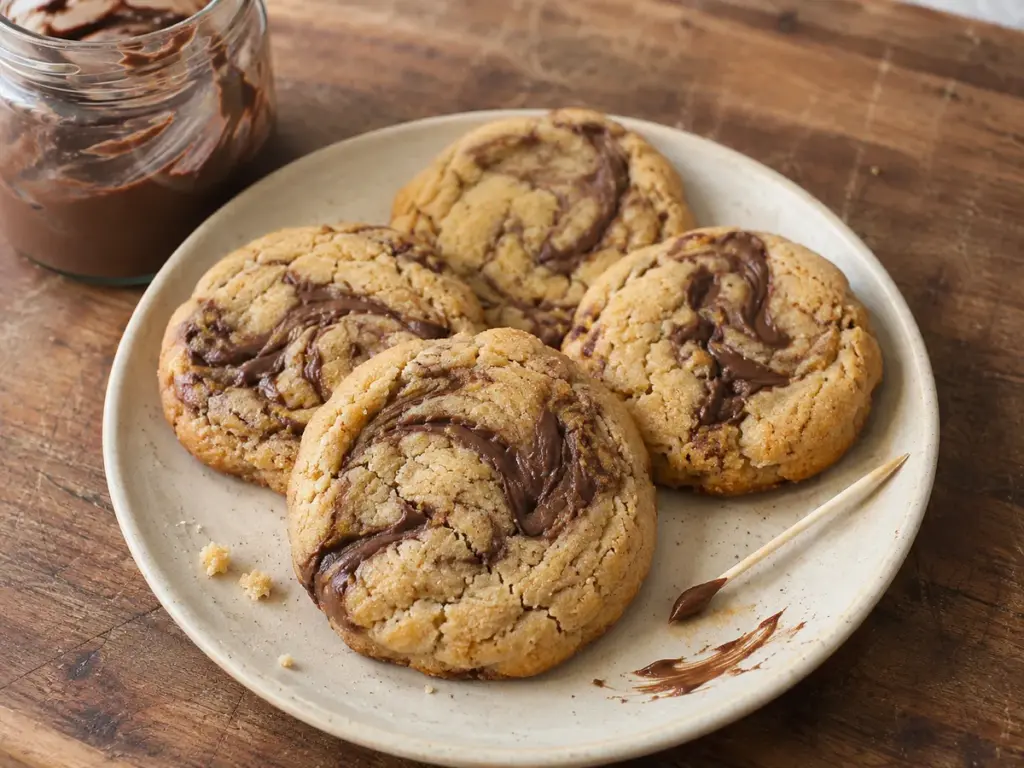
Two or three passes with the toothpick are enough, because more turns blend the spread into the dough and the marbling disappears.
The spread softens in the oven and sinks a little, which gives the cookies a glossy chocolate top that firms as it cools.
A ⅓ cup of Nutella is 16 teaspoons, which means you scoop 16 larger balls for a full teaspoon each, or stretch the spread to a scant ½ teaspoon on smaller scoops.
Any chocolate hazelnut spread works in the same amount, and a dairy-free spread leaves the dough as written, since the dough itself has no dairy.
Nutella contains hazelnuts and milk, which means a peanut-free swap for the peanut butter does not make this cookie nut-free.
- 1 cup creamy peanut butter
- ¾ cup granulated sugar
- 1 large egg
- ½ teaspoon baking soda
- ¼ teaspoon salt
- ⅓ cup Nutella, for swirling
- Heat the oven to 350°F (175°C) and line a baking sheet with parchment paper.
- Stir the peanut butter, sugar, egg, baking soda and salt in a bowl until a smooth dough forms.
- Scoop the dough in tablespoon-sized balls onto the sheet, 2 inches apart.
- Drop a teaspoon of Nutella on each ball and swirl it in with a toothpick or skewer.
- Bake 8 to 10 minutes, until the edges are set and the centers look slightly soft. Give the cookies 5 minutes to firm on the sheet, then move them to a rack.
8. Spicy Mexican-Inspired Peanut Butter Cookies with Cinnamon and Cayenne
A teaspoon of cinnamon and ¼ teaspoon of cayenne turn the plain flourless dough into a warm cookie, and because the cayenne spreads thin across a whole batch, the heat builds slowly after the cinnamon.
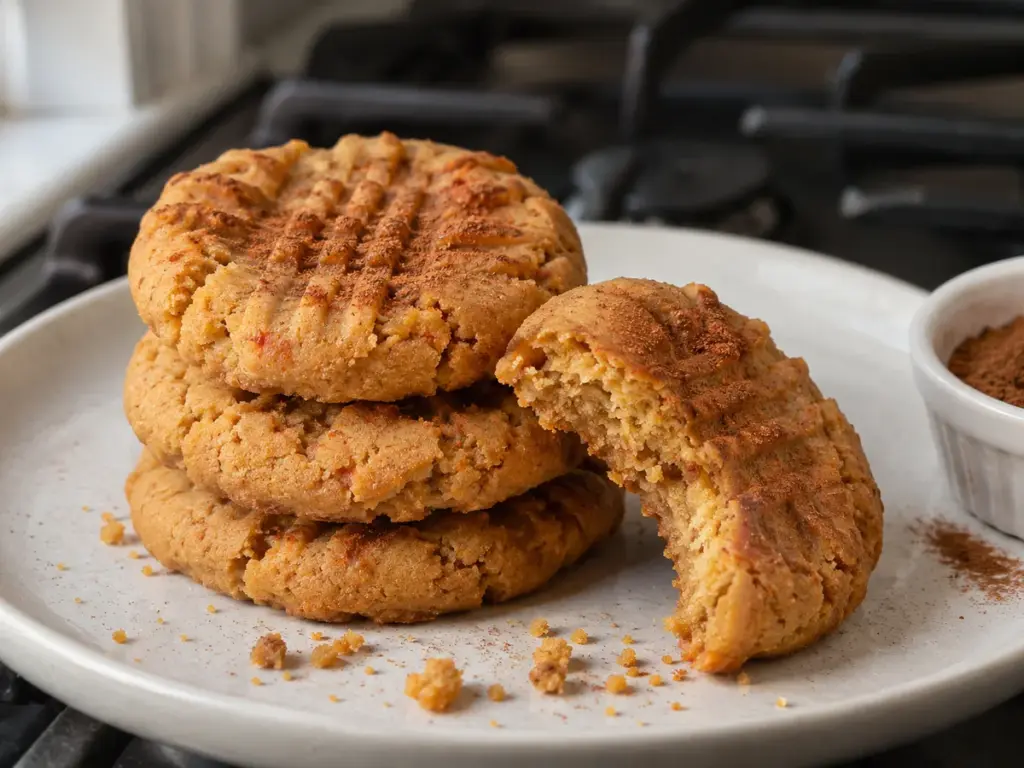
Cayenne clumps in a dense dough, which is why you stir until no red streaks remain before you scoop.
The same kind of dough also bakes in the air fryer, a few cookies at a time.
Cinnamon and chile are a pairing familiar from Mexican hot chocolate, and milk helps more than water if the cayenne turns out too hot.
Smoked paprika replaces the cayenne for a smoky note with less heat, and coconut sugar replaces the granulated sugar in the same amount for a caramel-like sweetness. You can raise or lower the cayenne a pinch at a time.
- 1 cup creamy peanut butter
- ¾ cup granulated sugar
- 1 large egg
- 1 teaspoon ground cinnamon
- ¼ teaspoon cayenne pepper
- ½ teaspoon baking soda
- ¼ teaspoon salt
- Heat the oven to 350°F (175°C) and line a baking sheet with parchment paper or a silicone mat.
- Combine the peanut butter, sugar and egg in a medium bowl and mix until smooth and creamy.
- Add the cinnamon, cayenne, baking soda and salt and stir until the dough is well incorporated.
- Scoop tablespoon portions and roll them into balls. Set them 2 inches apart and flatten each ball with the back of a fork in a crisscross pattern.
- Bake 8 to 10 minutes, until the edges start to turn golden. Set the tray aside for 5 minutes, then lift each cookie onto a cooling rack.
9. Peanut Butter Oatmeal Cookies with Honey and Sea Salt
Honey sweetens this dough in place of sugar, and 1 ½ cups of rolled oats stand in for flour, which gives chewy cookies from one bowl.
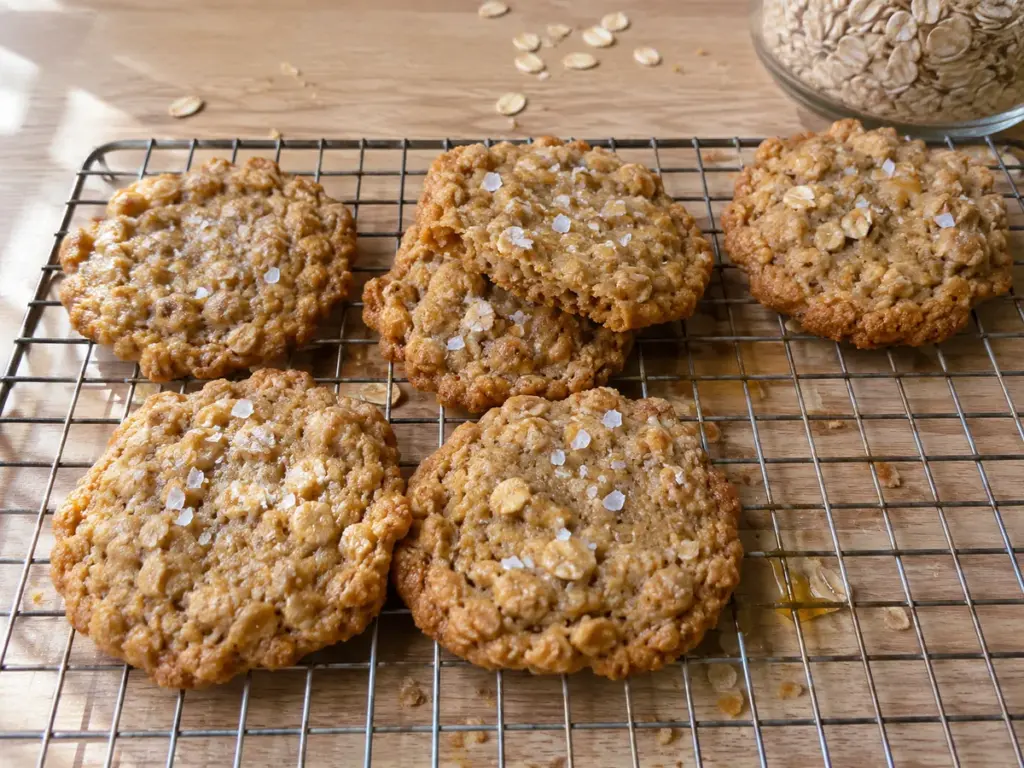
Old-fashioned rolled oats are flattened whole oat groats, while quick oats are cut smaller and soak up liquid faster, and a dough made with quick oats turns pasty and loses its chew.
Sea salt pressed onto each cookie before baking is the first thing you taste against the honey, and smoked sea salt adds a deeper, smoky contrast.
Honey holds moisture and browns quickly, which is why you pull the cookies when the edges are lightly golden and the centers still look soft.
Honey is the only sweetener and it sticks, and a sheet lined with parchment paper lets the cookies lift off cleanly once they have set for their 5 minutes.
Maple syrup replaces the honey for a different flavor, and the egg means the cookie is not vegan with either one.
Oats labeled gluten-free make the cookies gluten-free, since ordinary oats are often processed near wheat.
- 1 cup peanut butter, creamy or chunky
- 1 large egg
- ½ cup honey
- 1 teaspoon vanilla extract
- 1 ½ cups rolled oats
- ½ teaspoon baking soda
- ¼ teaspoon sea salt, plus extra for the tops
- Heat the oven to 350°F (175°C) and line a baking sheet with parchment paper.
- Mix the peanut butter, egg, honey and vanilla in a large bowl until smooth and combined.
- Stir in the oats, baking soda and sea salt until the oats are evenly distributed.
- Scoop tablespoon portions 2 inches apart, press each one gently flat and sprinkle a pinch of sea salt on top.
- Bake 10 to 12 minutes, until the edges are lightly golden and the centers are soft. Rest the cookies on the sheet for 5 minutes, then transfer them to a cooling rack.
10. Vegan Peanut Butter Cookies with Flax Eggs and Maple Syrup
Two flax eggs, ⅓ cup of maple syrup and 1 cup of peanut butter make a cookie with no eggs, dairy or flour, which suits vegan and egg-free baking.
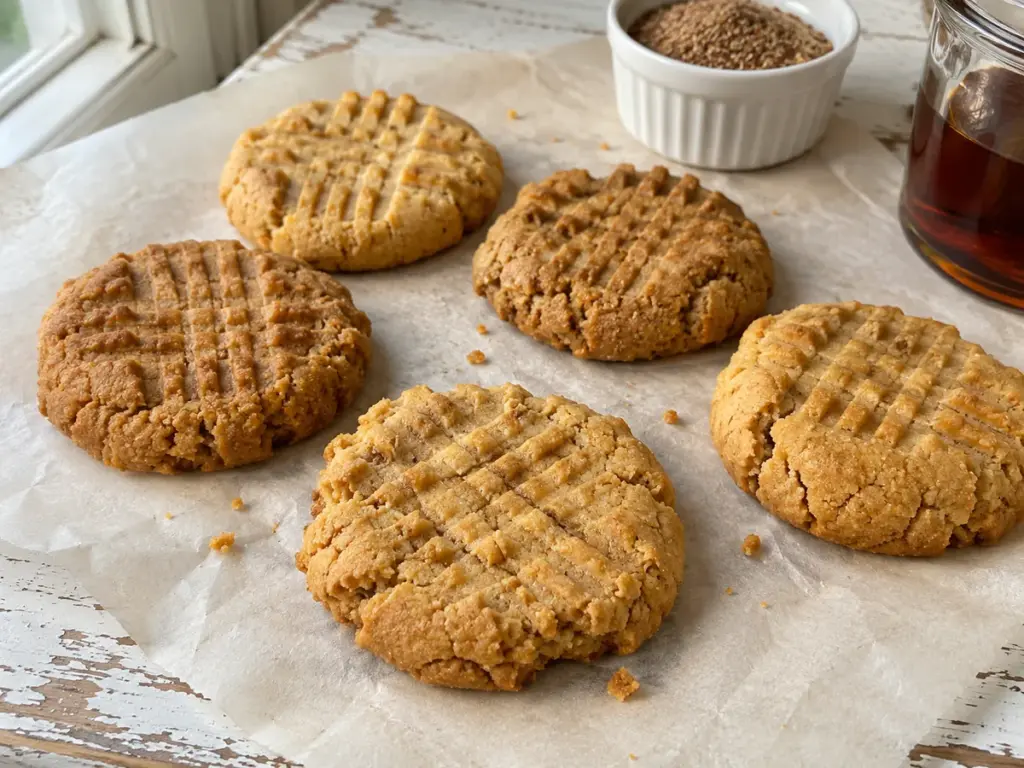
Flax eggs need about 5 minutes to thicken, which is why you stir the 2 tablespoons of ground flaxseed into 6 tablespoons of water first and let it sit while you measure the rest.
With no flour and no egg, the peanut butter supplies most of the structure. You stir the jar smooth, measure exactly and use pure maple syrup instead of pancake syrup.
The dough should hold a ball when you scoop it, and if it slumps because the flax gel is loose, chill the scoops briefly before you press them with the fork.
If you have chia seeds instead, you can make a chia egg from 1 tablespoon of seeds stirred into 3 tablespoons of water and left to gel, and you need twice that here.
Agave nectar or brown rice syrup can replace the maple syrup if you want a different sweetener.
- 1 cup peanut butter, creamy or crunchy
- ⅓ cup pure maple syrup
- 2 tablespoons ground flaxseed
- 6 tablespoons water
- 1 teaspoon vanilla extract
- ½ teaspoon baking soda
- ¼ teaspoon salt
- Heat the oven to 350°F (175°C) and line a baking sheet with parchment paper.
- Mix the ground flaxseed and water in a small bowl and let it stand about 5 minutes, until it thickens into flax eggs.
- Stir the peanut butter, maple syrup and vanilla together in a larger bowl, then stir in the flax eggs.
- Add the baking soda and salt and mix until the dough is smooth and well combined.
- Scoop tablespoons of dough 2 inches apart and flatten each cookie gently with a fork in a crisscross pattern.
- Bake 8 to 10 minutes, until the edges are lightly golden. Cool the cookies on the sheet for 5 minutes before moving them to a rack.
11. Gluten-Free Peanut Butter Cookies with Almond Flour and Coconut Sugar
Almond flour takes the place of wheat flour in this dough, and coconut sugar adds a caramel-like sweetness, which leaves nothing in the dough that is wheat. Coconut sugar still counts as sugar, and brown sugar replaces it by weight, about 77 g for the ½ cup, which is a little over ⅓ cup packed.
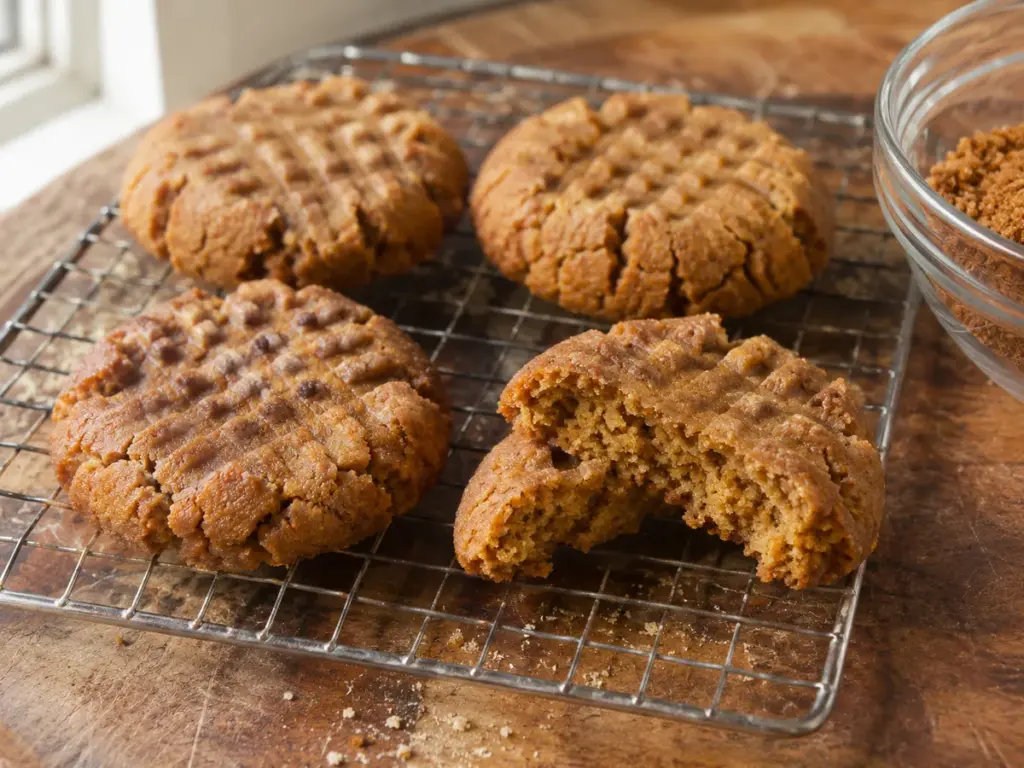
Almond flour has no gluten, which leaves the egg and the peanut butter to do the binding and makes a thick dough, and that is why you press each ball flat with a fork.
Finely ground almond flour gives a smooth crumb, while coarse almond meal leaves a gritty one, and the cookies are fragile when warm and stay on the sheet for the full 5 minutes.
Gluten-free here depends on every ingredient label, which means you check the peanut butter and vanilla, and buy almond flour labeled gluten-free if you bake for someone with celiac disease.
Granulated sugar replaces the coconut sugar by weight too, and the cookie stays gluten-free.
A flax egg made from 1 tablespoon of ground flaxseed and 3 tablespoons of water replaces the egg for a vegan cookie, and cashew or hazelnut flour can replace the almond flour in the same amount for a different nutty flavor.
- 1 ½ cups almond flour, finely ground
- ½ cup coconut sugar
- ½ cup peanut butter with no added sugar, creamy or crunchy
- 1 large egg
- ½ teaspoon baking soda
- ½ teaspoon vanilla extract
- ¼ teaspoon salt
- Heat the oven to 350°F (175°C) and line a baking sheet with parchment paper.
- Mix the almond flour, coconut sugar, baking soda and salt in a medium bowl.
- Add the peanut butter, egg and vanilla and stir until a thick dough forms.
- Scoop tablespoon portions and roll them into balls, then set them on the sheet and press each one with a fork in a crisscross pattern.
- Bake 10 to 12 minutes, until the edges are lightly golden and the centers are still soft. Once 5 minutes have passed, lift the cookies onto a wire rack to finish cooling.
What Swaps Work in Peanut Butter Cookies?
Most swaps change how the dough behaves, which is why you start with the same amount and watch the first tray before you bake the rest.
| Replace | With | Amount | What changes |
|---|---|---|---|
| Peanut butter | Sunflower seed butter | Same amount | Cookies can turn green with baking soda |
| Peanut butter | Soy nut butter | Same amount | Contains soy, which the label shows |
| Peanut butter | Almond or cashew butter | Same amount | Tree nuts, a separate allergen |
| All-purpose flour | Cup-for-cup gluten-free blend | Same amount | Gluten-free only if every other label is |
| Coconut sugar | Brown sugar | Same weight | A cup of brown sugar weighs more than a cup of coconut sugar |
| Egg | Flax egg | 1 tablespoon flaxseed plus 3 tablespoon water | Let it gel 5 minutes first |
| Honey | Maple syrup | Same amount | Flavor changes, egg stays |
| Butter | Softened coconut oil | Same amount | Check chips and caramel for milk |
Which Peanut Butter Replacement Is Safe for a Nut Allergy?
Almond butter and cashew butter are tree nuts, which the FDA lists as a separate major allergen from peanuts, and they suit a peanut-only allergy only when an allergist has cleared tree nuts and the label shows no shared-equipment warning (FDA).
Sunflower seed butter and soy nut butter are two peanut butter replacements that swap in measure for measure for a household that avoids all nuts. Sunflower butter can turn the baked cookies green, because a compound in sunflower seeds reacts with the baking soda (Chapman University).
How Do You Cut the Sugar in Peanut Butter Cookies?
Sugar affects spread and browning as well as sweetness, and the keto recipe among peanut butter cookies made with erythritol spreads so little that the fork marks stay sharp, which means you press every scoop flat before it bakes.
How Do You Make the Flour Cookies Gluten-Free?
A cup-for-cup gluten-free flour blend replaces the all-purpose flour in the Blossoms, chunky, espresso, banana and salted caramel doughs, and the chunky and salted caramel cookies also need gluten-free pretzels. You need to check every label, since a recipe is gluten-free only when every ingredient is.
How Do the Ingredients Change a Peanut Butter Cookie?
Each ingredient in these doughs does a separate job, and knowing which one you are changing tells you what the cookie will do.
- Brown sugar holds moisture, and doughs with more of it bake softer and chewier.
- Granulated sugar dries as it bakes, and cookies built on it spread and crisp at the edge.
- Egg binds the dough, and in the flourless cookies it is what holds the peanut butter together.
- Baking soda raises browning and gives a slight lift.
The sugar split shows up in the recipes: the espresso cookies use only brown sugar, while the Nutella and spicy cookies use only granulated sugar.
Why Do Peanut Butter Cookies Turn Out Crumbly, Flat or Hard?
Most peanut butter cookie problems trace back to how much oil the dough holds and how long the tray stays in the oven.
- Crumbly: the dry bottom of a natural jar went into the dough, or the cookies baked past set edges.
- Flat and greasy: loose oil from an under-stirred jar, or butter that was too soft.
- Hard: baked until the centers looked done, when they should still look soft.
- Cracked tops: normal in flourless and sugar-rolled dough.
A dough that behaves badly at the first tray can still be saved: stir the jar before the next batch, chill the scoops, and shorten the bake by a minute while you watch the edges.
Three habits prevent most of those problems:
- One size: scoop every cookie to 1 tablespoon, which is what the recipes assume, and give a larger cookie a minute or two more.
- A true oven: an oven thermometer shows whether the dial temperature is real, since a hot oven browns bottoms before centers set.
- Pan color: dark pans tend to brown cookie bottoms sooner, and checking them a minute early helps.
How Do You Bake and Store Peanut Butter Cookies?
Peanut butter dough spreads little, which is why the recipes press each scoop flat, and a fork pattern also keeps thick cookies from baking pale in the middle and dark at the edge.
One sheet at a time goes on the middle rack, lined with parchment paper or a silicone mat because the sugar in these doughs sticks to a bare pan. Between batches the sheet needs to cool, since dough balls set on a hot pan start to melt and spread before they bake.
Once the edges are set and the centers still look soft, the tray can come out, because peanut butter cookies keep firming while they cool on the sheet, which is why every recipe waits 5 minutes before moving them.
Do not taste the dough, since the FDA says raw flour and raw eggs can carry bacteria and baking is what kills them. The vegan cookies are the only dough here with neither flour nor egg.
Once the cookies are cool, you have three storage choices.
- Airtight container: keeps the cookies soft.
- Freezer, baked: layer with parchment, and the USDA FoodKeeper lists soft cookies at 8 to 12 months for best quality.
- Freezer, dough: freeze scooped balls on a tray, then bag them, and FoodKeeper lists cookie dough at 2 months.
Frozen dough balls bake without thawing, and you pull the tray when the edges look set, which takes a little longer than the recipe time.
Which Peanut Butter Cookies Travel Best in a Gift Box?
Plain-topped cookies pack differently from filled ones, and the packing should match the cookie.
- Layers with parchment: chunky pretzel, oatmeal, almond flour and vegan cookies.
- Single layer: Blossoms, thumbprints, Nutella swirls, drizzled and salted caramel cookies, until the chocolate, jam or caramel sets.
Sources
- Cook's Illustrated: baking with natural peanut butter
- FDA: flour is a raw food and other safety facts
- FDA: food allergies
- USDA FoodKeeper
- Chapman University: green color in sunflower seed cookies
- 21 CFR 164.150: peanut butter

Andrew Gray is a seasoned food writer and blogger with a wealth of experience in the restaurant and catering industries. With a passion for all things delicious, Andrew has honed his culinary expertise through his work as a personal chef and caterer.
His love for food led him to venture into food writing, where he has contributed to various online publications, sharing his knowledge and insights on the culinary world. As the proud owner of CooksCrafter.com, Andrew covers a wide range of topics, including recipes, restaurant reviews, product recommendations, and culinary tips.
Through his website, he aims to inspire and educate fellow food enthusiasts, offering a comprehensive resource for all things food-related.