Short Answer
Puff pastry appetizers start with one thawed sheet of store-bought pastry and a 400°F oven.
- These 15 run from caprese bites that bake in 10 to 12 minutes to onion tartlets that need 30 to 40 minutes of caramelizing first.
- Make the prosciutto and fig pinwheels first if you want a tray you can roll and chill ahead and bake in 15 to 18 minutes.
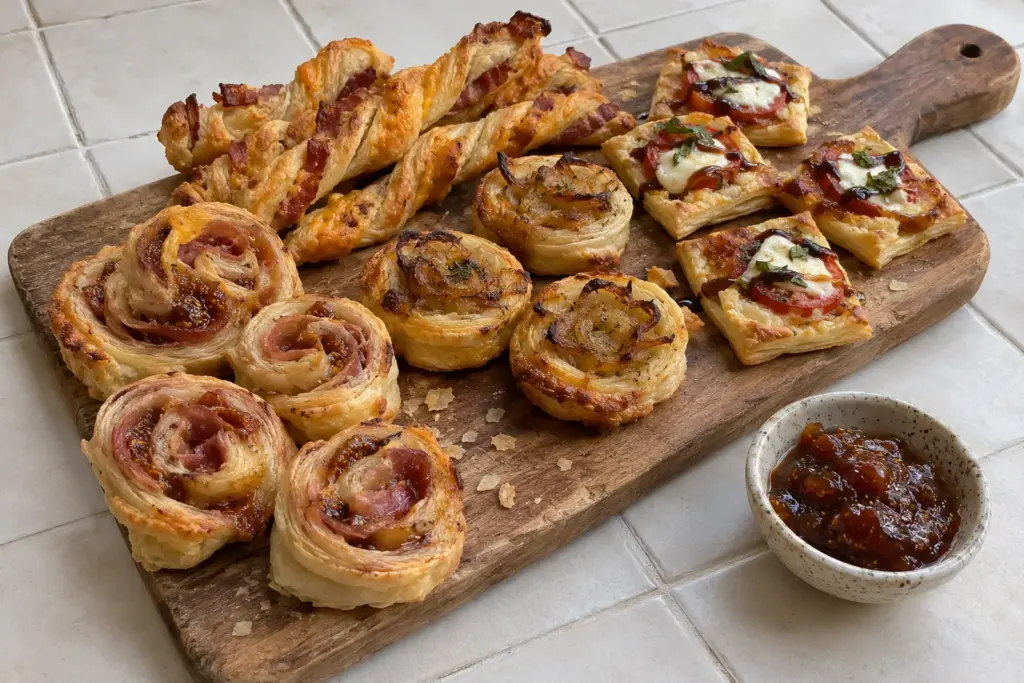
These hot starters and side dishes only puff when you bake them from cold, because butter between thin layers of dough turns to steam in a hot oven and lifts the layers apart. Rolled logs wait in the fridge until the oven is hot, and tartlets with a wet filling are best assembled just before baking.
1 How Do You Get Puff Pastry to Puff?
Thaw one sheet in the fridge for about 4 hours, covered in plastic wrap, or leave it on the counter for no more than 40 minutes until it unfolds without cracking, which is Pepperidge Farm's own guidance.
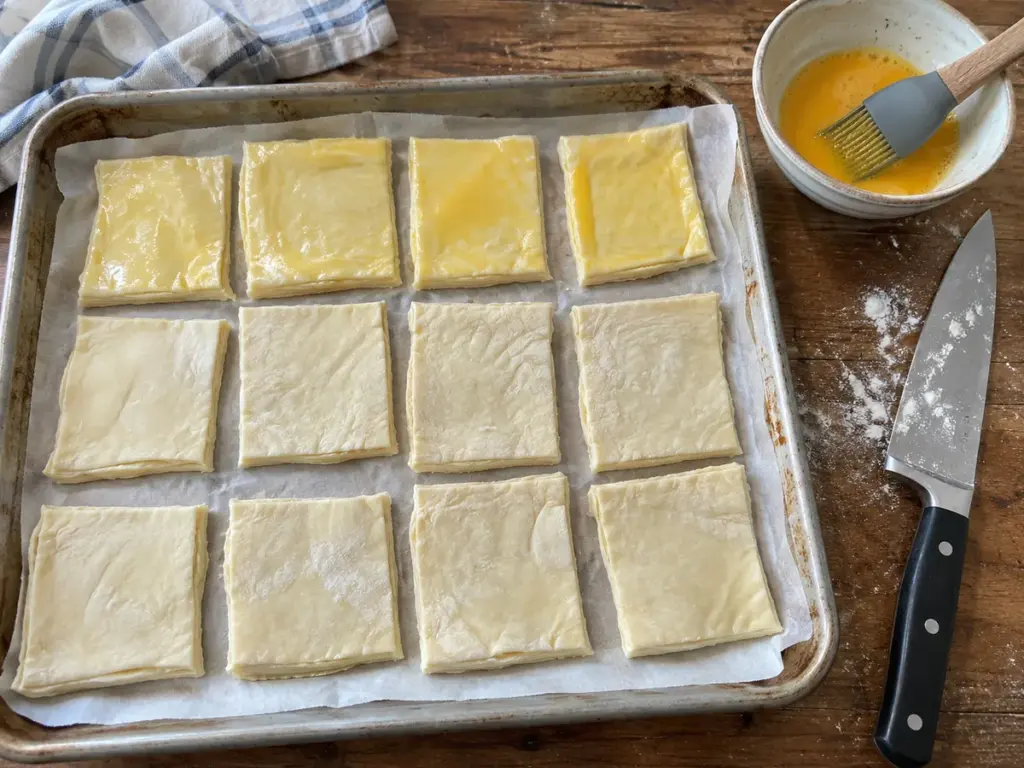
Puff pastry is a laminated dough: butter is folded into a lean dough again and again until the sheet holds hundreds of thin layers. Pepperidge Farm says it can rise up to 8 times its thickness, and a sheet rolled to ¼ inch climbs about 2 inches in the oven.
Keep cut shapes on the chilled pan in the fridge until the oven is ready, and preheat the oven for at least 15 to 20 minutes.
King Arthur Baking explains the reason: solid pieces of butter keep the dough in separate layers, then melt in the oven while their water turns to steam and leaves air pockets between the layers.
Roll only to the size each recipe gives.
A sheet that is warm and sticky when it reaches the oven bakes flat and greasy, so if the pastry softens while you work, put it back in the fridge for a few minutes.
- Brush the tops with one egg beaten with 1 teaspoon of water for a golden shine, and brush the flat top lightly, because egg that runs down the sides glues the layers together and stops the rise.
- If you prick the dough all over with a fork, steam escapes and the base bakes flat and crisp, which suits the tartines and caprese bites and would ruin a pinwheel.
- Cut with a sharp knife or a pizza wheel straight down in firm strokes without dragging the blade, as Pepperidge Farm advises, so the layers are not pressed shut along the cut.
- Bake on the middle rack, and if your oven has hot spots, turn the pan front to back halfway through.
- Look for deep golden tops and a dry, firm center, since a pale middle is still raw dough and turns gummy as the pastry cools.
Fillings go on cool and dry. A hot filling melts the butter in the layers before the oven does, and wet vegetables such as spinach, mushrooms and eggplant steam the underside of the pastry until it turns pale and soft, so you cook the water out of those fillings first.
Crescent roll dough swaps in at the same amount for pinwheels and twists but bakes soft and bready, and phyllo crisps only when melted butter is brushed between its sheets, so the puff pastry stand-ins change the texture of every recipe here.
2 Which Puff Pastry Appetizer Should You Make?
The work you do before the pastry goes in separates these recipes more than the fillings do: eight need a filling cooked first, four need a rolled log chilled, and three go straight from cutting to the oven or to the topping. Ten of the 15 contain no meat or fish, which leaves out the prosciutto, sausage, smoked salmon, chicken and bacon recipes.
Here is what each group needs before the pastry goes in:
- Cook the filling first (8): spinach (3 to 4 minutes), mushrooms (about 7), sausage and apple, bacon, the chicken sauce for the vol-au-vents, onions (30 to 40 minutes), asparagus (blanched 1 to 2 minutes) and eggplant (roasted 15 to 20 minutes).
- Chill a rolled log (4): prosciutto and fig pinwheels, brie and raspberry rolls and pesto pinwheels need 15 minutes; smoked salmon palmiers need 20.
- Nothing before the oven (3): goat cheese tartines and caprese bites bake bare and get their topping afterward, and the apple, brie and honey bites go in assembled.
Each recipe uses one sheet, so a party menu of three or four of them takes two boxes. If you pair one rolled log such as the pesto pinwheels, which waits in the fridge until the oven is hot, with one bake-then-top recipe such as the caprese bites, the only stove work is the filling for whichever pocket or tartlet you add.
If you are matching the tray to an occasion, these groups suit it best:
- Brunch: smoked salmon palmiers, asparagus and Parmesan tartlets, spinach and feta bites
- Cocktail party: prosciutto and fig pinwheels, caprese bites, caramelized onion tartlets
- Fall and holiday tables: brie and raspberry rolls, sausage and apple bites, apple, brie and honey bites
- Potluck or travel: pesto and sun-dried tomato pinwheels, which taste good warm or at room temperature
3 Which Appetizers Are Rolled Into Pinwheels and Palmiers?
Prosciutto and fig, brie and raspberry, pesto and sun-dried tomato, and smoked salmon with dill cream cheese all work as rolled appetizers, because a tight log chilled until firm slices into rounds that bake with the spiral showing. Roll the log from a long side with the seam on the bottom, then slice it with a sharp knife in a sawing motion, since a dull blade squashes the layers you just built.
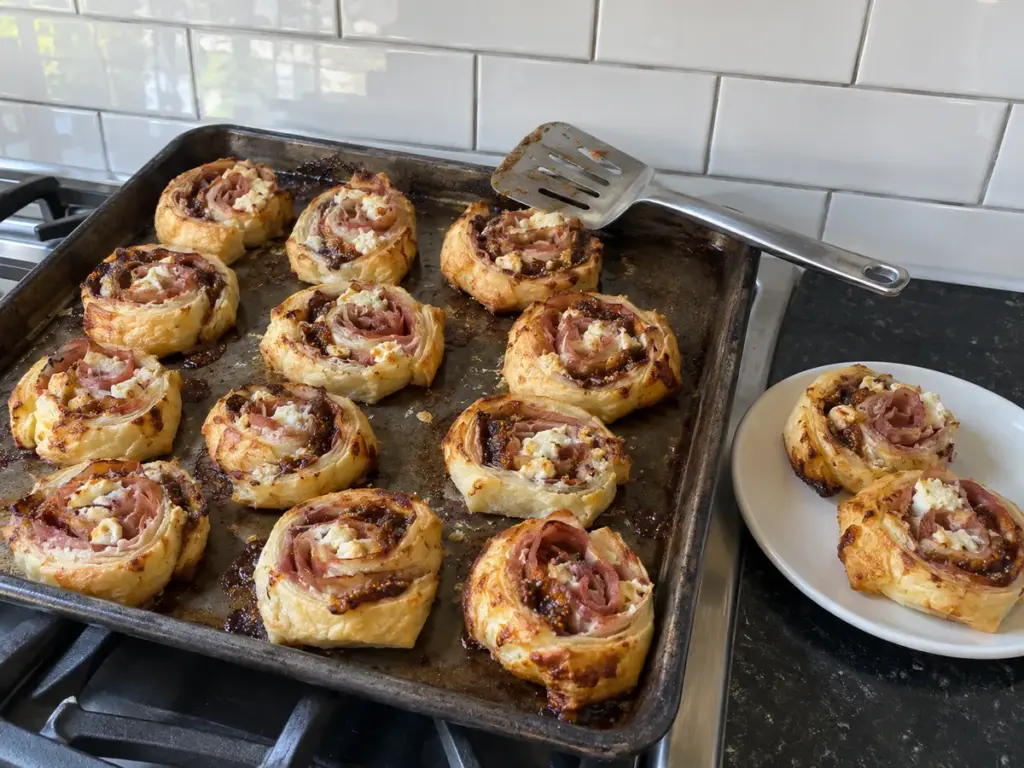
1. Prosciutto and Fig Jam Pinwheels
Salty prosciutto, sweet fig jam and tangy goat cheese give each slice three flavors, and prosciutto is cured and ready to eat, so your only cooking is the oven time. Chill the log for 15 minutes before you slice it, which keeps the goat cheese from smearing across the cut edge.
Spread the goat cheese in a thin layer, because a thick one squeezes out of the ends as the roll bakes, and pull the pan when the spirals are golden through the center.
Ingredients (for about 18 pinwheels, baked at 400°F for 15 to 18 minutes)
- 1 sheet puff pastry, thawed
- 4 ounces goat cheese, softened for easy spreading
- 3 tablespoons fig jam
- 4 ounces thinly sliced prosciutto
- 1 egg beaten with 1 teaspoon water
Instructions
- Heat the oven. Preheat to 400°F and line a baking sheet with parchment.
- Fill the pastry. Roll the pastry to about 10 by 12 inches, spread the goat cheese in a thin layer with a ½-inch border, dot the jam over it and cover with the prosciutto.
- Roll and chill. Roll the pastry tightly from a long side into a log, wrap it and chill it for 15 minutes.
- Slice. Cut the log into about 18 rounds, ½ inch thick, set them cut side up on the pan and brush with egg wash.
- Bake. Bake 15 to 18 minutes until puffed and golden, then let them cool for a few minutes.
Swaps
- Thin-sliced deli ham or turkey takes the prosciutto's place for a milder, leaner roll.
- Apricot or raspberry jam goes on in the same 3 tablespoons, dotted over the cheese the way the fig jam is, and the fig jam stand-ins page lists more options.
- Cream cheese or ricotta can stand in for the goat cheese, spread in the same thin layer once softened, and ricotta should be drained first.
2. Brie and Raspberry Rolls
Raspberries are the risk in this one. A berry that bursts inside the roll leaks juice into the pastry and turns the layers gummy, so rinse them, pat them dry and scatter them whole between thin slices of brie.
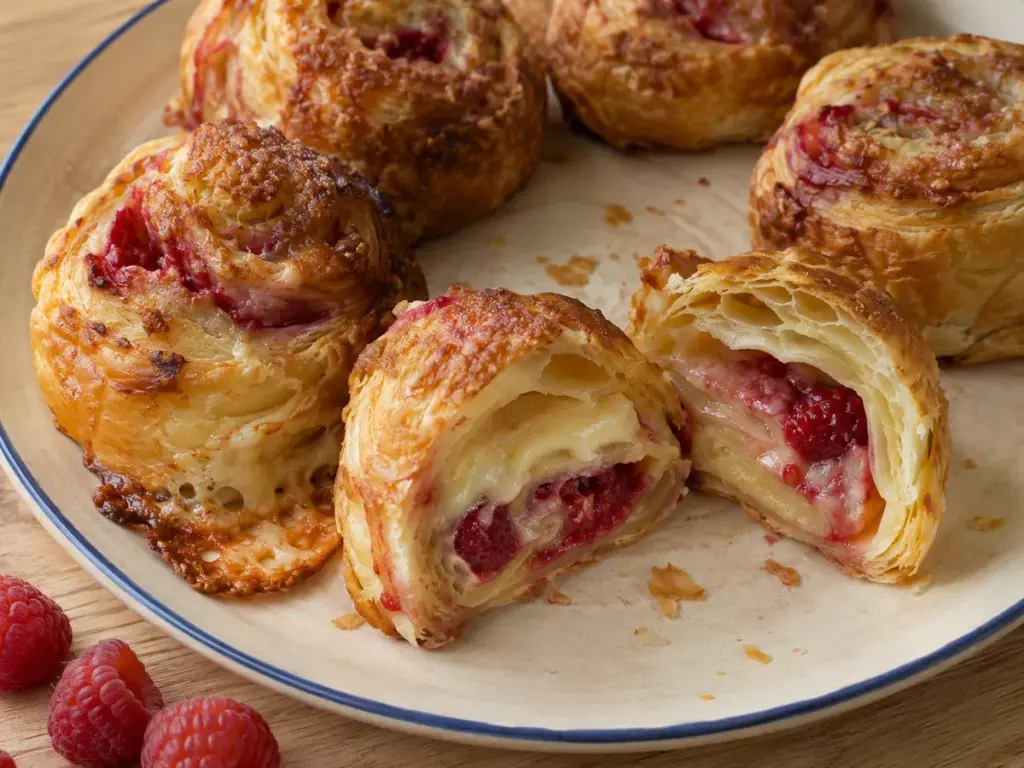
The rind is edible and melts with the cheese, so the slices need no trimming.
Ingredients (for about 10 rolls, baked at 400°F for 15 to 18 minutes)
- 1 sheet puff pastry, thawed
- 6 ounces brie, thinly sliced
- ½ cup fresh raspberries, rinsed and patted dry
- 1 teaspoon lemon zest
- 1 egg beaten with 1 teaspoon water
- 2 tablespoons granulated sugar for sprinkling (optional)
Instructions
- Heat the oven. Preheat to 400°F and line a baking sheet with parchment.
- Layer the filling. Roll the pastry to about 10 by 12 inches, lay the brie slices over it with a ½-inch border, then scatter the raspberries and lemon zest on top.
- Roll and chill. Roll from a long side into a log, press the seam closed and chill 15 minutes.
- Slice and wash. Cut 1-inch rolls (about 10), set them cut side down on the pan, brush with egg wash and sprinkle with sugar.
- Bake. Bake 15 to 18 minutes until puffed and golden, and let the rolls cool slightly so the cheese settles.
A 15-minute chill keeps the brie from oozing out before the pastry sets, and the sugar-topped rolls are ready when they are deep golden all over.
Swaps
- Camembert goes in at the same 6 ounces and tastes more earthy, and the brie cheese swap page lists other options.
- A mild goat cheese in the brie's place makes a tangier filling, sliced or crumbled thinly across the pastry.
- Blueberries, blackberries or chopped apple can replace the raspberries, but berries need the same rinse-and-dry step, because their juice is what turns the layers gummy.
- Honey or maple syrup, drizzled over the rolls once they are out of the oven, takes the place of the sugar sprinkle on top.
3. Pesto and Sun-Dried Tomato Pinwheels
Pesto is mostly oil, so a thick coat slides out of the roll and leaves the pastry greasy. Spread it thin, press oil-packed sun-dried tomatoes dry on a paper towel before chopping them, and the pinwheels stay crisp underneath.
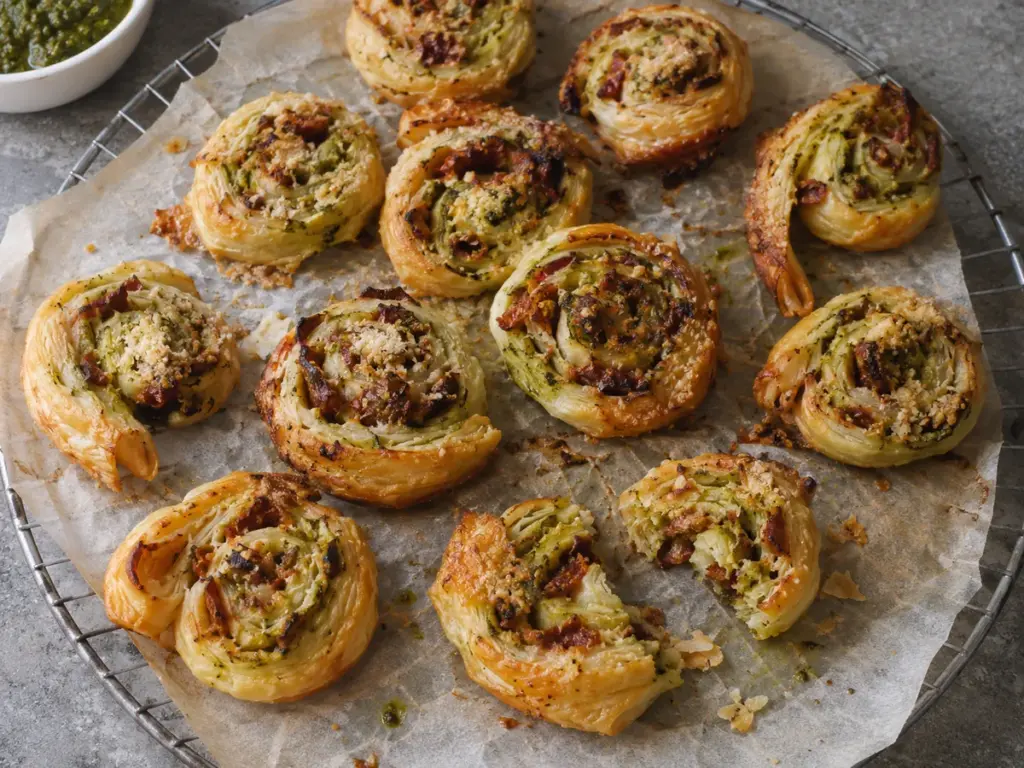
Parmesan scattered over the pesto adds salt, and the tomatoes add a tart note that keeps the basil from tasting flat.
Ingredients (for about 20 pinwheels, baked at 400°F for 12 to 15 minutes)
- 1 sheet puff pastry, thawed
- ¼ cup basil pesto, store-bought or homemade
- ⅓ cup oil-packed sun-dried tomatoes, drained, patted dry and finely chopped
- ¼ cup grated Parmesan (optional)
- ¼ teaspoon black pepper
- 1 tablespoon olive oil for brushing
Instructions
- Heat the oven. Preheat to 400°F and line a baking sheet with parchment.
- Spread and top. Roll the pastry to about 10 by 12 inches, spread the pesto thinly with a ½-inch border, then sprinkle on the tomatoes, Parmesan and pepper.
- Roll, chill and cut. Roll tightly from a long edge, chill the log for 15 minutes and cut it into about 20 pinwheels, ½ inch thick.
- Brush. Set the pinwheels cut side down on the pan and brush the tops with olive oil.
- Bake. Bake 12 to 15 minutes until puffed and browned.
The tops get olive oil in place of egg wash, which browns them and keeps the recipe egg-free. They taste good warm or at room temperature, so they travel to a potluck better than a filled pocket does.
You can tell they are done when the pesto at the edges darkens slightly and the pastry sounds crisp when you tap it.
Swaps
- Spinach pesto is milder and earthier than basil pesto, and arugula pesto is peppery; either goes on in the same thin coat.
- Roasted red peppers replace the sun-dried tomatoes for a sweeter, softer filling, drained, patted dry and chopped fine like the tomatoes.
- Shredded mozzarella or crumbled feta can go in with the Parmesan for a creamy, salty boost, in one thin even layer so the log still rolls tight.
4. Smoked Salmon and Dill Palmiers
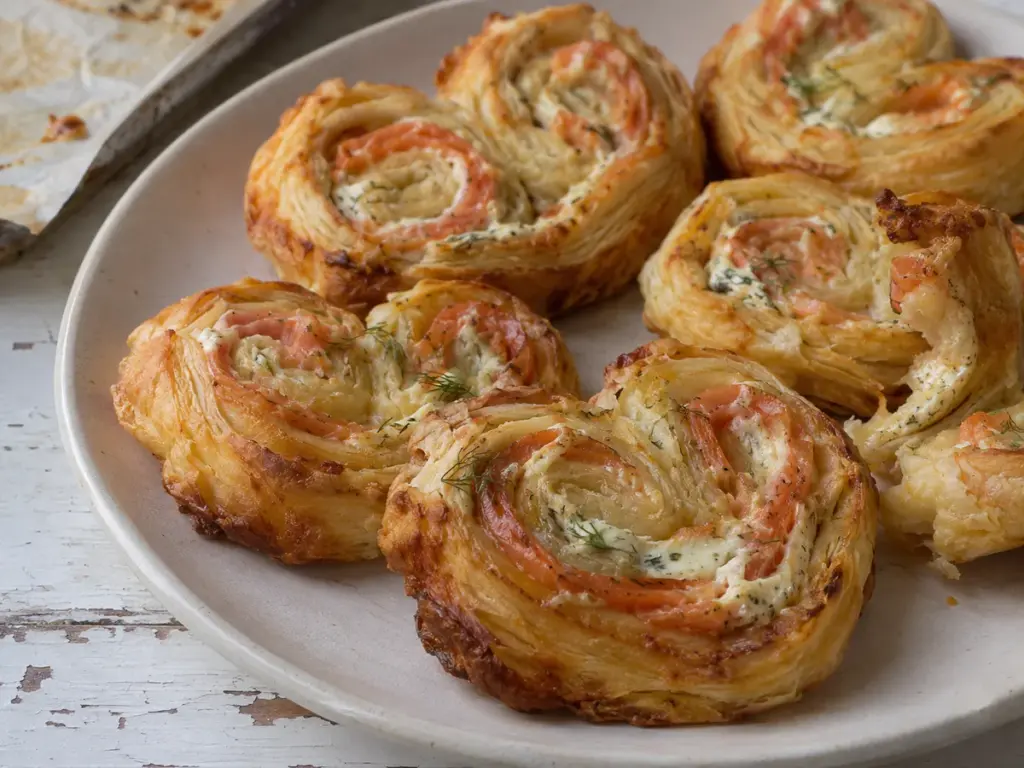
A palmier is pastry rolled in from both long sides until the two rolls meet, then folded and sliced, so each piece bakes into a double spiral with the filling in its folds. Smoked salmon is cured and ready to eat, so it only has to warm through, and laying it over the cream cheese keeps the pieces whole.
Ingredients (for about 16 palmiers, baked at 400°F for 15 to 18 minutes)
- 1 sheet puff pastry, thawed
- 4 ounces cream cheese, softened
- 2 tablespoons chopped fresh dill
- 1 tablespoon lemon juice
- ¼ teaspoon black pepper
- 4 ounces thinly sliced smoked salmon
- 1 egg beaten with 1 teaspoon water
Instructions
- Heat the oven. Preheat to 400°F and line a baking sheet with parchment.
- Fill. Beat the cream cheese, dill, lemon juice and pepper smooth. Roll the pastry to about 10 by 12 inches, spread the mixture over it and lay the salmon on top.
- Fold and chill. Roll both long sides toward the center until they meet, fold one half over the other along the seam between the rolls, wrap and chill for 20 minutes.
- Slice. Cut the log into about 16 pieces, ½ inch thick, lay them flat on the pan and brush with egg wash.
- Bake. Bake 15 to 18 minutes until puffed and golden, then let them cool slightly.
The 20-minute chill firms the folded log so the cream cheese stays inside as you slice. Lay the slices flat with the folds facing up and leave 1 inch between them, because palmiers spread as they puff.
Swaps
- Smoked trout or cooked shrimp can stand in for the salmon, and the shrimp should be patted dry.
- Chives or tarragon replace the dill: chives keep the same 2 tablespoons, while tarragon has an anise note, so start with 1 tablespoon and taste.
- For a dairy-free filling, beat a vegan cream cheese in the same 4 ounces with the dill, lemon juice and pepper.
4 Which Appetizers Are Folded Into Pockets and Twists?
Spinach and feta, mushroom and thyme, sausage and apple, and bacon and cheddar all fold a cooked or dry filling inside cut pastry, so the stove work comes first and you only have to cut, fill and seal the pastry. Press the edges with a fork, because an open seam leaks filling onto the pan.
5. Spinach and Feta Puff Pastry Bites
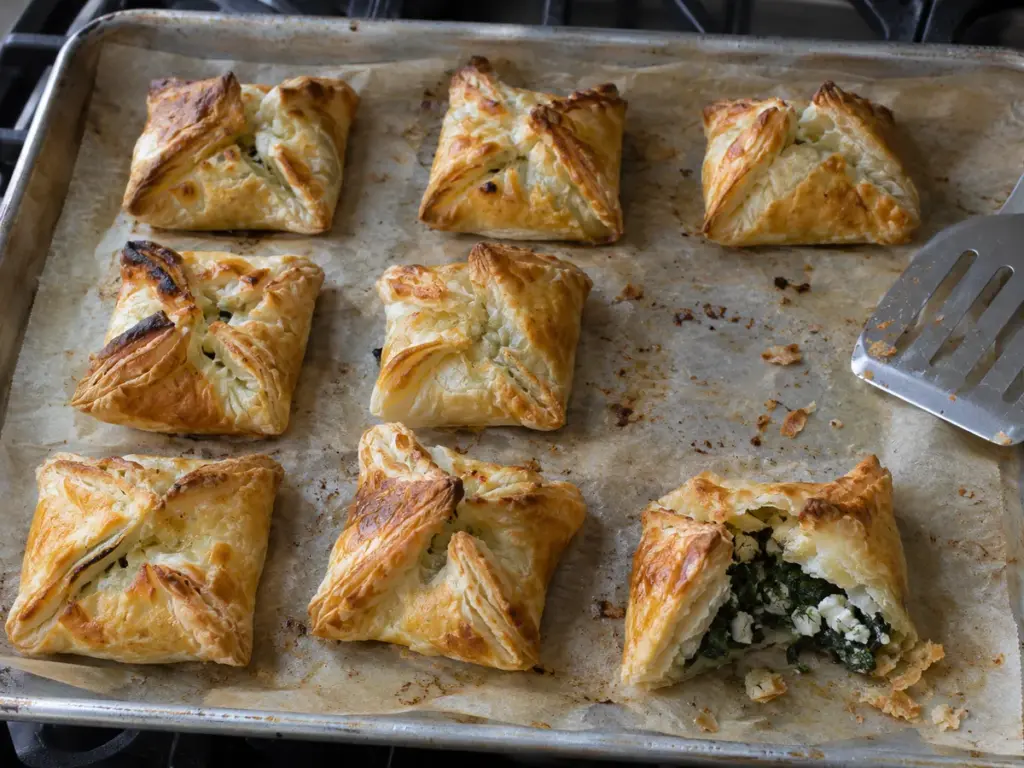
Fresh spinach is mostly water, and a cup of it cooks down to a few spoonfuls, so sauté it with the garlic until the pan is dry, about 3 to 4 minutes, and cool the mix before it touches the pastry. Dill and lemon zest give the filling the flavor of spanakopita in a bite that bakes in 15 to 18 minutes.
Ingredients (for 9 bites, baked at 400°F for 15 to 18 minutes)
- 1 sheet puff pastry, thawed
- 1 tablespoon olive oil
- 1 garlic clove, minced
- 1 cup fresh spinach, chopped and packed
- ½ cup crumbled feta
- 1 tablespoon chopped fresh dill
- 1 teaspoon lemon zest
- ¼ teaspoon black pepper
- 1 egg beaten with 1 teaspoon water
Instructions
- Heat the oven. Preheat to 400°F and line a baking sheet with parchment.
- Cook the spinach. Warm the oil over medium heat, cook the garlic for 30 seconds, add the spinach and cook 3 to 4 minutes until it wilts and the pan is dry. Stir in the feta, dill, lemon zest and pepper, then let the filling cool.
- Cut. Roll the pastry to about 9 by 9 inches and cut it into 9 squares.
- Fill and seal. Put 1 tablespoon of filling in the center of each square, fold the corners to the middle and press to seal.
- Bake. Brush with egg wash and bake 15 to 18 minutes until puffed and golden brown.
The bites are done when the corners have lifted and the seams look dry and golden.
Swaps
- Kale or Swiss chard can take the spinach's place when it is chopped fine and cooked until the pan is dry, which takes longer than spinach does.
- Goat cheese or ricotta make a milder, creamier filling than feta, stirred in once the greens are off the heat and the pan has cooled.
- Parsley or mint can replace the dill in the same 1 tablespoon, and the lemon zest keeps the filling bright either way.
6. Mushroom and Thyme Puff Pastry Pockets
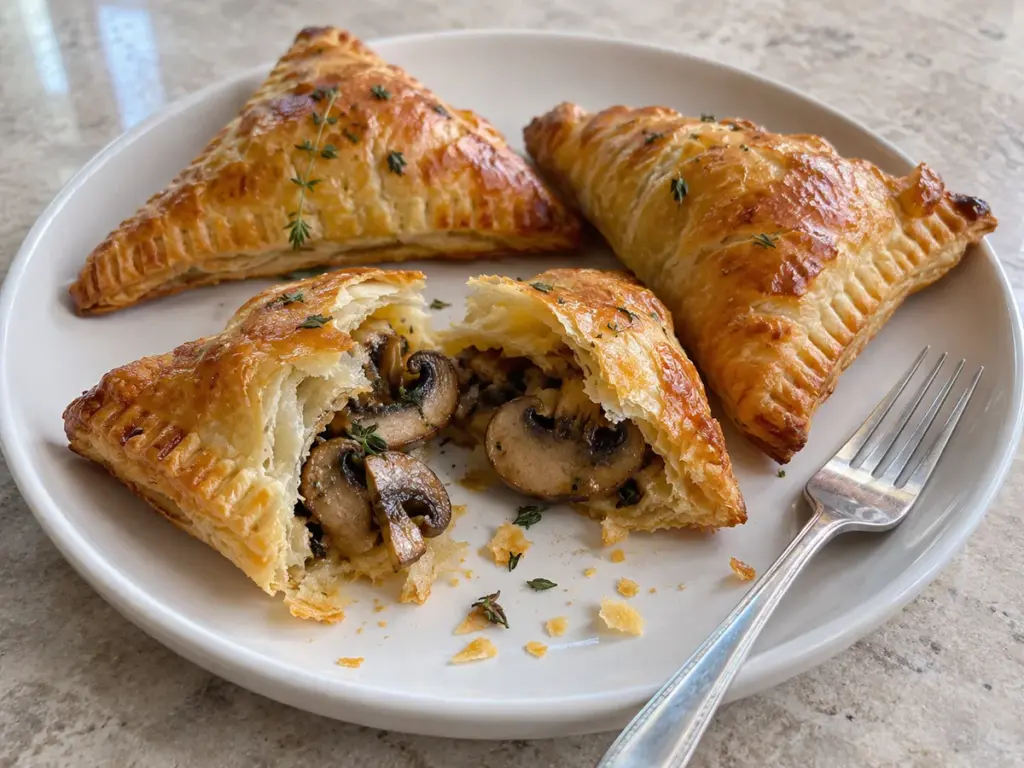
Mushrooms release a lot of liquid as they cook, so give them the full 7 minutes in the pan, until the liquid is gone and the slices start to brown, or the pockets turn soggy inside. Butter and olive oil together give the mushrooms flavor and browning, and garlic and thyme go in last so they only cook for a minute or two.
Ingredients (for 4 pockets, or 8 halves, baked at 400°F for 15 to 20 minutes)
- 1 sheet puff pastry, thawed
- 10 ounces button or cremini mushrooms, sliced
- 1 tablespoon olive oil
- 1 tablespoon unsalted butter
- 2 garlic cloves, minced
- 1 teaspoon fresh thyme leaves, chopped
- Salt and black pepper
- ¼ cup grated Parmesan (optional)
- 1 egg beaten with 1 teaspoon water
Instructions
- Heat the oven. Preheat to 400°F and line a baking sheet with parchment.
- Brown the mushrooms. Heat the oil and butter over medium heat and cook the mushrooms about 7 minutes, until their liquid evaporates and they brown.
- Season and cool. Stir in the garlic and thyme for 1 to 2 minutes, season, stir in the Parmesan if you use it and let the filling cool until barely warm.
- Fill. Roll the pastry, cut it into 4 squares, put a generous spoonful of filling on each, fold over into triangles and press the edges with a fork. Brush with egg wash.
- Bake. Bake 15 to 20 minutes until golden and puffed, cool a few minutes and halve.
Eat the pockets warm, because the mushroom filling slowly softens the pastry from inside as it cools.
Swaps
- Sage or rosemary can replace the thyme, but both taste stronger, so start with ½ teaspoon and taste.
- A spoonful of grated Gruyère or mozzarella, stirred in once the filling has cooled, adds a melty texture; about ¼ cup is a reasonable starting amount.
- Olive oil in place of the butter, with the optional Parmesan left out, makes the filling dairy-free, but puff pastry itself is often made with butter, so read the box.
7. Sausage and Apple Puff Pastry Bites
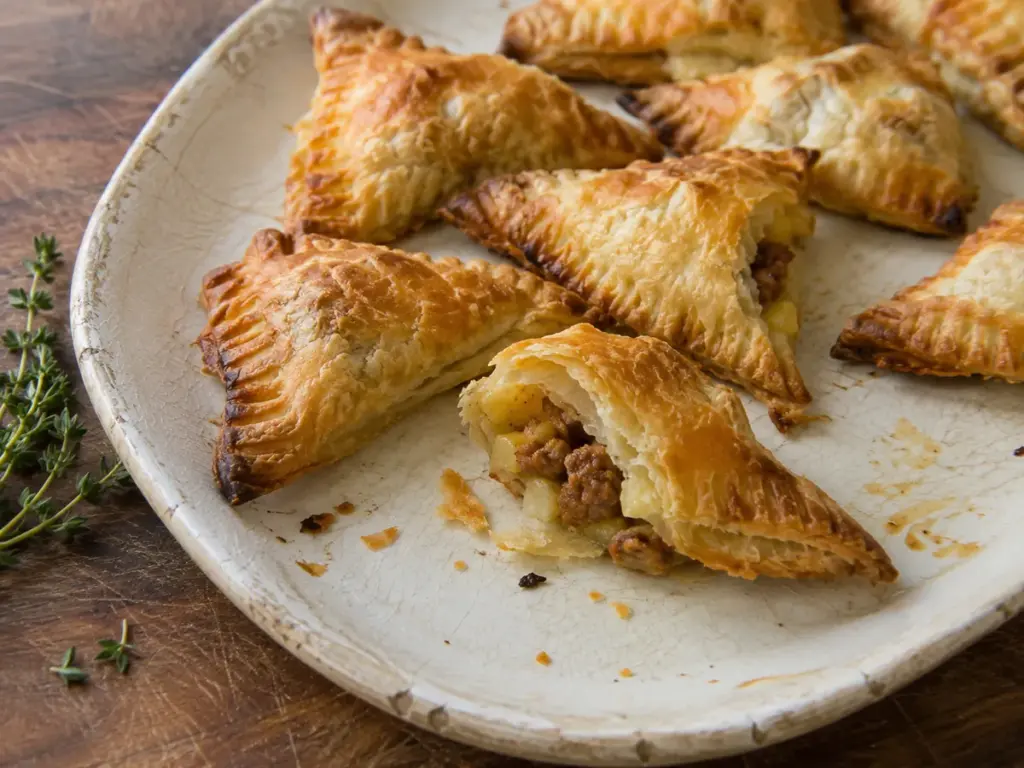
Apple's tartness cuts the fat in pork sausage, and a firm apple such as Granny Smith or Honeycrisp keeps its shape during its 2 minutes in the pan. The sausage cooks first until it is browned and no longer pink, which means 160°F inside, the USDA minimum for ground pork.
Ingredients (for 12 bites, baked at 400°F for 15 to 20 minutes)
- 1 sheet puff pastry, thawed
- 8 ounces bulk pork sausage
- 1 small onion, finely chopped
- 1 tablespoon olive oil
- 1 medium firm apple, diced
- 1 teaspoon fresh thyme, chopped (or ½ teaspoon dried)
- Salt and black pepper
- 1 egg beaten with 1 teaspoon water
Instructions
- Heat the oven. Preheat to 400°F and line a baking sheet with parchment.
- Cook the filling. Soften the onion in the oil for 3 minutes, add the sausage and break it up until it is browned and cooked through, then stir in the apple and thyme for 2 more minutes. Season and let it cool.
- Cut. Roll the pastry to about 9 by 12 inches, cut 12 squares and spoon a small amount of filling in the center of each.
- Fold. Fold each square into a triangle, press the edges to seal and brush with egg wash.
- Bake. Bake 15 to 20 minutes until golden, with the filling at 165°F, and serve warm.
Cool the filling before it goes on the pastry, since warm sausage melts the butter in the layers.
Dice the apple about ¼ inch so no piece pushes through the pastry.
Swaps
- Turkey or chicken sausage can replace the pork; cook it to 165°F in the pan, the poultry minimum, and the filling still reads 165°F after baking.
- Fuji or Gala apples give a sweeter bite than Granny Smith, diced the same ¼ inch.
- Shredded sharp cheddar or Gruyère makes a richer bite: stir in about ¼ cup (a starting amount) after the filling has cooled, so it does not melt the butter in the pastry layers.
8. Bacon and Cheddar Puff Pastry Twists
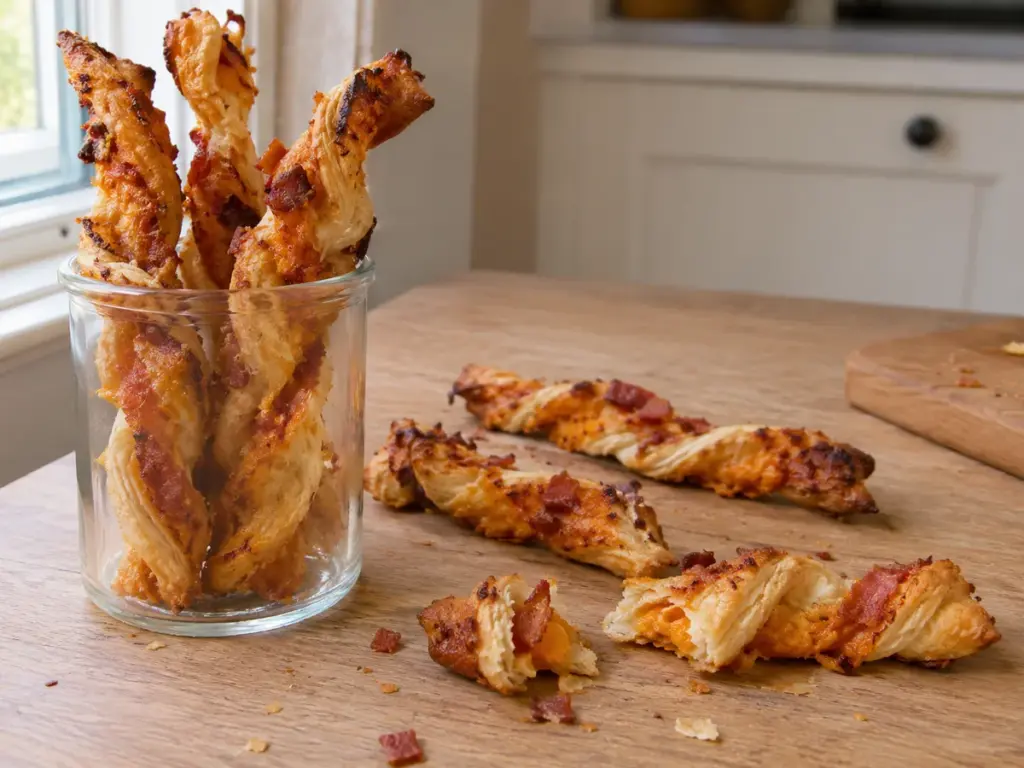
Fold the pastry over a layer of bacon and cheddar, cut strips and twist them, and the filling stays inside the spiral where the cheese melts into the layers instead of onto the pan. Dijon mustard brushed on first adds sharpness against the smoke and fat of the bacon, and cheddar grated from a block melts smoothly.
Ingredients (for about 10 twists, baked at 400°F for 15 to 18 minutes)
- 1 sheet puff pastry, thawed
- 6 slices bacon, cooked crisp and crumbled
- 1 cup shredded sharp cheddar
- 1 tablespoon Dijon mustard
- 1 egg beaten with 1 teaspoon water
Instructions
- Heat the oven. Preheat to 400°F and line a baking sheet with parchment.
- Season the pastry. Roll the pastry into a 10-inch square and brush it with the Dijon.
- Fold. Scatter the bacon and cheddar over one half, fold the other half over it and press down with a rolling pin.
- Cut and twist. Cut strips about 1 inch wide (about 10), twist each a few times and set them apart on the pan. Brush with egg wash.
- Bake. Bake 15 to 18 minutes until golden and puffed, then cool slightly.
Pat the cooked bacon dry on paper towels, because grease seeps into the pastry, and press the folded sheet once with a rolling pin so the layers stay together as you twist. Leave 1 inch between the twists on the pan, since they swell as they bake. Without the bacon, the same cut-and-twist method works with only Parmesan scattered on the pastry, as in these Parmesan puff pastry twists.
Swaps
- Gruyère or mozzarella can replace the cheddar, with Gruyère melting nutty and a little milder and mozzarella stretching more.
- Vegetarian version: use mushrooms cooked dry or smoked tempeh in place of the bacon, and a pinch of smoked paprika mixed into the cheese brings back the smoke.
5 Which Appetizers Do You Top After Baking?
Goat cheese and roasted pepper, caprese, and chicken and mushroom start as bare baked pastry, and the topping goes on afterward, because tomato, fresh mozzarella and a creamy filling would soften the pastry in the oven. That order keeps the pastry crisp at the table, and you can bake the bases before the guests arrive.
9. Goat Cheese and Roasted Red Pepper Tartines
If you prick the pastry all over with a fork, steam escapes and the square bakes flat and crisp, which makes a base for the cheese and is a trick Pepperidge Farm lists for thin, crisp pastry.
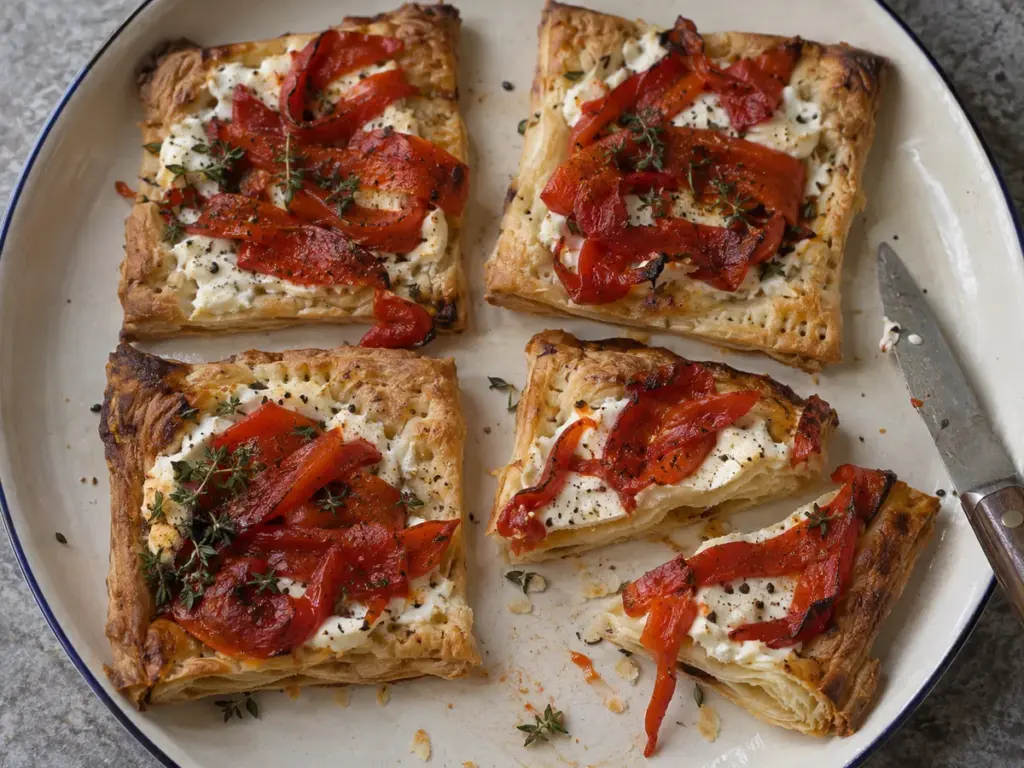
A brush of olive oil adds color, and you should let the squares cool for a few minutes before topping them so the cheese does not melt into the pastry.
Jarred peppers come packed in liquid, so drain them and pat them dry, or the juice seeps into the goat cheese and the base.
Ingredients (for 4 tartines, or 8 halves, with the bases baked at 400°F for about 12 minutes)
- 1 sheet puff pastry, thawed
- 1 tablespoon olive oil
- 4 ounces goat cheese, softened
- 1 cup roasted red peppers, drained, patted dry and cut into strips
- 1 teaspoon fresh thyme leaves (optional)
- Salt and black pepper
Instructions
- Heat the oven. Preheat to 400°F and line a baking sheet with parchment.
- Cut and prick. Roll the pastry lightly, cut it into 4 squares, set them on the pan, brush with olive oil and prick all over with a fork.
- Bake the bases. Bake about 12 minutes until golden and crisp, then let them cool slightly.
- Top. Spread the goat cheese on each square, add the pepper strips, season with salt and pepper and scatter the thyme over.
- Serve. Serve warm or at room temperature, cut in half for 8 appetizer-sized pieces.
Swaps
- Jarred fire-roasted peppers or fresh grilled peppers give the topping a smokier note, and the jarred ones still get drained and patted dry.
- A few torn basil leaves in place of the thyme change the herb note.
10. Caprese Puff Pastry Bites
Bake the squares empty and build each bite at the last minute, because a tomato slice sitting on pastry for more than a few minutes soaks through it. Pat the tomato and mozzarella slices with paper towels first, and drizzle the balsamic glaze just before the tray goes out so it stays glossy.
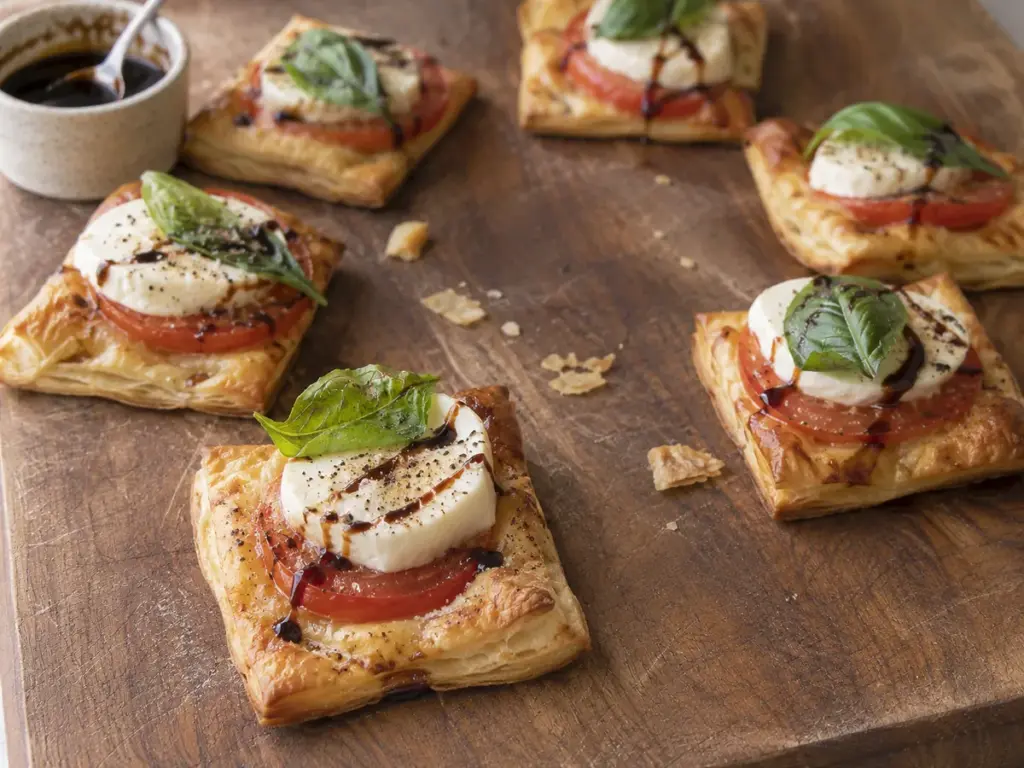
Ingredients (for 12 bites, with the squares baked at 400°F for 10 to 12 minutes)
- 1 sheet puff pastry, thawed
- 1 egg beaten with 1 teaspoon water
- 2 medium ripe tomatoes, thinly sliced
- 8 ounces fresh mozzarella, sliced into rounds
- ¼ cup fresh basil leaves
- 2 tablespoons balsamic glaze, store-bought or homemade
- Salt and black pepper
Instructions
- Heat the oven. Preheat to 400°F and line a baking sheet with parchment or a silicone mat.
- Cut and prick. Roll the pastry, cut 12 squares, set them on the pan, brush with egg wash and prick each with a fork.
- Bake. Bake on the middle rack 10 to 12 minutes until golden and puffed, then cool slightly.
- Build. Layer a tomato slice, a mozzarella slice and a few basil leaves on each square and season lightly.
- Glaze. Drizzle with balsamic glaze right before serving.
Swaps
- Cherry or grape tomatoes, cut into thin rounds, fit a bite-sized square and get patted dry like the larger slices.
- Burrata, torn on last, makes the bite creamier and wetter, and vegan mozzarella gives a dairy-free version added cold the same way, since nothing here melts in the oven.
- Fresh parsley can replace the basil leaves, though basil gives the classic caprese flavor.
11. Mini Chicken and Mushroom Vol-au-Vents
Vol-au-vent is French for a hollow pastry case, and a scored round makes one: cut a shallow circle inside the edge, bake, and press the puffed center down to make room for the filling. Brush the egg wash on the flat top only, because egg that runs down the scored edge glues the layers shut.
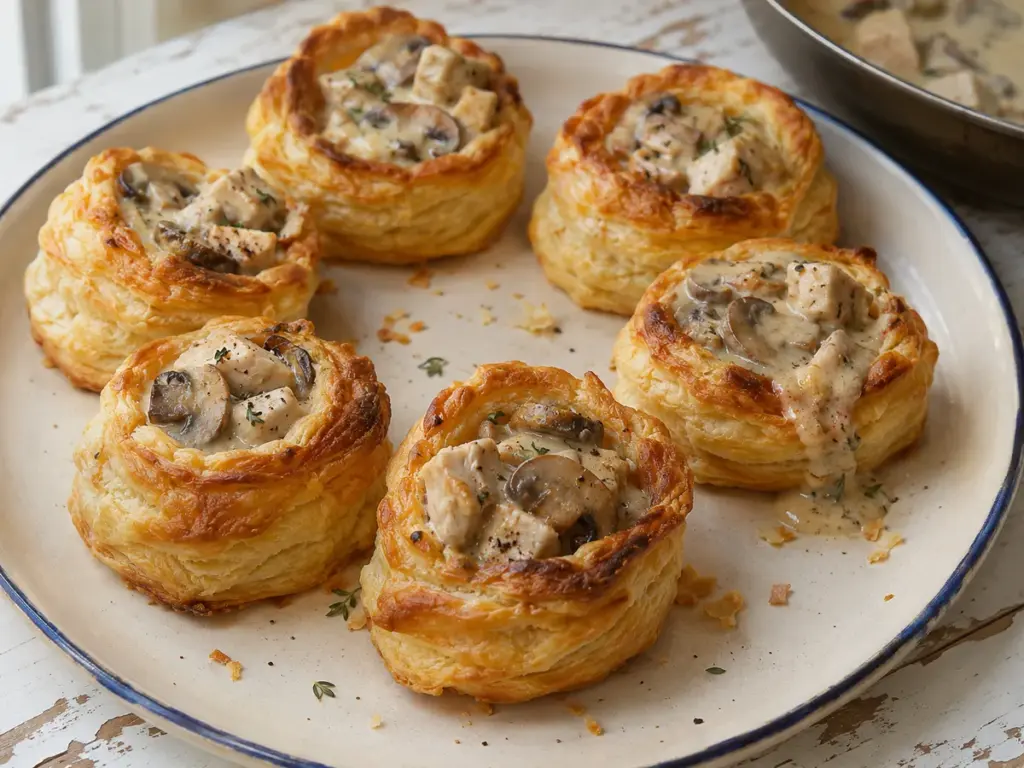
Ingredients (for 12 cases, baked at 400°F for 12 to 15 minutes)
- 1 sheet puff pastry, thawed
- 1 egg beaten with 1 teaspoon water
- 1 tablespoon olive oil
- ½ medium onion, finely chopped
- 1 garlic clove, minced
- 5 ounces button or cremini mushrooms, sliced
- 1 tablespoon all-purpose flour
- ¼ cup chicken broth
- ½ cup heavy cream
- 6 ounces cooked chicken breast, diced
- 1 teaspoon fresh thyme leaves, chopped
- Salt and black pepper
Instructions
- Cut and score. Preheat to 400°F and line a pan with parchment. Cut 12 rounds about 2 inches wide, score a circle ½ inch inside each edge without cutting through, and brush only the tops with egg wash.
- Bake the cases. Bake 12 to 15 minutes until puffed and golden, press each center down gently and set the cases aside.
- Cook the vegetables. Cook the onion and garlic in the oil for 3 minutes, add the mushrooms and cook 5 minutes until they release their liquid and brown.
- Make the sauce. Stir in the flour for 1 minute, then add the broth and cream gradually and stir until the sauce thickens slightly.
- Fill. Add the chicken and thyme, season and simmer until the filling reads 165°F, then spoon it into the cases and serve right away.
Swaps
- Cooked turkey or shredded rotisserie chicken replaces the chicken breast, diced small, and the filling still has to read 165°F before it goes into the cases.
- Cremini or shiitake can stand in for the same 5 ounces of mushrooms, sliced and cooked until their liquid is gone.
- Coconut cream or an unsweetened plant-based cream turns the sauce dairy-free, with a faint coconut taste in the first case.
- Parsley can replace the thyme in the same 1 teaspoon.
6 Which Appetizers Bake With the Filling on Top?
Caramelized onion and Gruyère, asparagus and Parmesan, eggplant Parmesan, and apple, brie and honey bake with the cheese and filling already sitting on the pastry (the onion cups bake empty for 8 minutes first), so the cheese melts into the pastry as it bakes. A wet filling steams the underside, which is why you cook the onions, asparagus and eggplant first and slice the apple thin.
12. Caramelized Onion and Gruyère Tartlets
Onions turn soft, golden and jammy only after most of their water has cooked off, which takes 30 to 40 minutes over medium-low heat, and high heat scorches the edges before the centers soften. Gruyère is nutty and melts smoothly over them, so a small sprinkle is enough.
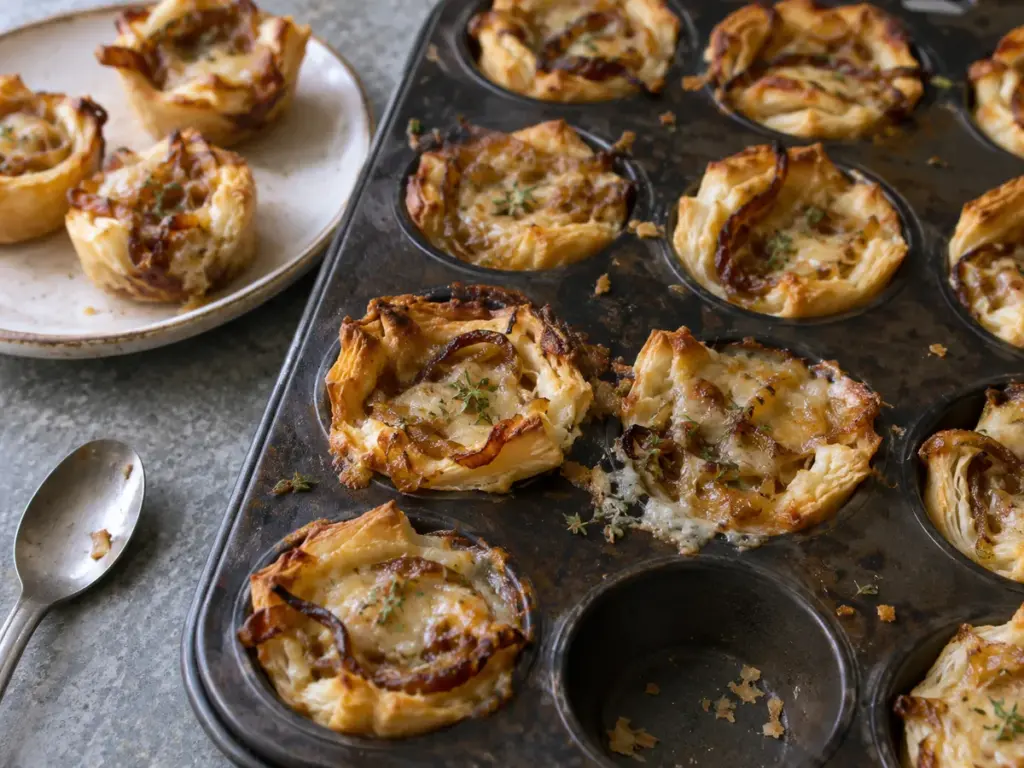
Ingredients (for 12 tartlets, baked at 400°F for 8 minutes, then 6 to 8 minutes)
- 1 sheet puff pastry, thawed
- 2 large yellow onions, thinly sliced
- 1 tablespoon unsalted butter
- 1 tablespoon olive oil
- ½ teaspoon sugar
- Salt and black pepper
- ½ cup finely grated Gruyère
- Fresh thyme leaves for garnish (optional)
Instructions
- Caramelize the onions. Heat the butter and oil in a large skillet over medium-low heat, add the onions, sugar and a pinch of salt and cook, stirring now and then, 30 to 40 minutes until soft and golden. Season and cool.
- Shape the cups. Preheat to 400°F. Cut 12 rounds with a 2 ½-inch cutter, press them into 12 cups of a mini muffin pan and prick the bottoms.
- Bake empty. Bake the cups 8 minutes until set, pressing the puffed centers down with a spoon.
- Fill. Divide the onions among the cups and top with the Gruyère.
- Finish. Bake 6 to 8 minutes more until the cheese melts, cool a few minutes and garnish with thyme.
Puff pastry pressed into a mini muffin pan makes the cups, and baking them empty for 8 minutes sets the base before the onions weigh it down. Stir every few minutes and add a splash of water if the onions stick before they color.
Swaps
- Baked mini tartlet shells replace the pressed pastry cups, so you can skip the empty bake, fill the shells and warm them at 375°F for 12 to 15 minutes until the cheese melts; a box of 24 shells takes about 4 onions and 1 cup of Gruyère.
- Gluten-free mini tart shells fit the same way as other store-bought shells and need no empty bake.
- Swiss or fontina melts milder than Gruyère but stays creamy.
- Vidalia onions or shallots caramelize into a sweet filling too, so judge them by color rather than by the 30 to 40 minute clock.
- Another tablespoon of olive oil can take the butter's place, which leaves the onions dairy-free, though the Gruyère still is not.
13. Asparagus and Parmesan Tartlets
Blanch the asparagus for 1 to 2 minutes in boiling water, then move it to ice water, so the spears are tender-crisp and green before they meet the oven.
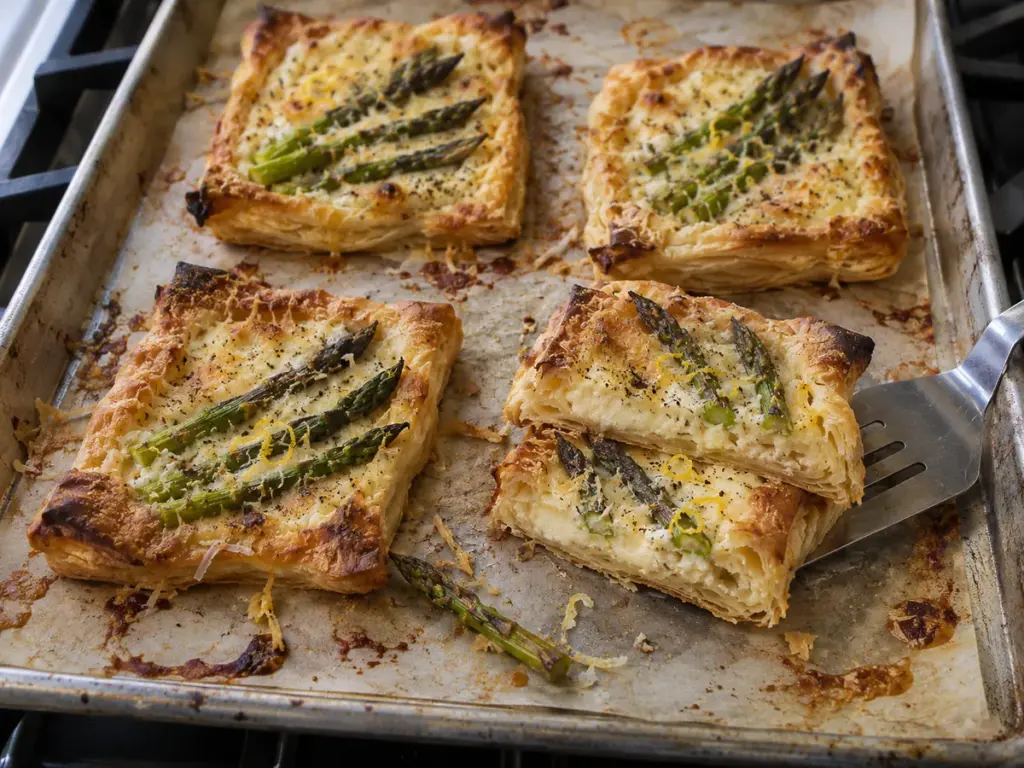
Ingredients (for 4 tartlets, or 8 halves, baked at 400°F for 15 to 18 minutes)
- 1 sheet puff pastry, thawed and cut into 4 squares
- ½ pound asparagus, trimmed
- ½ cup grated Parmesan
- ¼ cup heavy cream
- 1 teaspoon lemon zest
- 1 large egg, beaten
- Salt and black pepper
Instructions
- Blanch. Boil the asparagus 1 to 2 minutes, move it to ice water, drain and pat dry.
- Score. Preheat to 400°F. Set the squares on a parchment-lined pan and score a ½-inch border on each without cutting through.
- Fill. Stir the Parmesan, cream, lemon zest, half the egg and a pinch of salt and pepper until smooth, spread it inside the borders and press the asparagus on top.
- Bake. Brush the borders with the remaining egg and bake 15 to 18 minutes until golden and the filling is set.
- Finish. Cool slightly and add a little extra lemon zest or Parmesan if you like.
The scored border rises into a rim that holds the cream and Parmesan mix. Because the filling contains egg, bake until it is set in the center, since USDA lists 160°F for egg dishes.
Swaps
- Pecorino Romano in place of the Parmesan is sharper and saltier, so taste the filling before adding the pinch of salt.
- Green beans blanch and dry like the asparagus, and thin zucchini slices are patted dry because they release water.
14. Eggplant Parmesan Puff Pastry Squares
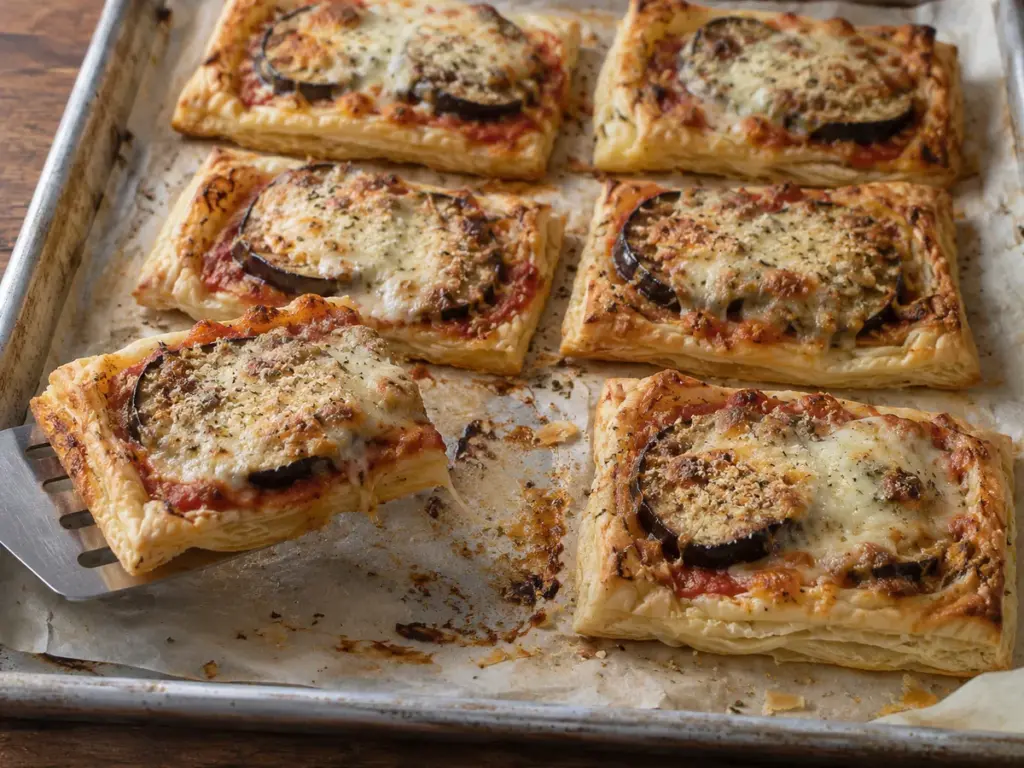
This is eggplant Parmesan without the frying or the layering, but the eggplant has to be roasted first, because raw slices hold enough water to steam the pastry from the inside. Roasted at 400°F for 15 to 20 minutes they turn soft and lightly browned, and a thick tomato sauce, about 1 tablespoon per square, adds flavor without adding more water.
Ingredients (for 6 squares, baked at 400°F for 15 to 18 minutes)
- 1 large eggplant, sliced into ¼-inch rounds
- 1 tablespoon olive oil
- 1 teaspoon dried Italian herbs
- Salt and black pepper
- 1 sheet puff pastry, thawed
- 6 tablespoons thick tomato sauce, such as store-bought or homemade marinara
- 1 ½ cups shredded mozzarella
- ¼ cup grated Parmesan
- 1 egg beaten with 1 teaspoon water
Instructions
- Roast the eggplant. Preheat to 400°F. Toss the slices with the oil, herbs, salt and pepper and roast on a sheet pan 15 to 20 minutes until soft and lightly browned.
- Cut. Roll the pastry to about 10 by 12 inches, cut 6 rectangles and set them on a parchment-lined pan.
- Layer. Spread about 1 tablespoon of sauce on each, then add the eggplant, mozzarella and Parmesan.
- Make the rim. Fold the edges up slightly to form a shallow well and brush the exposed pastry with egg wash.
- Bake. Bake 15 to 18 minutes until the pastry is golden and the cheese bubbles, then cool a few minutes.
The rim is about ½ inch high and holds the cheese, and the egg wash goes only on that exposed rim.
Swaps
- Zucchini rounds or portobello slices can replace the eggplant, and both need to roast first because they also release water.
- Crumbled feta mixed in with the mozzarella gives a sharper, saltier bite.
- A vegan mozzarella, with the Parmesan left out, makes the squares dairy-free.
15. Apple, Brie and Honey Puff Pastry Bites
Thin apple slices, cut thin enough to bend slightly because thick ones stay firm in 12 to 15 minutes, sit under the brie so the fruit softens in the steam while the cheese melts over it. The corners stay loosely folded and unsealed so steam can leave, and the honey goes on after baking so it stays glossy instead of scorching on the 400°F pan.
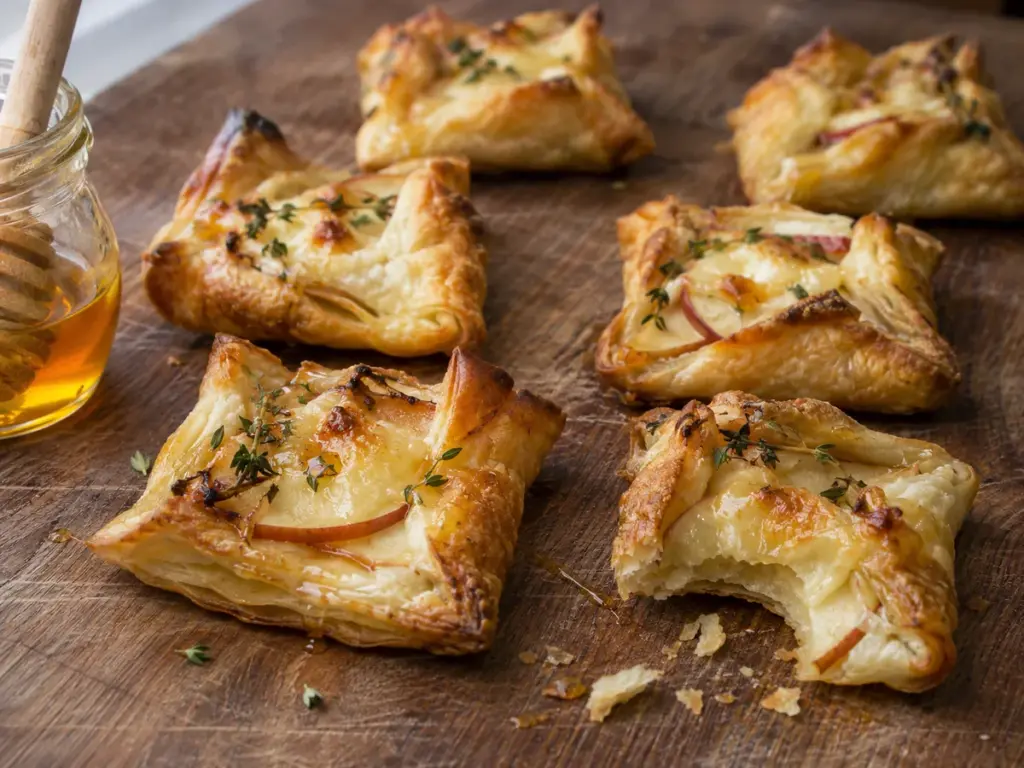
Slice the apple just before you assemble the bites, since cut apple browns, and bake them right after. A whole wheel of brie wrapped in pastry with honey and walnuts is the centerpiece version of this pairing, and the bites make the same flavors easy to pass around.
Ingredients (for 12 bites, baked at 400°F for 12 to 15 minutes)
- 1 sheet puff pastry, thawed
- 1 medium firm apple (Granny Smith or Honeycrisp), cored and very thinly sliced
- 4 ounces brie, cut into 12 small pieces
- 2 tablespoons honey
- 1 egg beaten with 1 teaspoon water
- Fresh thyme leaves (optional)
Instructions
- Heat the oven. Preheat to 400°F and line a baking sheet with parchment.
- Cut. Roll the pastry to about 9 by 12 inches and cut 12 squares.
- Fill. Put one apple slice and one piece of brie in the center of each square and fold the corners loosely toward the middle without sealing.
- Wash. Brush the pastry edges with egg wash, keeping it off the cheese, and set the squares on the pan.
- Bake and finish. Bake 12 to 15 minutes until golden and the brie is melting, then drizzle with honey, add the thyme and serve warm.
Swaps
- A firm pear can replace the apple, sliced just as thin and just before assembling, since cut pear browns too.
- Agave nectar replaces the honey for a honey-free bite and is drizzled after baking like the honey.
7 How Do You Build Your Own Puff Pastry Appetizer?
Any filling that is cooked dry, cooled and spread thin can borrow one of the shapes in these recipes, using the cut and fill amounts the 15 recipes already give.
| Shape | Cut and fill |
|---|---|
| Pinwheel or palmier | 10 by 12 inch sheet, thin layer, ½-inch border, rolled and chilled |
| Folded bite or pocket | 4 to 12 squares, about 1 tablespoon per 3-inch square, edges pressed |
| Twist | 10-inch square folded over the filling, 1-inch strips twisted |
| Baked base | 4 to 12 squares, pricked, topped after baking |
| Tartlet cup | 12 rounds pressed into a mini muffin pan, baked empty first |
| Scored case | 12 rounds, circle scored ½ inch inside the edge |
The fillings above share a pattern: a rich base such as brie, goat cheese or cream cheese, a sharp or sweet partner such as raspberries, fig jam or lemon, and a herb or zest to finish. Brie with raspberries and lemon zest, or cream cheese with smoked salmon and dill, follow it exactly.
If your filling releases liquid, as mushrooms and eggplant do, cook it dry in a pan or oven first, and pat wet toppings dry before they go on.
8 Which Puff Pastry Appetizers Work for Vegetarian or Egg-Free Guests?
These ten recipes contain no meat or fish, so one tray of them covers vegetarian guests:
- Brie and raspberry rolls
- Pesto and sun-dried tomato pinwheels
- Spinach and feta bites
- Mushroom and thyme pockets
- Goat cheese and roasted red pepper tartines
- Caprese bites
- Caramelized onion and Gruyère tartlets
- Asparagus and Parmesan tartlets
- Eggplant Parmesan squares
- Apple, brie and honey bites
Traditional Parmesan and Gruyère use animal rennet, so strict vegetarians should check the cheese label.
Only the pesto pinwheels, goat cheese tartines and onion tartlets use no egg as written: the first two are brushed with olive oil and the tartlets get no wash.
Olive oil can replace the egg wash on the brie rolls, spinach bites, mushroom pockets, caprese bites, eggplant squares and apple bites; the asparagus tartlets keep egg in the filling. Check the pastry box label too, because this covers only what the recipes add.
9 Which Puff Pastry Appetizers Work for Gluten-Free or Dairy-Free Guests?
A gluten-free puff pastry sheet covers the pastry in 14 of the 15 recipes. These sheets handle differently from wheat pastry, so follow the box for thawing and bake time before you cut and fill it.
The chicken and mushroom vol-au-vents are the exception, because their sauce is thickened with 1 tablespoon of all-purpose flour, so a gluten-free sheet alone does not make them gluten-free.
For dairy-free guests, read the pastry label first, since some puff pastry is made with butter and some with vegetable oil. The sausage and apple bites (item 7) contain no dairy as written, and these recipes have a dairy-free swap in their Swaps lists:
- Smoked salmon palmiers (item 4)
- Mushroom and thyme pockets (item 6)
- Caprese bites (item 10)
- Chicken and mushroom vol-au-vents (item 11)
- Eggplant Parmesan squares (item 14)
The caramelized onion tartlets (item 12) can take a dairy-free butter, but the Gruyère stays, so they are not dairy-free.
10 How Do You Serve, Store and Reheat Puff Pastry Appetizers?
Serve these warm from the oven or at room temperature, and take a tray off the table after 2 hours, the limit USDA sets for perishable food left at room temperature. If your party runs long, bake a second tray when the first is gone instead of leaving one out.
Pepperidge Farm says finished puff pastry is best eaten within a few hours of baking.
- Rolled logs (pinwheels, rolls, palmiers): wrap and refrigerate, then slice and bake once the oven is hot. Pepperidge Farm says to keep filled, unbaked pastry covered in plastic wrap in the fridge until you bake it, and sliced brie rolls wait that way on the pan.
- Mushroom filling and caramelized onions: both keep a day in the fridge, and the pastry is filled at baking time.
- Chicken filling for the vol-au-vents: refrigerate it within 2 hours, keep it a day and reheat it to 165°F before it goes into the cases.
- Baked cases: unfilled vol-au-vent cases keep up to 2 days in an airtight container and crisp in a 400°F oven in about 5 minutes.
- Build at the last minute: caprese bites, the cream mixture on the asparagus tartlets, the sauce on the eggplant squares and the apple slices go on right before baking or serving. The asparagus can be blanched and dried ahead.
- You can set the baked prosciutto pinwheels on a charcuterie board at room temperature, and the same 2-hour limit applies to them there.
- Unthawed sheets stay in the freezer in their original package for up to 6 months, and a thawed sheet is never refrozen.
- Baked pinwheels and palmiers that went cold refresh on a baking sheet in a 350°F oven for 5 to 8 minutes, longer if the centers are not yet at 165°F.
Warning
Refrigerate leftovers within 2 hours and eat them within 3 to 4 days, then reheat them on a baking sheet in a 350°F oven until a thermometer in the center reads 165°F.
USDA FSIS gives 3 to 4 days for leftovers in the refrigerator and 165°F as the reheating temperature. The oven does a better job than a microwave here, because dry heat crisps the pastry again while the filling warms through.
Every recipe here wants the oven at 400°F, so a menu made only of these queues up behind one oven, and two or three cold starters such as caprese skewers beside the hot tray take the pressure off it.
Frequently Asked Questions
Butter that melted before the oven could turn it to steam is the usual cause, and it happens when the sheet sat out past 40 minutes, the shaped pieces were not chilled, or the oven was not preheated for 15 to 20 minutes at 400°F. Egg wash that ran down the sides also glues the layers shut.
Pepperidge Farm says not to. A sheet that has reached room temperature goes back in the fridge to firm up instead, and it should be baked rather than frozen again.
One sheet makes from 4 to 20 pieces, depending on the recipe. If you double a recipe, use a second sheet, because stretching one sheet thins the layers and the pieces bake flat.
Some brands sell gluten-free sheets, and they handle differently, so follow the box for thawing and bake time. For dairy-free appetizers, read the label, since some puff pastry is made with butter and some with vegetable oil, and choose fillings without cheese or cream.
A thick layer of filling squeezes out of the ends as the roll bakes, and a log that was rolled loosely or skipped its 15-minute chill springs open as the layers rise. Roll tightly from a long side with the seam on the bottom, chill the log until firm and slice it with a sawing motion.
Water in the filling steams the underside of the pastry before the layers set. Cook mushrooms, spinach and eggplant until their liquid is gone, cool the filling, pat tomatoes, mozzarella and jarred peppers dry, and add wet toppings after baking.
Sources
- Pepperidge Farm puff pastry tips and techniques: thawing, egg wash, pricking, storing
- King Arthur Baking: why butter temperature matters in pastry
- USDA FSIS: safe minimum internal temperature chart
- USDA FSIS: leftovers and food safety

Andrew Gray is a seasoned food writer and blogger with a wealth of experience in the restaurant and catering industries. With a passion for all things delicious, Andrew has honed his culinary expertise through his work as a personal chef and caterer.
His love for food led him to venture into food writing, where he has contributed to various online publications, sharing his knowledge and insights on the culinary world. As the proud owner of CooksCrafter.com, Andrew covers a wide range of topics, including recipes, restaurant reviews, product recommendations, and culinary tips.
Through his website, he aims to inspire and educate fellow food enthusiasts, offering a comprehensive resource for all things food-related.